Introduction
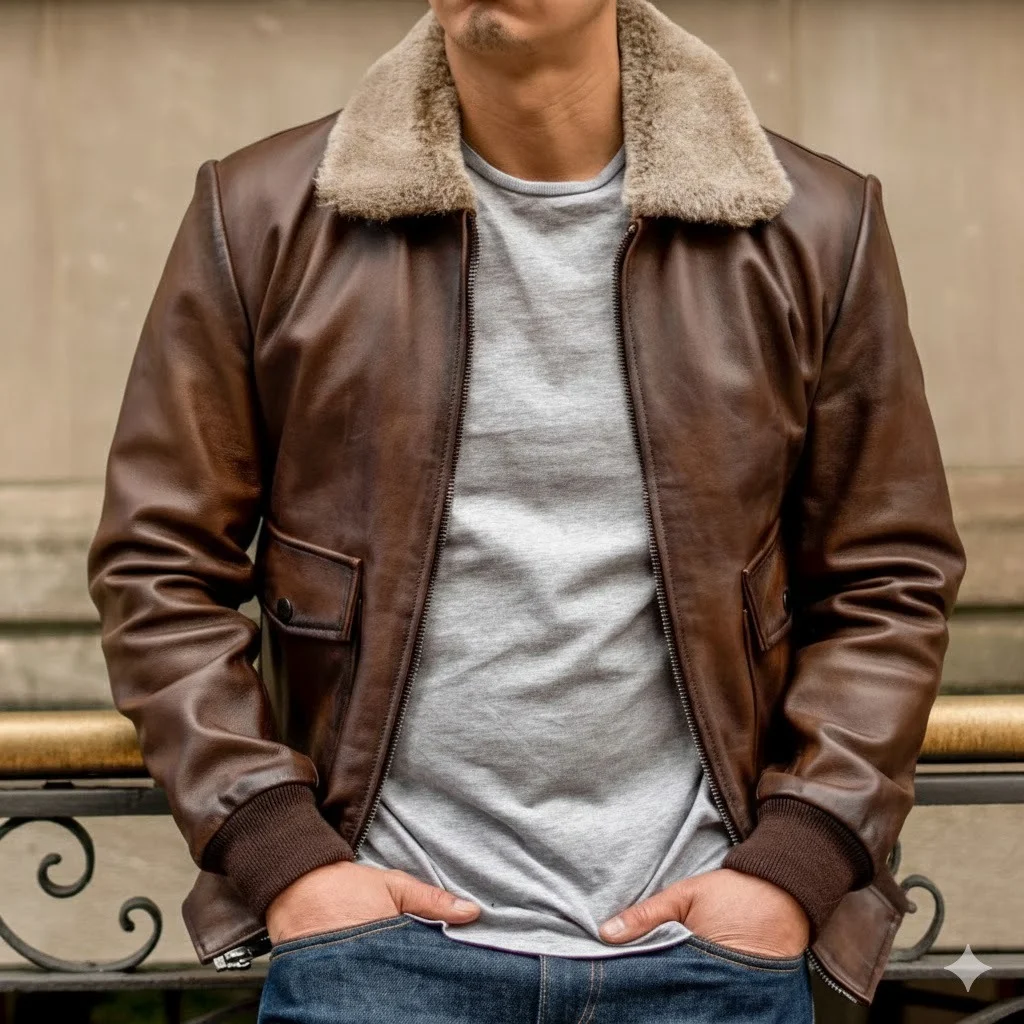
An Aviator Jacket Brown Leather is an archetypal outerwear entity: it carries a clear set of attributes and behaviors (ages into patina, insulates, layers well). In natural language processing terms we can think of the jacket as an object in an ontology with labeled features that help consumers classify, compare, and rank options. This guide rewrites the classic buyer’s manual into an NLP-friendly document: structured, attribute-focused, and optimized for extracting facts (useful for product pages, editors, or shopkeepers). You’ll get a practical taxonomy, quality signals (features → confidence), decision rules for fit and purchase, styling “intent” templates, and long-term care policies (procedures). By the end you’ll be able to treat any brown aviator jacket as a structured record easy to compare, describe, or sell.
What is a Brown Leather Aviator Jacket?
In schema terms, an Aviator Jacket is a Product entity with these primary attributes:
- Material: Leather (brown shades like tan, cognac, chestnut)
- Collar: Shearling or stand collar (attribute: closable)
- Lining: Shearling/fleece/quilt (attribute: thermal)
- Hardware: Heavy-duty zipper, sometimes toggles or buckles
- Pockets: Functional (hand / inside / coin)
- Length: Hip-length vintage or cropped contemporary
- Heritage: Flight / military origin (A-2 lineage, etc.)
Short history of the aviator jacket
Treat this as a temporal sequence of events (time-stamped tokens):
- Early 1900s: Flight conditions are cold; leather used for windproof protection (open cockpits).
- 1920s–1930s: Standardized military patterns emerge; A-1 and later A-2 style jackets formalized.
- WWII (1939–1945): A-2 becomes an iconic flight jacket; pilots personalize jackets with squadron patches (entity-level metadata).
- Post-war: Aviation wear migrates into civilian fashion — data shows adoption in subcultures and mainstream fashion.
- Today: Designers fuse heritage details with modern cuts; the jacket persists as a style token and functional garment.
Why brown leather is a wardrobe staple
Brown leather carries positive semantic associations that make it a stable token in style vocabularies:
- Warmth brown reads as softer and more approachable than black.
- Versatility pairs well with navy, olive, denim, cream.
- Aging patina forms, which increases perceived authenticity.
- Seasonal span lighter browns for transitional seasons; shearling-lined browns for winter.
Types and variations of aviator jackets
We can think of variations as sub-classes with attribute differences:
- Classic Shearling Aviator
- Attributes: Thick leather, full shearling lining.
- Use-case: Cold climates, functional warmth, heritage styling.
- A-2 Style Leather
- Attributes: Military silhouette, mid-weight leather, metal zippers.
- Use-case: Heritage reissues, collectible market.
- Sheepskin-lined Aviator
- Attributes: Softer shell, strategic shearling panels.
- Use-case: Comfort + warmth with a slightly lighter profile.
- Distressed / Vintage Finish
- Attributes: Pre-worn surface, lower sheen.
- Use-case: Rugged looks, immediate “lived-in” aesthetic.
- Slim / Contemporary Cut
- Attributes: Tailored silhouette, cleaner lines.
- Use-case: Smart-casual wardrobes, urban styling.
- Hybrid / Lightweight Aviator
- Attributes: Thinner hides or top-grain finishes, minimal lining.
- Use-case: Transitional seasons, warmer climates.
When modeling options for a product database, include a variation field and tags like shearling, distressed, slim for faceted navigation.
Leather types explained
This is a taxonomy of hide types with short property lists (pros/cons):
- Full-Grain
- Definition: Top layer of the hide, retains natural grain.
- Pros: Maximum Durability, develops patina.
- Cons: Higher cost.
- Top-Grain
- Definition: Slightly sanded, more uniform surface.
- Pros: High quality at lower cost than full-grain.
- Cons: Less natural grain character.
- Corrected-Grain / “Genuine” Leather
- Definition: Split hide or surface-treated hide.
- Pros: Budget-friendly.
- Cons: Lower durability, less authentic feel.
Manufacturing process
This is a production pipeline with checkpoints
- Design & Patterning
- Checkpoint: balanced proportions, arm mobility accounted for (pattern prototyping).
- Leather Selection
- Checkpoint: confirm thickness (oz or mm), check defect ratio, grain orientation.
- Cutting
- Checkpoint: grain direction preserved; minimize waste.
- Skiving & Edge Prep
- Checkpoint: edges thinned for cleaner seams.
- Lining & Interfacing
- Checkpoint: lining securely attached; insulation even.
- Sewing & Assembly
- Checkpoint: stitch density (e.g., >8–10 stitches per inch for heavy seams), thread quality.
- Hardware Fit & Install
- Checkpoint: zippers operate smoothly; buckles and snaps are metal and well fixed.
- Finishing
- Checkpoint: edge dyeing even, burnishing consistent, finish applied for protection.
- Quality Control
- Checkpoint: seams, zipper functionality, lining integrity, aesthetic defects.
- Packaging
- Checkpoint: padded hanger, breathable cover, shipping instructions to avoid creasing.
A manufacturing manifest should list testers and acceptance criteria for each checkpoint to ensure reproducibility and reduce returns.
How to tell real leather from fake
Think of these as lightweight classifiers you can run in-store or over photos:
- Smell (olfactory feature): Real leather has a complex hide aroma; faux often smells like plastic or chemicals.
- Grain irregularity (visual feature): Natural Grain is irregular; perfectly uniform grain suggests corrected-grain or PU.
- Back of hide (structural feature): Real leather shows fibers; PU shows a fabric or smooth backing.
- Edge profile (micro-feature): Real hide edges are fibrous; faux edges are smooth or plastic-like.
- Price signal (meta-feature): Extremely low prices for claims of full-grain are suspicious.
- Hardware and stitching (quality features): Metal zippers (YKK or stamped), dense and even stitching indicate higher quality.
- Patina test (dynamic feature): Lightly rubbing a hidden area causes slight color change on real leather; faux usually does not change.
If you’re shopping online, request high-resolution close-ups of the grain, internal labels, zippers, and the inside seam where lining meets the shell.
Buying guide what to check before purchase
Use this checklist sequentially to evaluate a candidate jacket:
- Confirm hide type: Full-grain/top-grain/lambskin?
- Inspect photos: Grain, edges, backing, lining attachment.
- Check hardware: Metal zippers, reinforced stress points, branded zippers if listed.
- Verify stitching: Uniform stitches, no loose threads, reinforced shoulder points.
- Assess fit: Shoulder seam alignment, chest ease, sleeve length.
- Read return/warranty policy: Repair services offered? money-back period?
- Check provenance, tannery: Origin, country of manufacture, brand transparency.
- Compare price to specs: Low price + high claims = red flag.
Decision rule examples
- If hide type == “full-grain” and hardware == “metal” and stitch density >= 8, then quality score += high.
- If hide type == “PU” and price > midrange, then discount for value = true (likely overpriced for synthetic).
Fit & sizing how an aviator should feel
Important fit parameters as structured attributes:
- Shoulder fit: Seam sits at the natural shoulder line. (If off, the silhouette looks wrong.)
- Chest ease: Allow about one clenched fist of space between jacket and chest for layering.
- Sleeve length: Cuff should hit where wrist meets hand when arms are at rest, with a little movement room.
- Torso length: Classic aviators are hip-length; cropped or tailored variants will sit higher.
- Arm mobility: When you lift your arms, jacket should not bind at the shoulder seam.
Styling guide outfit templates
These are simple templates you can copy and paste into product descriptions or editorial copy.
For Men
- Casual Everyday brown aviator + slim blue jeans + white tee + leather boots. (Intent: effortless weekend)
- Smart Casual brown aviator + olive chinos + white Oxford shirt + suede loafers. (Intent: date or casual meeting)
- Layered Winter shearling aviator + wool sweater + corduroy trousers + heavy boots. (Intent: warmth + texture)
- Street Edge distressed aviator + black skinny jeans + graphic tee + high-top sneakers. (Intent: urban cool)
For Women
- Effortless Chic cropped brown aviator + midi sweater dress + ankle boots. (Intent: polished weekend)
- Edgy Casual brown aviator + black skinny jeans + graphic tee + combat boots. (Intent: statement layering)
- Office-Casual tidy brown aviator + tailored trousers + turtleneck + loafers. (Intent: refined practicality)
- Weekend Brunch brown aviator + high-waisted jeans + blouse + ballet flats. (Intent: relaxed and feminine)
Aviator vs. Bomber quick comparison
| Feature | Aviator Jacket | Bomber Jacket |
| Origin | Pilot/flight heritage (A-2) | Aircrew (MA-1), later general |
| Collar | Often shearling / stand collar | Usually ribbed or low collar |
| Lining | Shearling or quilted | Often nylon / light quilt |
| Hem & Cuffs | May be plain or adjustable | Ribbed hem & cuffs |
| Silhouette | Bulkier, longer | Shorter, sportier |
| Styling | Vintage & versatile | Sporty & casual |
Caring & maintenance
Routine Care
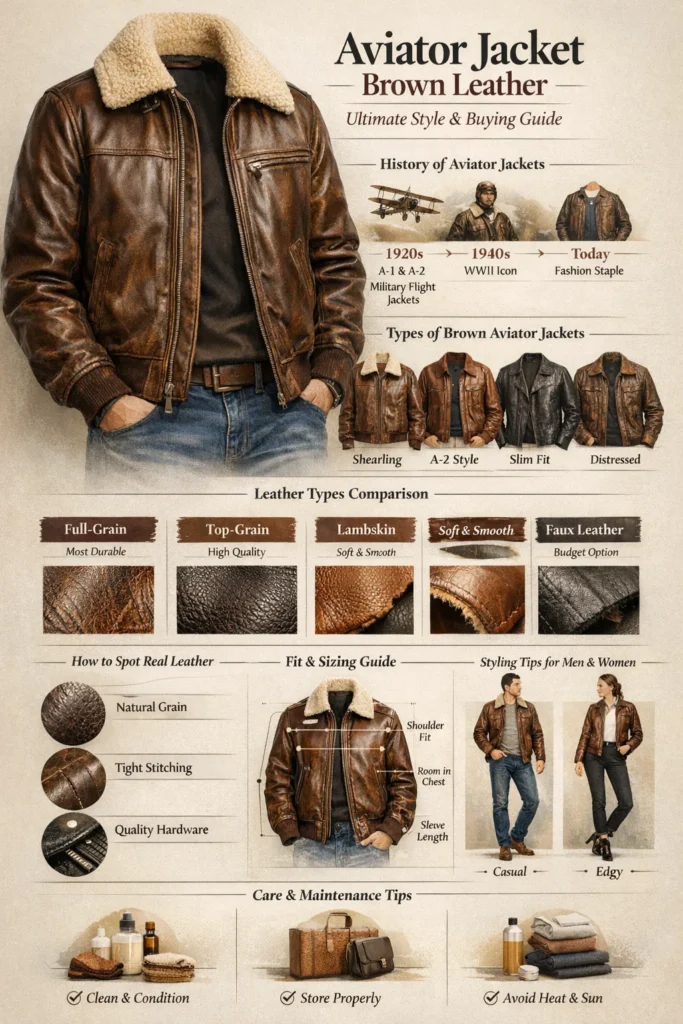
- Wipe dust with soft, slightly damp cloth weekly.
- Dry naturally after wet weather; avoid heat sources.
- Hang on a wide padded hanger; avoid wire hangers.
Conditioning schedule
- For regular use: condition 1–2 times per year.
- For dry climates or heavy use: condition every 4–6 months.
- Test all products on a hidden seam first.
Shearling care
- Spot clean with damp cloth and mild detergent.
- For heavy soiling, use professional leather/suede cleaning.
Protection
- Use a leather-protectant spray compatible with the leather type.
- Avoid prolonged direct sunlight to reduce fading.
Storage
- Use breathable cloth covers; avoid plastic.
- Keep in a cool, dry place with air circulation.
Repair
- Fix small tears, replace zippers early, and re-stitch seams when needed.
- Many heritage brands offer repair services at purchase.
Price ranges worldwide compact reference
| Region | Budget (PU/low grade) | Mid (top-grain/reissues) | Premium (full-grain/heritage) |
| USA | $60–$200 | $250–$700 | $700–$2,000+ |
| UK / EU | £50–£180 | £200–£650 | £650–£1,800+ |
| Canada / Australia | CAD/AUD 80–250 | 300–900 | 900–2,200+ |
| Middle East | $80–$220 | $260–$800 | $800–$2,000+ |
Pros & Cons
Pros
- Timeless military heritage & style token.
- Versatile across many outfits and seasons.
- Brown leather develops an attractive patina.
- Shearling variants provide substantial warmth.
- Durable when made from full-grain or strong top-grain hides.
Cons
- Premium-quality items can be expensive.
- Poor care may cause dryness, splitting, or uneven color loss.
- Shearling styles can feel bulky.
- Faux alternatives lack authentic aging and long-term durability.
FAQs
A1: Yes, pick a lightweight top-grain or lambskin jacket without shearling. In hot areas, thin leather or light-lined bombers feel easier to wear.
A2: It should sit firm on the shoulders but leave space in the chest for a sweater. You should still move your arms without effort.
A3: Yes, in smart-casual workplaces. Pick a tidy, less-distressed brown and a cleaner cut. Pair with chinos and a shirt.
A4: Yes. Sun and heavy wear cause fading and patina. Use protection sprays and rotate the jacket to avoid uneven fading.
A5: For regular use, condition 1–2 times a year. In drier climates or heavy use, consider every 4–6 months.
Conclusion
Think of choosing a brown aviator jacket as making a structured file: collect hide type, thickness, lining, hardware, stitch density, country of origin, and Warranty. Use these details to calculate a buying score and favor jackets that clearly show materials and build quality. If you are buying, follow the checklist above and ask for close-up images when shopping online. If you sell or write product text, use the given feature system and styling guides to create clear, searchable, and quality product descriptions.