Introduction
Retro Leather Jackets are more than a seasonal fad — they are wearable history. Whether you want a reissue biker, a 1970s shearling aviator, or a clean café racer, retro leather jackets channel vintage style with modern comfort. This guide explains what makes a jacket “retro” vs “vintage,” shows the most iconic silhouettes, explains leather types, and gives robust buying, styling, and care advice tailored for 2026. It’s written for buyers, fashion fans, and e-commerce sellers who want a jacket that lasts and photographs well. Read on to learn how to spot quality, pick the right retro piece, and keep it looking its best.
What is a Retro Leather Jacket?
A retro leather jacket is a new garment produced today but deliberately modeled on designs, proportions, and details from past decades — typically the 1950s through the 1990s. Unlike true vintage pieces (actual garments produced in earlier eras), retro jackets are contemporary builds that borrow classic zips, wide lapels, shearling linings, belt details, or intentionally distressed finishes. The defining trade-off: retro pieces pair nostalgic silhouettes with modern sizing, up-to-date linings, and contemporary production standards.
Retro vs Vintage vs Replica Quick Comparison
| Feature | Retro (Modern Reissue) | Vintage (Original) | Replica / Faux Vintage |
| Age | New | Old — from the era | New (made to look old) |
| Authenticity | Inspired by past | Historically authentic | Imitation styling |
| Price Range | Moderate → High | Often high (rare) | Low → Moderate |
| Condition | Pristine or intentionally aged | Worn; has genuine patina | Intentionally aged, synthetic |
| Sizing | Modern | Smaller / varied | Modern |
| Value as collectible | Low–moderate | High | Low |
| Best use | Daily wear, modern comfort | Collectors | Costume or low-cost fashion |
The History of Leather Jackets
Leather jackets began as pure utility: hardwearing outerwear for pilots, riders, and industrial workers. Their purposeful construction—durable hides, snug collars, and insulating linings—morphed into cultural symbolism: rebellion, cool, and timelessness.
Military Roots
Early 20th-century flight jackets such as the A-2 and B-3 were engineered to protect pilots from cold, wind, and the hazards of early open cockpits. These jackets prioritized thermal performance and rugged construction.
WWII influence
During World War II, jackets were strictly functional: reinforced seams, insulated linings, and shapes designed for movement. After the war, surplus and military-derived pieces entered civilian life and informed mainstream designs.
Hollywood & Rebellion
In the 1950s, actors like Marlon Brando and James Dean turned the leather jacket into an icon of youthful defiance. Motorcycle culture, rock’n’roll, and the punk movement layered personalization—studs, patches, paint—onto leather’s built-in attitude.
Fashion Evolution
From the 1970s onward, designers appropriated leather’s rebellious cachet into runway aesthetics. The 1990s and the early 2000s saw reissues and reworkings of classic cuts; today, reissues attempt to replicate original construction while offering modern comfort and ethical disclosure.
Classic Retro Leather Jacket Styles
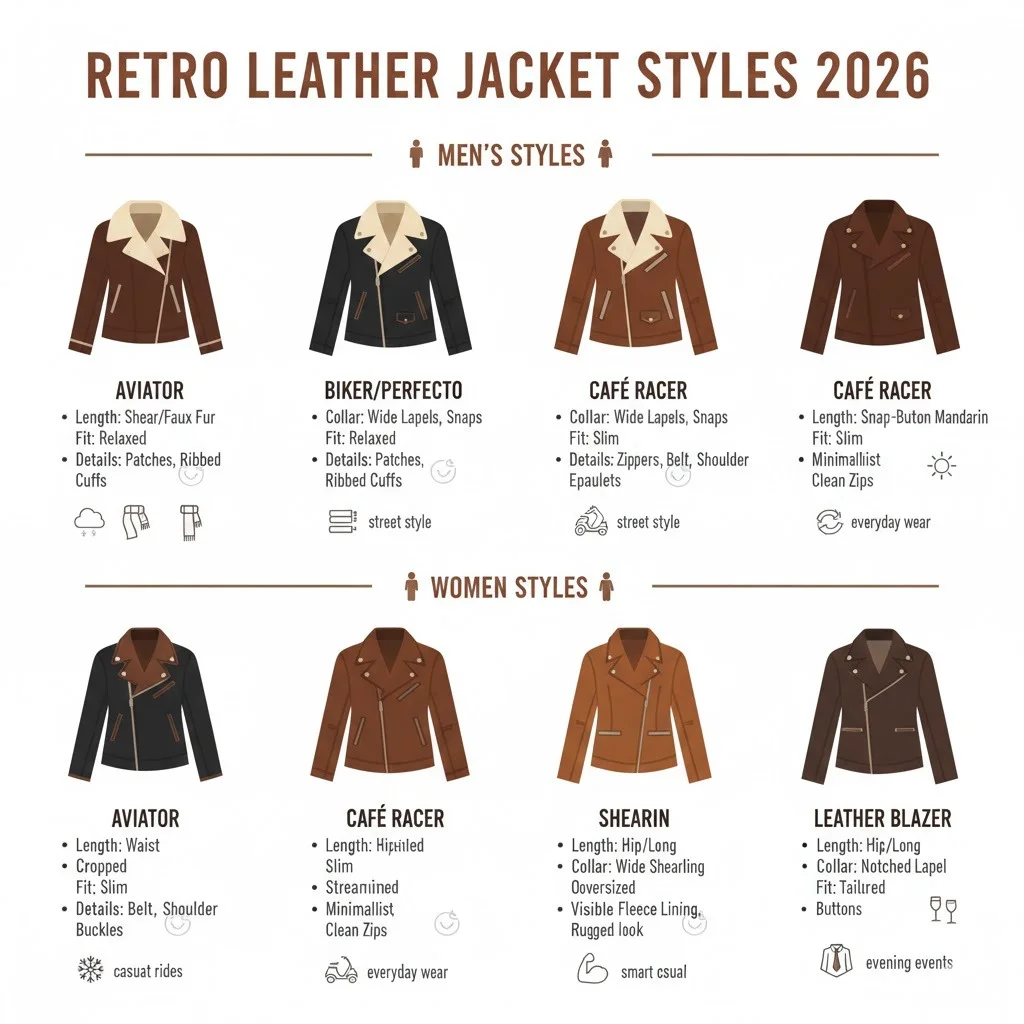
Below are the most common retro styles you’ll encounter; each has unique design markers and typical uses.
Biker / Motorcycle Jacket
Key features: Asymmetrical zipper, wide lapel, belted waist, heavy metal hardware.
Best for: Edgy everyday wear, layering over tees and hoodies.
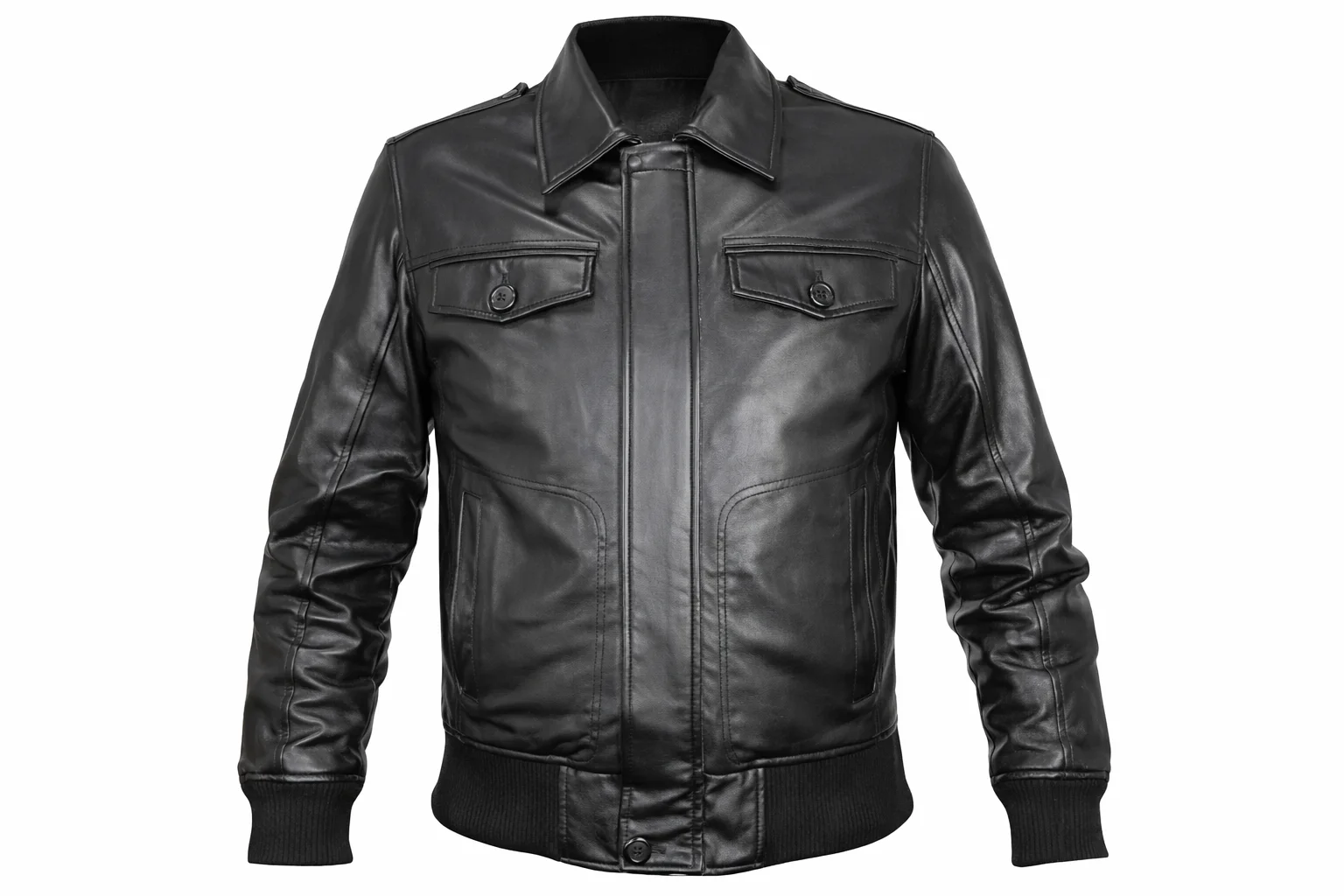
Bomber / Flight Jacket
Key features: Ribbed cuffs and hem, straight front zip, boxy relaxed fit.
Best for: Casual looks and transitional weather.
Café Racer / Racer Jacket
Key features: Minimalist lines, small or stand collar, straight zip, slim cut.
Best for: Clean retro looks, smart-casual outfits.
Aviator / Shearling Jacket
Key features: Shearling collar or full shearling lining, heavy leather, warm.
Best for: Cold climates and authentic vintage silhouettes.
70s & 80s Retro Cuts
Key features: Broader shoulders, longer lengths, decorative seams, fringe or paneling.
Best for: Statement pieces and trend revivals.
Leather Types Used in Retro Jackets
Knowing leather varieties helps you match price to Durability and look.
Full-Grain Leather
What it is: The topmost layer of hide, unbuffed and with natural grain intact.
Why it matters: The most durable; develops a unique patina with wear.
Price: high.
Best for: Investment pieces.
Top-Grain Leather
What it is: Slightly sanded or corrected surface; more uniform.
Why it matters: Softer hand and easier maintenance; still long-lasting.
Price: Mid to high.
Corrected-Grain / Nubuck
What it is: Buffed to create a suede-like nap.
Why it matters: Soft hand and matte finish; it shows wear differently.
Price: mid.
Genuine Leather
What it is: Lower grades or split layers bonded together, often with finishes to imitate higher grades.
Why it matters: Affordable, but far less durable than full-grain.
PU / Vegan Leather
What it is: Synthetic leather made from polymer coatings (PU), PVC, or novel bio-based alternatives.
Pros: Cruelty-free, typically lower cost, and easier color consistency.
Cons: Usually doesn’t breathe or patinate like animal hides; performance varies.
Manufacturing Process Step-by-Step
A short production checklist and what to watch for when evaluating quality.
| Step | Process | Quality sign to check |
| 1 | Skin sourcing | Large hides, natural marks for full-grain |
| 2 | Tanning | Vegetable tanning ages well; chrome tanning gives softness |
| 3 | Dyeing & finishing | Even color, no cracking; edge finishing consistent |
| 4 | Cutting & patterning | Single-piece backs, aligned grain, matched panels |
| 5 | Stitching & assembly | Double stitching on stress points |
| 6 | Hardware attachment | Branded zips (YKK or equivalent), solid snaps |
| 7 | Lining insertion | Quilted or cotton lining for warmth and comfort |
| 8 | Finishing & QC | Smooth edges, secure collars, no puckering |
How to Identify Real vs Fake Leather
Spotting genuine leather is straightforward if you inspect a few sensory and construction cues.
Smell & Touch
Real leather: Organic, slightly sweet or earthy scent; tactile variance across the hide.
Fake leather: Chemical or plastic smell; overly uniform texture.
Pores & Grain
Full-grain leather shows varied, irregular pores. Faux leather often repeats the same grain pattern.
Edges & Backing
Real leather has fibrous, rough edges and a suede-like backing on splits. Faux leather usually has smooth, plastic backings.
Price & Labeling
Extremely low prices claiming “full-grain” are suspect. Check for clear labeling (e.g., full grain, top grain, genuine leather) and country of origin.
Stitching & Hardware
High-quality jackets use robust stitching, locked seams, and reputable zippers (YKK or branded hardware). Loose threads, cheap snaps, and poorly sewn linings are red flags.
Price Range Worldwide
| Category | Price Range (USD) | Typical Characteristics |
| Budget Retro | $40 – $200 | Trendy looks, limited durability |
| Mid-Range Retro | $200 – $700 | Good leather, reliable hardware |
| Premium Retro | $700 – $2,500+ | Full-grain, heritage quality |
| Vintage Originals | $500 – $10,000+ | Rarity and collectible value |
How to Style Retro Leather Jackets 2026 Tips
Below are clear outfit ideas and trend notes for 2026, pulled from current fashion coverage: classic silhouettes remain foundational, while boho and earthy spring palettes and bomber revivals are visible in street and runway coverage for 2026.
For Men
- Classic: Biker + slim jeans + white tee + sturdy boots.
- Smart-casual: Café racer + chinos + thin turtleneck + loafers.
- Layering: Bomber under a long wool coat for texture contrast.
For Women
- Feminine edge: Biker + midi dress + ankle boots.
- Minimal: Racer + high-waist trousers + fine knit top.
- 70s revival: Shearling aviator + flared jeans + platform boots.
Streetwear & Contemporary
- Oversized retro jackets with tailored joggers and chunky trainers.
- Mix textures: Leather + knit + silk or modern technical fabrics for depth.
Color & Trim Tips
- Black is universally versatile.
- Brown/tan ages into attractive patina.
- For distressed finishes, pair with clean or tailored pieces to balance the look.
Top Brands & Countries Famous for Retro Leather Jackets
A note on heritage makers and why they matter. Brands with long histories often bring construction knowledge, archival patterns, and Reputational Value.
- Schott NYC (USA) — Iconic Perfecto-style bikers and deep American heritage. Schott’s long history and status as a maker of the original motorcycle jacket are well documented.
- Belstaff (UK) — Known for motorcycle and waxed outerwear; active heritage brand with recent ownership shifts and strategic repositioning. Recent business news indicates ownership changes aimed at building growth.
- Aero Leather (Scotland) — Small-batch, handmade reissues and military reproductions with a reputation for durable hides and traditional construction.
- The Real McCoy’s / Buzz Rickson’s (Japan) — Meticulous reissue culture and high-fidelity reproductions of vintage military jackets with dedicated enthusiasts and steady demand.
Country highlights
- USA: Motorcycle and bomber heritage.
- UK & Europe: Tailoring and shearling traditions.
- Italy & Spain: Premium tanning and artisanal finishing.
- Japan: Precise reissue culture and small-batch craft.
Pros & Cons
Pros
- Iconic style, modern comfort.
Easier sizing than vintage pieces. - Built with contemporary improvements (linings, zips).
- Long life when well selected and maintained.
Cons
- Not authentic collectors’ originals.
- Low-quality retro jackets can be mislabeled.
- Real leather requires ongoing care.
- Ethical concerns for some consumers.
Sample Product Comparison
| Model (Type) | Leather Type | Best Use | Price Band | Why Choose |
| Heritage Biker | Full-grain steerhide | Everyday edge | $$$ | Classic silhouette, solid hardware |
| Modern Café Racer | Top-grain lamb | Smart-casual | $$ | Slim fit, lighter weight |
| Shearling Aviator | Cowhide + shearling | Cold climates | $$$$ | Warm and authentic retro look |
| Lightweight Bomber (vegan) | PU leather | Trend/budget | $ | Animal-free, fashion-forward |
FAQs
A: Retro jackets are newly manufactured and designed to evoke historic styles; they are modern constructions with vintage inspiration. Vintage jackets were actually produced in the past and carry authentic age, patina, and provenance—often sought by collectors. Retro is optimized for modern wearability; vintage is prized for originality.
A: Full-grain steerhide or horsehide are top choices for durability, structure, and patina development. Top-grain offers a softer hand and easier break-in while still providing a high-quality finish.
A: Yes, when you choose full-grain or high-quality top-grain and maintain the jacket. A well-made piece can last decades and improve with age. For trend or short-lived use, budget options may be appropriate, but they are not lifetime investments.
A: Measure chest, shoulder width, and sleeve length. Compare the seller’s size chart. Allow room if you’ll layer thick sweaters. Leather relaxes slightly after initial wear, so aim for a snug but not constricting fit.
A: Short exposure to light rain is usually tolerable. For prolonged wet weather, treat leather with a water-repellent product and dry naturally away from heat. Avoid machine drying or direct heaters.
Conclusion
Retro leather jackets give you the visual history of classic outerwear while delivering Modern comfort, sizing, and technical updates. Choose based on leather grade, construction, and intended use: full-grain and top-grain deliver the best longevity; shearling linings add insulation; vegan and bio alternatives answer ethical concerns and market demand. For e-commerce sellers, prioritize clear photography, detailed measurements, and supply-chain transparency to build trust and increase conversions.
Brand & trend note summary: Heritage makers like Schott, Aero, and Japanese reissue houses are prominent names in reissue culture, and consumer attention to vegan leather alternatives is growing with measurable market momentum—both of which are shaping product offerings in 2026.