Introduction
A Motorcycle Leather Jacket is more than an aesthetic choice — it’s a critical safety layer that stands between a rider and the road. The right jacket resists abrasion, positions armour correctly, and keeps you comfortable across different climates. But “leather jacket” is a huge category: materials, thicknesses, seams, armour standards, fit, and construction all drastically change how protective a jacket is. This guide translates those technical differences into simple, practical steps you can use to pick the best jacket for the job.
What is a motorcycle leather jacket?
A motorcycle leather jacket is a garment cut, constructed, and finished to protect riders. Unlike fashion jackets, a true motorcycle jacket is engineered to:
- Use a thicker, tougher hide in impact zones (shoulders, elbows, hips).
- Accept and retain armour (shoulder, elbow, back) so it stays aligned with joints during movement.
- Features heavy-duty seams and reinforced stitching to resist seam-splitting under load.
- Include closure systems (zippers, snaps, storm flaps) that prevent wind from tugging the jacket open at speed.
- Have a riding-specific cut — often slightly shorter in the torso for sport jackets, longer for cruisers, and pre-curved sleeves where necessary to maintain comfort on the bike.
If you ride at highway speeds or track, invest in a purpose-built jacket with appropriate hide thickness and CE ratings. If you commute around town at low speeds, a lighter leather or hybrid can be acceptable — but always understand trade-offs.
A short history — why leather became standard
Leather’s association with riders dates back to the early 1900s, when aviation and military gear doubled as early motorcycle outerwear. Leather blocks wind and provides a level of abrasion resistance far beyond woven cloth. In the post-war decades, motorcycle culture adopted leather as both a practical kit and an identity symbol. From the café racer movement to modern track suits, leather evolved: manufacturers started tailoring hides for sliding-resistance, adding armour pockets, and later, testing to standards (EN/CE). Today’s motorcycle leather mixes heritage styling with modern performance: pre-shaped panels, laminated reinforcements, and certified armour make a leather jacket both a safety device and a style statement.
Types and variations of motorcycle leather jackets
Style and protection often overlap. Here are the primary categories and the situations they serve:
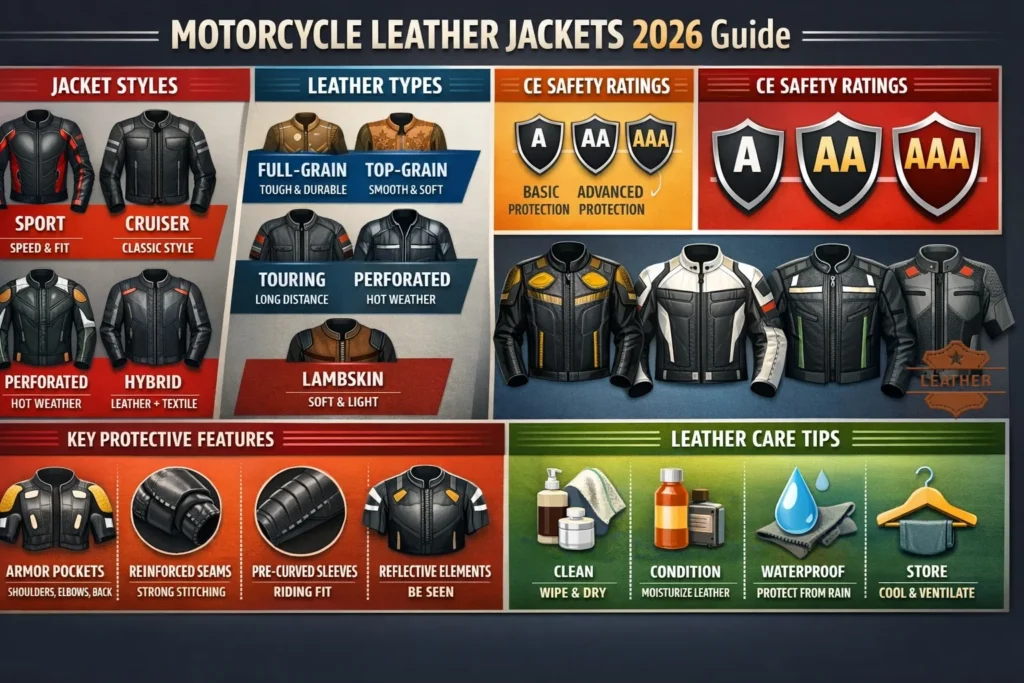
Sport / Track Jackets
- Purpose: High-speed protection and aerodynamic fit.
- Features: Pre-curved sleeves, aggressive fit, higher hide thickness, often paired with a race hump and connection zipper to pants.
- Best for: Track days, fast road riding.
Cruiser / Classic Jackets
- Purpose: Comfort, durability, and long-distance stability.
- Features: Heavier, more flexible hides, relaxed torso length, focus on ruggedness and comfort.
- Best for: Cruisers, long-haul riders, retro looks.
Café Racer / Vintage Jackets
- Purpose: Slim, stylish profile with moderate protection.
- Features: Hip-length, clean lines, and some models include armour pockets.
- Best for: Urban rides, style-first riders who prefer stronger hides for occasional highway use.
Touring Jackets
- Purpose: Comfort for long days, weather management, and storage.
- Features: Removable thermal liners, ventilation, waterproof membranes in some models, and many pockets.
- Best for: Distance riders, touring, multi-climate trips.
Perforated / Summer Jackets
- Purpose: Maximise airflow while retaining leather’s abrasion resistance.
- Features: Perforated panels, mesh liners, extra vents.
- Best for: Hot climates and warm-season riding.
Hybrid Jackets
- Purpose: Balance leather’s protection with textile flexibility and breathability.
- Features: Leather in impact zones, textile/Kevlar stretches in comfort areas, water-resistant membranes.
- Best for: Riders wanting a compromise between protection and climate control.
Leather types — which leather should you choose?
Not all leather is the same. Below are common types and their practical implications:
- Full-Grain Leather Description: The outermost layer with the natural grain intact. Protection: Highest abrasion resistance and durability; develops patina. Best use: Sport and serious road protection.
- Top-Grain Leather Description: Slightly sanded or corrected for uniformity. Protection: Very good, slightly less resistant than full-grain but softer and more forgiving. Best use: Comfortable protective jackets, everyday riding.
- Steerhide / Cowhide Description: Tough, widely available, varying thicknesses. Protection: Excellent when in thicker cuts (1.0–1.4 mm or more). Best use: Sport and cruiser jackets.
- Buffalo Description: Coarser grain, robust. Protection: Durable and heavy; takes abuse well. Best use: Cruisers, touring, where durability and water resistance help.
- Lambskin / Sheepskin Description: Soft and supple, very comfortable. Protection: Thinner; good for style and light urban use, but not as abrasion-resistant for high-speed slides. Best use: City riding, fashion-conscious commuters.
- Bonded/Reconstituted Leather & PU (synthetic leather) Description: Composite materials made of leather fragments or plastic. Protection: Poor for sliding; tears quickly and offers little abrasion resistance. Best use: Fashion only — avoid for serious riding.
Rule of thumb: For higher speeds and serious protection, choose full-grain or thick cowhide in the 1.0–1.4 mm+ range. For hot climates or city commuting, top-grain or leather/textile hybrids with correct armour can be a realistic compromise.
Anatomy — what to inspect on any jacket
When you evaluate a jacket — in-store or on a product page — check these elements:
- Outer shell & panels — Consistent leather thickness and visible grain. Reinforced panels should be obvious in the shoulders and elbows.
- Armour pockets & armour — Pockets for CE-rated protectors that hold armour snugly so it won’t shift.
- Stitching & seams — Double- or triple-stitched seams and bar tacks in high-stress zones. Loose threads or single-stitched seams are red flags.
- Zippers & closures — Heavy-duty zips (metal or robust moulded), storm flaps, and collar snaps. Collar designs that close firmly reduce wind lift.
- Liners & thermal layers — Removable liners for cold weather; breathable mesh liners for hot climates.
- Vents & perforation — Zippered vents or perforated panels for airflow — critical for summer riding.
- Fit features — Waist adjusters, sleeve zips, and pant-connection zips to keep the jacket in position.
- Reflective elements — Subtle reflective piping increases nighttime visibility without ruining aesthetics.
A jacket can be CE-certified, but poor armour placement or bad fit will reduce protection. Always evaluate the whole system.
CE safety ratings decoded in plain English
European standards for motorcycle clothing are consolidated under EN 17092 (clothing) and EN 1621 for protectors (armour). The EN garment class (A / AA / AAA) gives a quick indication of protective performance; higher-rated garments usually offer higher abrasion resistance and energy absorption, though they can be heavier and stiffer.
What the classes mean in practice:
- Class A: Entry-level, lighter protection — good for city riding and lower speeds. Not ideal for sustained high-speed sliding.
- Class AA: Midweight protection — a solid choice for most road riders, balancing comfort and protection.
- Class AAA: Top-tier protection — often used in race suits and high-protection jackets. Heavier and more abrasion-resistant.
Armour note: Garment classes are separate from armour ratings. Armour follows EN 1621 standards with Levels (Level 1 vs Level 2). Level 2 armour absorbs more impact energy than Level 1. For shoulders/elbows, prefer Level 2 for aggressive riding. A high-class garment plus Level 2 armour gives the best protection package.
How to choose the right jacket — fit & function
Follow this practical plan when buying:
Define primary use
- Commuter: easy on/off, vents, reflective.
- Touring: pockets, liners, weatherproofing.
- Sport/Track: thick hide, pre-curved sleeves, AAA/Level 2 armour.
Measure properly
- Chest: fullest part with arms relaxed.
- Arm length: centre back of neck → over shoulder → wrist (elbow slightly bent).
- Torso length: sit on a bike and ensure lower back coverage.
Try in the riding position
Lean forward as on the bike. Sleeves reach wrists? Back stays covered? Armour sits on bony landmarks (shoulder cap, elbow) — not behind them.
Snug, not restrictive
Snug so armour doesn’t move, but allows torso rotation and reach for controls.
Inspect armour
Remove and evaluate protectors. CE-rated? Dense and moulded? Consider a separate Level 2 back protector if needed.
Check materials & hide thickness
Aim for 1.0–1.4 mm+ in primary impact zones for sliding protection.
Seasonality & extras
- Hot weather: perforation, vents, mesh liners.
- Rainy climates: waterproof membranes or over-jacket.
- Cold: removable thermal liners, high collars.
For online shopping, use manufacturer fit guides, check return policies, and read real-world user reviews.
Use-case breakdown & recommended jacket types
| Rider Type | Best Jacket Style | Leather Type | Key Features |
| Sport / Track | Sport performance | Full-grain / thick cowhide | Pre-curved sleeves, AA/AAA, Level 2 armour |
| Cruiser | Cruiser / Classic | Buffalo / thick cowhide | Heavy hide, long body, comfort |
| Touring | Touring jacket | Full-grain or top-grain + lining | Removable liner, pockets, ventilation, AA |
| Hot-weather | Perforated leather | Top-grain / perforated cowhide | Perforation, vents, mesh liner |
| City commuter | Lightweight leather / hybrid | Top-grain or leather+textile | Easy on/off, breathable, reflective |
Group picks by use-case and budget for clearer buying pages and better conversions.
Building a “best-of” list — transparent methodology
Transparency builds trust. Structure selection like this (weighted scoring):
- Construction quality (30%): Seams, panel layout, reinforcement.
- Leather grade & thickness (25%): Full-grain vs top-grain, mm values.
- CE class & armour levels (20%): Garment class plus protector Levels.
- Comfort & fit (10%): Pre-curved sleeves, adjusters and Flexibility.
- Climate features (5%): Vents, liners, waterproofing.
- Warranty & aftercare (5%): Returns, repair options, brand support.
- Real-world testing & reviews (5%): Abrasion tests, user feedback.
Create separate lists by purpose (sport, touring, commuter) and price tier (entry, mid, premium). For each pick, include a score breakdown and an ideal rider type.
Caring for your leather jacket — clean, condition, protect
Good leather care preserves both look and safety. Clean leather that stays supple resists cracking and performs better in abrasion.
Daily / After-ride
- Wipe dust and road grime with a soft, slightly damp cloth; avoid soaking the leather.
- Let the jacket air-dry naturally away from direct heat sources (radiators, direct sunlight) that can dry and stiffen the hide.
Deep cleaning
- Use a leather cleaner formulated for the specific leather type (test in an inconspicuous spot).
- Apply cleaner sparingly, follow product instructions, and avoid household detergents, bleach, or strong solvents.
Conditioning
- Condition leather 1–2 times per year (more in dry climates). Apply a small amount, work in gently, and buff off excess. Conditioning restores oils and maintains flexibility, which can help the jacket absorb and distribute forces better in a slide.
Waterproofing
- Leather is naturally water resistant for short periods, but will soak over extended wet exposure. For heavy rain, use a wax or waterproofing product made for leather (test first). For long wet rides, prefer a waterproof over-jacket or a jacket with a waterproof membrane.
Storage
- Hang the jacket on a wide-shouldered hanger; avoid wire hangers. Use breathable garment bags (cotton or canvas) rather than plastic to prevent mildew.
Repairs
- Small surface scratches can often be improved with leather conditioner or subtle dye. For seam failures or major tears, consult a specialist leather repair service. Save receipts and document repairs for warranty claims.
How to spot fake or low-quality leather
Quick, practical checks:
- Smell: Genuine leather has a complex, organic scent; PU/synthetic often smells chemical or plasticky.
- Grain & imperfections: Full-grain hides show natural marks — tiny scars, uneven grain. A perfectly uniform surface can indicate corrected grain or synthetic.
- Edges: Real leather edge looks fibrous and layered; bonded leather shows compressed layers.
- Water test: A tiny drop of water is slightly absorbed into genuine leather, darkening it; synthetics tend to bead. Test carefully and discreetly.
- Price & provenance: High-quality protective jackets from reputable brands are rarely deeply discounted at launch. If a jacket claims full-grain protection at a suspiciously low price, dig deeper.
- Labels & documentation: CE certification, stated hide thickness (mm), and named protector standards (EN 1621) are good signs. If claims are vague — be cautious.
Price ranges and what to expect for each tier
These are approximate worldwide ranges (2026 estimates; vary by region, brand, and sales):
- Budget / Fashion (non-protective): $80 – $250 — fashion leathers or synthetics, minimal protection.
- Entry protective: $200 – $450 — adequate for commuting with basic CE armour.
- Mid-range: $450 – $900 — balanced protection and comfort, good materials.
- Premium / Race: $900 – $2500+ — advanced materials, test-backed protection, race-ready features (e.g., Dainese, Alpinestars, Schott premium lines).
Always assess features and build rather than price alone. A mid-priced jacket with Level 2 armour and good construction is often safer than a cheap “full-grain” jacket of unknown provenance.
FAQs
A: Yes — full-grain cowhide or steerhide, combined with CE-rated armour, is one of the most abrasion-resistant options for riders. Safety depends on hide thickness, construction quality, fit, and proper armour placement. A well-made, genuine leather jacket with Level 2 armour and an AA/AAA garment class provides strong sliding protection.
A: You can, but fashion jackets typically lack CE testing, reinforced seams, and correctly placed armour pockets. For low-speed urban riding, they are better than nothing, but for highway travel, choose a purpose-built jacket.
A: It should be snug so armour stays in place, but still allow torso rotation and reach for controls. Try the jacket leaning forward or in a riding position — sleeves should reach the wrist and the jacket should cover the lower back when seated.
A: For highway or touring, aim for AA or AAA garment class and Level 2 back protection if possible. For city-only commutes, Class A can be acceptable but offers less abrasion resistance.
A: Generally, 1–2 times per year. In dry climates condition more frequent. Always test a product in a hidden spot and follow the manufacturer’s care guidance.
Conclusion
A motorcycle leather jacket combines safety and style. For maximum Protection, choose full-grain or thick cowhide, confirm CE garment class and Level 2 armour where possible, and always ensure the jacket fits well in a riding position. Maintain the leather with proper care, and repair issues promptly to preserve both looks and protective function.