Introduction
Think of choosing a Leather Messenger Bag as a classification problem: you have features (leather type, strap design, laptop sleeve, hardware), labels (daily commute, travel, professional, rugged), and an objective (longevity + aesthetics + value). In NLP terms, a great leather messenger bag is like a well-trained model — it generalizes across contexts (meetings, commutes, trips) while developing its own signature style through patina and texture.
This guide reframes classic advice using feature engineering, model evaluation, and deployment analogies so you can make a precise, durable choice in 2026.
What Is a Leather Messenger Bag?
A leather messenger bag is a crossbody bag with a long adjustable strap for quick access. From an NLP view, it’s a compact data structure: defined fields (main compartment, laptop sleeve, front pockets) and APIs (closures, buckles, zippers) optimized for tasks like carrying laptops, documents, and daily essentials.
Common payloads include:
- Laptop (13″–16″)
- A4 notebooks or documents
- Chargers, cables, gadgets
- Keys, wallet, phone
Historically used by couriers, modern versions add padding, organization, and weather resistance.
A Brief History — From Courier Roots to Modern Designs
The messenger bag’s “language family” traces back to military mail bags and courier satchels. Iterative updates (like model training) added features as needs evolved — especially with laptops in the 1990s–2000s. Today’s leather versions blend traditional craftsmanship (tanning, hand-stitching) with practical engineering (padded compartments, reinforced straps).
Types & Variations
- Traditional Flap Messenger — Large front flap with magnetic or buckle closures; excellent accessibility.
- Zip-Top Messenger — Focuses on security and water resistance.
- Convertible (Briefcase + Messenger) — Dual-mode with handles and crossbody strap.
- Sling / Compact Messenger — Minimalist, single-shoulder for light loads.
- Rugged / Vintage — Distressed, waxed leather for durability.
- Slim Laptop Messenger — Sleek design with targeted padding for commuters.
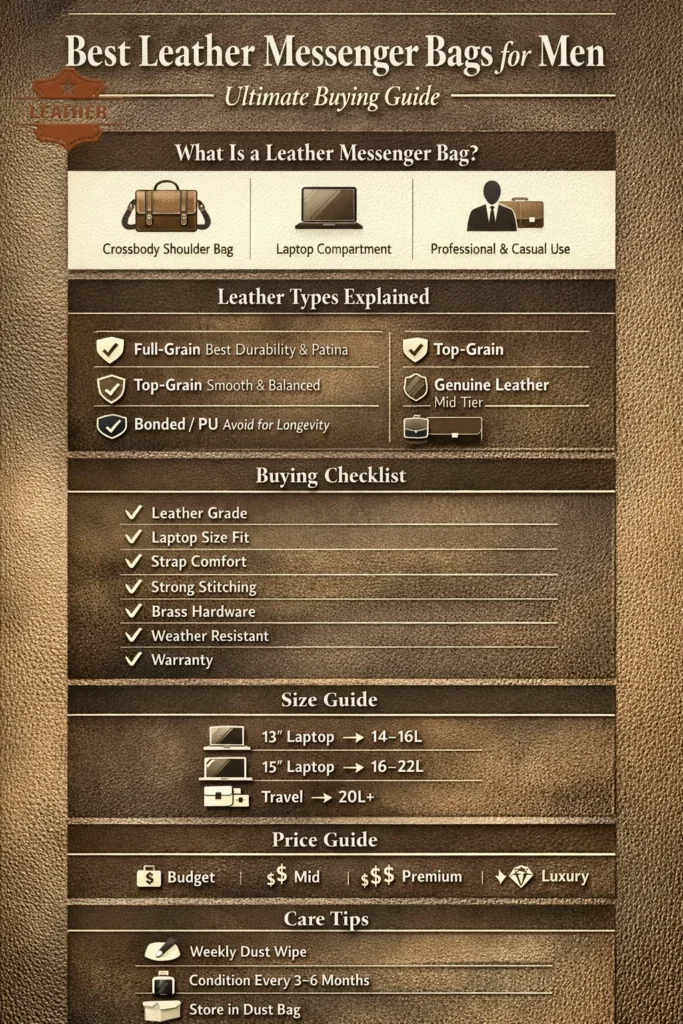
Leather Types Explained
Leather type is the strongest predictive feature for bag performance.
- Full-Grain Leather — Top hide layer with natural grain; extremely durable, develops rich patina, highly repairable (heirloom quality).
- Top-Grain Leather — Slightly sanded for uniformity; durable with milder patina (great cost-performance balance).
- Genuine Leather — Lower layers, often corrected; affordable but less long-lasting.
- Bonded Leather — Scraps glued together; cheap and prone to peeling (avoid for longevity).
- PU (Vegan) Leather — Synthetic; consistent but no patina (ethical alternative with trade-offs).
Quick rule: Prioritize full-grain for heirloom potential; top-grain for balanced value.
How Leather Quality Affects Performance & Price
| Feature/Metric | Full-Grain | Top-Grain | Genuine | PU/Bonded |
| Durability | 5/5 | 4/5 | 2–3/5 | 1/5 |
| Patina Potential | 5/5 | 3/5 | 1–2/5 | 0/5 |
| Repairability | Excellent | Good | Limited | Very low |
| Price Signal | High | Mid | Low | Low |
| Weight | Heavier | Medium | Medium | Light |
Use this as a feature selection table — balance against your priorities (Cost vs. lifespan).
How Genuine Leather Bags Are Made
- Hide selection
- Tanning (chrome or vegetable)
- Splitting & shaving
- Dyeing & finishing
- Cutting & patterning
- Stitching & edge burnishing
- Hardware installation
- Quality inspection
Premium brands enforce strict QA at every step.
How to Spot Real vs. Fake Leather
- Smell: Organic vs. plasticky
- Texture: Natural variability vs. uniform
- Water drop: Absorbs slightly vs. repels
- Edge: Fibrous vs. sealed
- Price check: Suspiciously cheap “full-grain” claims
Combine these for high-confidence authenticity detection.
Buying Guide — Feature Checklist
Parse product pages like unstructured text:
- Leather grade (full/top-grain, vegetable-tanned?)
- Laptop fit (exact sleeve dimensions)
- Strap (width, padding, reinforcement)
- Stitching (dense, even)
- Hardware (brass/stainless preferred)
- Organization (pockets, sleeves)
- Weather resistance
- Warranty/repair services
Size & Fit — Capacity Lookup Table
| Use Case | Recommended Size |
| Daily essentials (tablet, etc.) | Medium (10–13″) |
| 13″ Laptop | 14–16 L |
| 15″ Laptop | 16–22 L |
| Travel/heavy gear | 20 L+ |
Always measure your laptop and compare it to the specs.
Messenger Bags vs. Backpacks vs. Briefcases
- Messenger: High precision (quick access, style); lower recall (comfort over long periods).
- Backpack: High recall (weight distribution); less precision (access).
- Briefcase: High precision (formal); limited versatility.
Optimize for your daily tradeoffs.
How to Style a Leather Messenger Bag
- Business/Formal: Black/dark brown + blazer/suit; slim profile.
- Smart Casual: Cognac/tan + chinos/Oxford shirt.
- Casual/Weekend: Distressed + jeans/tee/sneakers.
- Travel: Neutral/dark with secure closures.
Match the “context” to the leather “token.”
Care & Maintenance
- Weekly: Dust with a lint-free cloth.
- Every 3–6 months: Conditioner (patch test first).
- Yearly: Inspect seams/hardware.
- Storage: Acid-free paper stuffing, dust bag, no sun/dampness.
- Repairs: Professional services for stitching/straps.
Price Guide — Cost vs. Lifespan
- Budget (≤ $100): PU/low-grade; short life.
- Mid ($150–$350): Top-grain, solid build.
- Premium ($400–$900): Full-grain, excellent quality.
- Luxury ($1000+): Handcrafted/designer.
Calculate the cost per year for the true value.
Top Picks — Best Leather Messenger Bags for Men (2026)
Updated based on recent reviews and testing for durability, organization, and value:
- Saddleback Classic Messenger: Thick full-grain, overbuilt; heirloom-level longevity for tool-like users.
- Shinola Canfield Relaxed Messenger Refined structure, office-ready; premium materials and hardware.
- Leatherology Classic Laptop Messenger Clean, functional pockets; ideal commuter balance (often top-rated overall).
- Fossil Haskell Workbag (or similar models) Vintage-inspired, casual organization; great everyday character.
- Other strong 2026 contenders (from recent tests): Cravar F.C. 15 (best overall balance), Satchel & Page Mailbag (premium leather), Thursday Boot Co. Commuter (value pick).
Check current specs, Reviews, and pricing before purchase.
Common Buying Mistakes to Avoid
- Not measuring laptop → Fix: Compare dimensions.
- Looks over construction → Fix: Prioritize leather/hardware.
- Choosing bonded leather → Fix: Go full/top-grain.
- Ignoring warranty → Fix: Choose repair-friendly brands.
- Weak hardware → Fix: Check brass/rivets.
FAQs
A: Yes — quality ones outlast synthetics and gain character (patina) over time.
A: Seek a padded 15″+ sleeve; measure your device first.
A: Full-grain and vegetable-tanned develop the richest aging.
A: Yes — high-quality ones support stitching, strap fixes, etc.
Quick Decision Framework
- Budget? (≤$150 → top-grain; $150+ → full-grain options)
- Load? (Light → compact; moderate → 14–18 L; heavy → consider backpack)
- Style? (Formal → dark/slim; casual → distressed)
- Warranty? (Prioritize repair services)
Putting It Together — Practical Use Cases
- Urban Professional (15″ laptop): Slim full/top-grain with padded sleeve + pockets.
- Weekend Traveler: 18–20 L zip-top with waxed leather.
- Student/Creative: Rugged distressed with easy-access compartments.
Final Checklist Before Purchase
- Leather grade verified
- Laptop fits sleeve
- Strap comfortable
- Hardware durable
- Warranty/repairs available
- Stitching/edges high-quality
Next Steps
- Measure devices.
- Define budget/use case.
- Filter with a checklist.
- Buy from good return policies.
- Condition regularly.
Conclusion
Selecting the best leather messenger bag is a requirement engineering: prioritize leather for longevity, match size/organization to needs, scrutinize build quality, and choose repairable brands. With proper care, it becomes a durable, Characterful companion — like a fine-tuned model that improves with time.