Introduction
Leather Bomber Jackets for women are a season less wardrobe token that function like a high-frequency token in your outfit corpus versatile, contextually robust, and easy to embed into multiple style vectors (jeans, dresses, office layering). But selecting the optimal bomber is more than a surface-level label match. Think of buying as classification: you must evaluate features (leather type, construction, fit, lining, hardware) to predict the jacket’s longevity and comfort. This guide converts product attributes into human-readable features and walks you from raw-hide data to runway-ready inference. You’ll get an ontology of leather types, a stepwise manufacturing pipeline, heuristic checks for real vs faux leather, fit rules (the evaluation metric), maintenance strategies, sustainability signals, price distributions, outfit templates (style prompts), and a printable buying checklist (downloadable artifact). Read on to make a data-driven purchase and maintain your bomber’s performance over time.
What is a Leather Bomber Jacket Women?
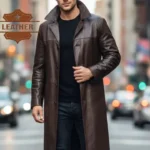
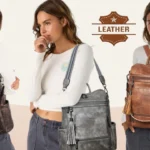
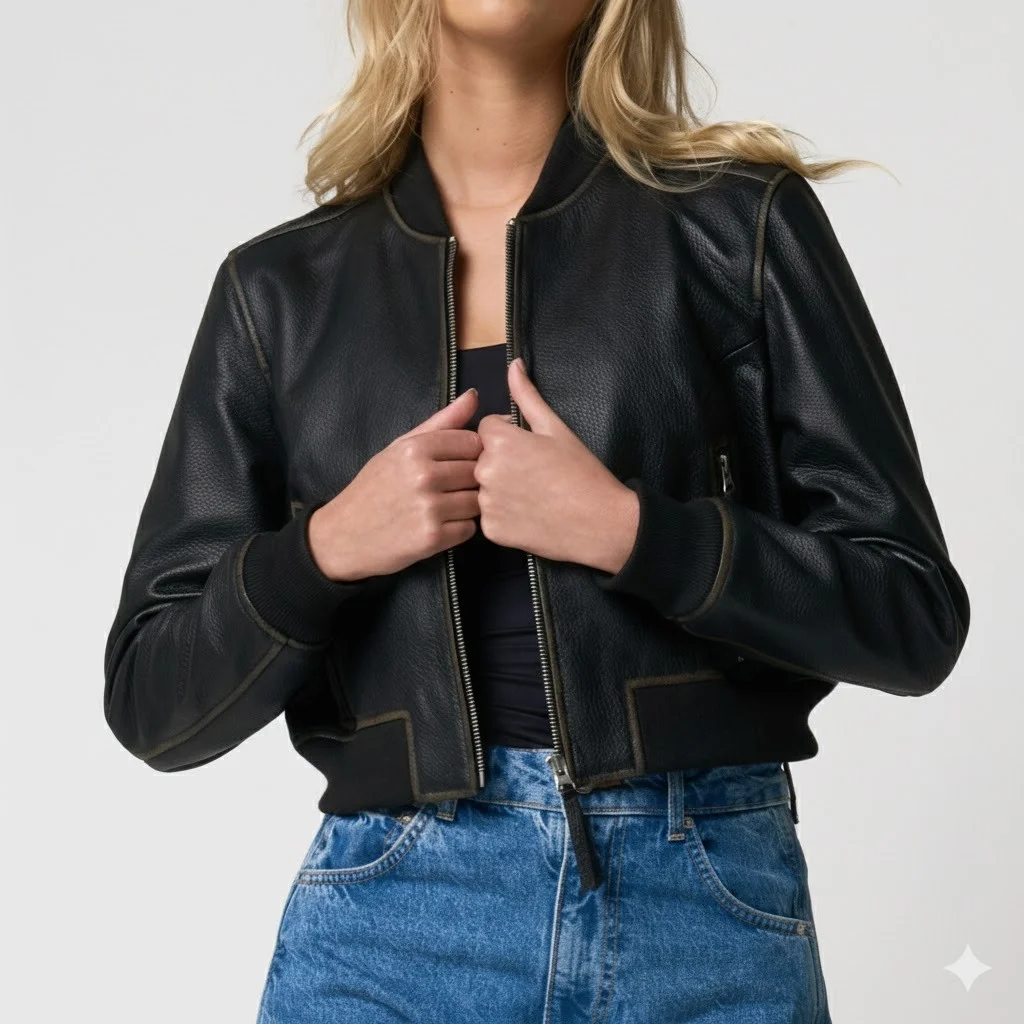
A leather bomber jacket for women is a bounded-length garment token: typically hip- or waist-length with a defined collar (ribbed or shirt-style), a front zipper (the primary operator), and ribbed or elastic cuffs/hem that act like boundary constraints on the silhouette. Historically originating as flight wear (a high-utility class), its modern instantiations form a diverse set of embeddings — from slim lambskin vectors to oversized shearling matrices and vegan substitutes. Core structural attributes that define the class: relaxed torso topology, defined hem positioning (waist/hip), front closure, and characteristic collar/cuff treatments.
Quick history timeline as sequence data
Represent the history as a compact sequence of timestamps and state transitions:
- Early 1900s (Origin state): Flight jacket prototypes created to insulate pilots in open cockpits. Functional designs emphasized warmth, mobility, and durability. Notable early forms include the A-1 and later the A-2 — the latter introduced front zips and fold-down collars that seeded the bomber silhouette.
- Post-war (Adoption state): Transition from functional uniform to civilian fashion token. Soldiers, cinema, and celebrity culture acted as external influencers that amplified adoption in daily wardrobes.
- Late 20th century to 2020s (Iteration & diversification): The silhouette diversified into many variants — bomber, moto, shearling-lined — and became a recurrent motif in streetwear and high fashion.
- 2020s–2026 (Recent epochs): Revival of heritage aesthetics (chestnut and cognac browns, oversized fits) plus stronger attention to sustainability, alternative plant-based leathers, and supply-chain transparency.
Types & variations of women’s leather bomber jackets taxonomy
Below is a concise taxonomy — think of each as a class label with defining attributes.
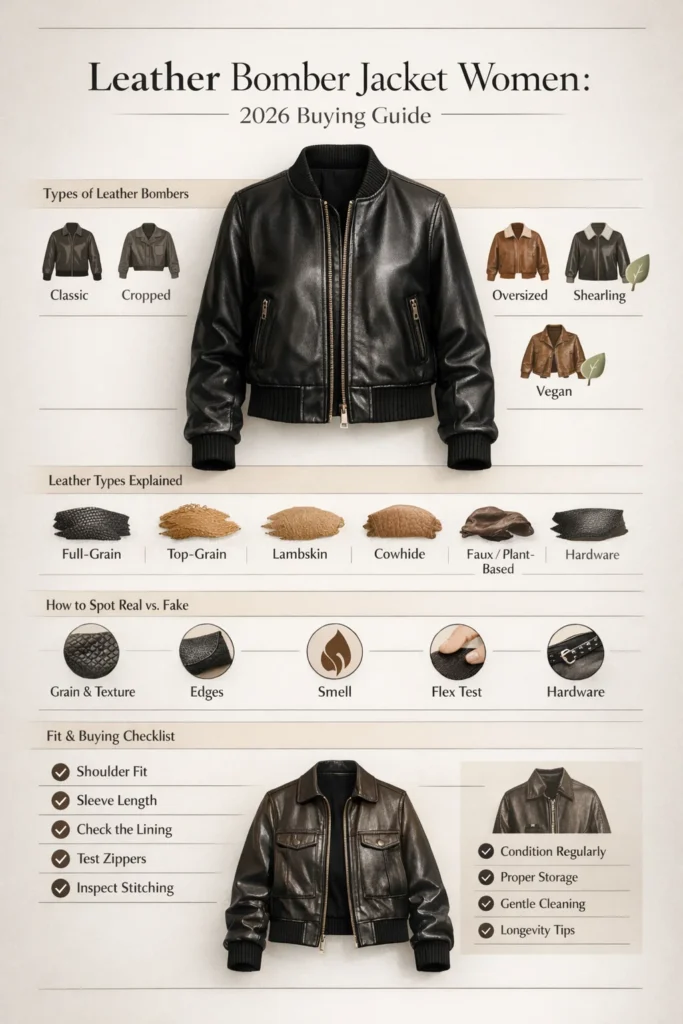
- Classic Waist-Length Bomber — hits the hip, balanced torso proportion; high versatility.
- Cropped Bomber — hem above waist; pairs well with high-waist bottoms; higher “fashion” score.
- Oversized / Boxy Bomber — roomy silhouette; modern, comfortable; emphasizes relaxed priors.
- Shearling-Lined Bomber — leather exterior + wool interior; insulation optimized for cold climates.
- Quilted or Padded Bomber — internal padding layers; thermal performance without shearling weight.
- Moto-Influenced Bomber — extra zips, reinforced shoulders; hybrid with motorcycle jacket features.
- Vegan / PU / Plant-Based Bomber — non-animal leather substitutes; varied durability profiles and sustainability metrics.
Leather types quick table & what they mean
| Leather type | Look & feel (feature) | Durability (lifetime prior) | Best for (use-case) |
| Full-grain | Natural grain; develops patina | Very high | Heirloom bombers, investment pieces |
| Top-grain | Smoothed, uniform finish | High | Premium shell with consistent appearance |
| Corrected-grain | Embossed to hide defects | Moderate–High | Mid-range jackets, uniform look |
| Genuine leather | Lower layers of hide | Moderate | Budget leather options |
| Lambskin | Buttery soft touch | Moderate (delicate) | Fashion-fitted silhouettes |
| Cowhide | Structured, heavy | Very high | Daily-wear and rugged pieces |
| Goatskin | Pebbled, flexible | High | Mobility-focused wearable pieces |
| Shearling | Leather outside, wool inside | High with care | Cold-weather luxe |
| PU / Faux leather | Synthetic imitation | Low–Moderate | Animal-free, budget options |
| Bio/plant leather | Pineapple/cactus-based | Varies | Sustainable alternative experiments |
How a leather bomber jacket is made the production pipeline
Think of manufacturing as a pipeline with stages (functions) that transform input raw hide into a finished garment output.
- Design & pattern making (specification stage) designers encode silhouette, panel layout, and pocket placements into pattern templates. These are the schema definitions for the jacket.
- Hide sourcing (data acquisition) selection of hides: full-grain, top-grain, or synthetic sheets. Provenance matters: country-of-origin influences hide characteristics.
- Tanning (transformation stage) raw hides are converted into stable material via tanning (vegetable or chrome). This affects colorfastness, flexibility, and longevity.
- Dyeing & finishing (feature augmentation) pigments and protective finishes are applied, altering surface attributes (aniline, semi-aniline, corrected).
- Cutting (material segmentation) panels are cut with yield-optimization algorithms to reduce waste. For real leather, strategic placement avoids flaws.
- Skiving & edge work (preparation) seams are thinned (skived) to ensure clean joins and reduce bulk at seamlines.
- Stitching & assembly (integration) panel seams, sleeves, and collars are sewn. Stitch density, seam types, and bar tacks are quality indicators.
- Hardware installation (functionalization) zippers, snaps, and rivets installed. Reputable jackets often use YKK zips or other robust hardware.
- Lining & insulation insertion (interiorization) lining fabrics (viscose, cotton, satin) and any padding are attached.
- Quality control (validation) grain inspection, seam testing, and hardware checks. Good QC is analogous to unit testing in software.
- Final finishing & packing (deployment) final conditioning, polishing, and boxing for retail delivery.
How to spot real leather vs fake validation heuristics
Treat this like a detective model: apply several non-destructive tests (features) to increase confidence in the “real-leather” label.
- Smell test (olfactory feature): Real leather has a complex, organic scent; faux leather smells like plastic/polymer or chemical treatments. (Online: check seller descriptions and reviews for mention of “natural leather smell” or “chemical odor”).
- Grain & texture (visual feature): Real hide displays irregular pores and natural marks; faux leather often displays overly uniform, repeating grain patterns.
- Edges (structural feature): True leather edges look fibrous; synthetic edges are smooth and homogenous.
- Flex & crease behavior (dynamic feature): Real leather creases and develops patina over repeated flex; faux often springs back and can crack.
- Label & price (meta features): A suspiciously low price labeled “genuine leather” may indicate bonded or corrected leather. Higher-quality labels will explicitly say “full-grain” or “top-grain”.
- Water absorption test (physio-chemical feature): A small drop of water will absorb gradually into real leather. Only perform if permitted or if the item is already in your possession.
- Hardware & stitching (construction features): Quality zippers, even stitches, and reinforced stress points (bar tacks) correlate strongly with genuine, well-made leather.
- Red flags (negative indicators): Strong plastic smell, perfectly uniform grain, glued seams, lightweight shell claiming premium full-grain status.
What to check before you buy the full buying checklist
Divide the checklist into Fit, Construction, Material, Practical, and Style checks — treat each as a mini-evaluation rubric.
Fit checklist
- Shoulder seam should sit at the edge of your shoulder bone.
- Sleeve length should reach the wrist when the arm hangs naturally.
- Chest/torso should permit 1–2 inches (2–5 cm) of extra room for layering.
- Hem should sit where intended (cropped vs hip-length).
Construction checklist
- Stitching: even, no loose or skipped threads.
- Zippers: run smoothly and have solid stops.
- Lining: breathable fabric (cotton/viscose) or insulated lining for colder climates.
- Reinforcements: presence of bar tacks at stress points (pockets, collar).
- Hardware: metal zips vs cheap plastic.
Material checklist
- Leather type clearly stated (lamb, cowhide, top-grain, full-grain).
- Finish type specified (aniline vs corrected).
- For vegan leather: transparent details about the composite (PU, plant-based resin, etc).
- Check for LWG audit claims or other tannery certifications for sustainability.
Practical checklist
- Return policy and warranty/repair options.
- Country of manufacture — countries with known tanneries often provide traceable quality.
- Sustainability info transparent supply-chain statements, LWG certification, or vegetable tanning claims.
Style & function
- Intended use (daily wear vs occasional).
- Climate suitability — insulated vs lightweight shells.
- Hardware color and finishes (gold vs silver) to coordinate your wardrobe.
Price ranges global price distribution
Frame prices as a probabilistic distribution across tiers:
- Budget faux / fast-fashion: $40–$150 — low lifespan, high replacement rate. Expect synthetic shells, cheap hardware, and limited reparability.
- Entry mid-range genuine leather: $180–$400 — good value for cowhide or top-grain jackets with decent construction and better closures.
- Quality premium leather: $400–$1,200 — lambskin or well-constructed cowhide with superior hardware and finishing. Often includes better lining and warranty terms.
- Designer / luxury: $1,200–$5,000+ — luxury house branding, premium hides, artisanal tannery finishing and unique details.
- Shearling-lined premium: $700–$3,000 — heavier price due to material cost and construction complexity.
Brands & countries known for good leather provenance & reputation signals
Certain countries and brands act as high-quality priors in a product recommendation model:
- Italy: Global reputation for tanning and finishing excellence—think Florence and Tuscany tanneries.
- USA: Heritage brands, classic fits, and mature repair networks.
- UK: Tailoring quality and classic silhouette knowledge.
- Spain & Portugal: Competent tanning and good price-to-quality ratios.
- Turkey, India, Pakistan: Large manufacturing hubs; quality varies by factory and brand oversight. Many reputable manufacturers operate here for mid-Range and premium private-label goods.
Care & maintenance lifecycle management to reach 10+ years
Think of leather care as a maintenance scheduler that preserves material elasticity and aesthetic appearance.
Daily & weekly micro-routines
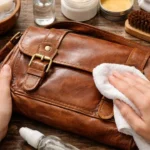
- Wipe dust and surface dirt with a soft cloth after use.
- Hang on a wide-shoulder hanger to preserve shoulder shape.
- Avoid folding for extended periods; creases can localize stress.
Conditioning & protection (bi-annual macro-ops)
- Condition leather roughly every 6 months under typical wear; adjust frequency for climate (more often in dry climates).
- Always perform a small patch test before applying any product — leather finishes vary.
- Use leather-specific conditioners and avoid household oils and solvents.
Cleaning
- Blot liquid spills immediately with a clean, absorbent cloth.
- For heavy stains or structural damage, consult professional leather cleaners — valuable jackets benefit from pro intervention.
- Avoid strong household chemicals and bleaching agents.
Storage
- Store in a breathable garment bag (100% cotton) to allow moisture exchange.
- Maintain a cool, dry environment with moderate humidity (aim ~40–50%).
- Avoid plastic bags and vacuum sealing which can induce mildew or cracking.
Repairs & restoration
- For hardware or seam issues, consult a leather repair specialist.
- For scratches and color touch-up, a professional colorist can re-dye localized areas using matching pigments.
How to style a leather bomber 10 outfit formulas
Treat these as style templates.
- Cropped bomber + high-waist jeans + ankle boots — casual polished, balanced proportions.
- Brown bomber + midi dress + loafers — boho-chic, office-appropriate.
- Oversized bomber + leggings + sneakers — modern athleisure with relaxed silhouettes.
- Shearling bomber + chunky knit + Chelsea boots — winter-proof, texture-rich layering.
- Leather bomber + silk blouse + tailored trousers — smart-casual, office-to-evening pivot.
- Black bomber + little black dress + heels — night-out with built-in edge.
- Bomber + turtleneck + straight-leg denim — cozy and stylish; neutral palette.
- Bomber with texture + neutral base — make the jacket the focal point of a minimalist outfit.
- Bomber + blazer under + trousers — layered street-luxe; smart layering for fall.
- Vegan bomber + tonal accessories — animal-free capsule wardrobe building block.
Pros & Cons
Pros
- Timeless silhouette with wide versatility across style vectors.
- Long lifespan if constructed from high-quality leather and maintained properly.
- Large range of aesthetic options and performance characteristics.
Cons
- Premium leather has a high upfront cost (higher capex vs alternatives).
- Some leathers need specialized care and environmental controls.
- Label ambiguity (e.g., “genuine leather”) can mislead buyers.
- Many faux leathers age poorly and are less repairable.
FAQs
A: Prioritize shoulder fit as the principal sizing metric. If you plan frequent heavy layering (thick sweaters, blazers underneath), consider sizing up one size. For fitted bombers designed to be sleek, choose your usual size. Cotton or viscose linings will add slight bulk; leather itself relaxes slightly over the first few wears, so minor snugness often eases.
A: Light rain usually won’t permanently damage a well-finished leather jacket if you blot it dry immediately and allow it to air-dry away from heat. Prolonged soaking can cause stains, stiffness, or fiber bonding (when poorly finished). After drying, apply a conditioner to restore suppleness.
A: Reduce sharp creasing, avoid heat, wipe clean after wear, and store properly (wide hanger, breathable bag). Use cleaners and conditioners formulated for synthetic materials. Don’t overexpose to sun, which can dry or fade polyurethane surfaces, and patch or repair seam issues early.
A: It depends. Many plant-based leathers reduce animal usage but still use polymers or resins that have environmental costs. Some plant-derived leathers (cactus, pineapple) have lower synthetic content and better life-cycle trade-offs, but durability varies. Always inspect the brand’s lifecycle disclosures when sustainability is a priority. Comparative lifecycle assessments (LCAs) are the best source for an objective answer.
Conclusion
A well-chosen leather bomber jacket is an investment-class wardrobe asset that, when selected using the feature-based approach above (fit + material + construction + provenance), will deliver style and utility for years. Prioritize shoulder fit, leather grade, and assembly quality. Always verify return and repair policies, especially for online purchases. If Sustainability matters, look for LWG certification, vegetable tanning claims, or transparent lifecycle statements. Use the printable buying checklist (above) during shopping.