Introduction
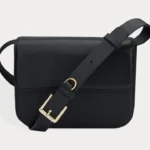
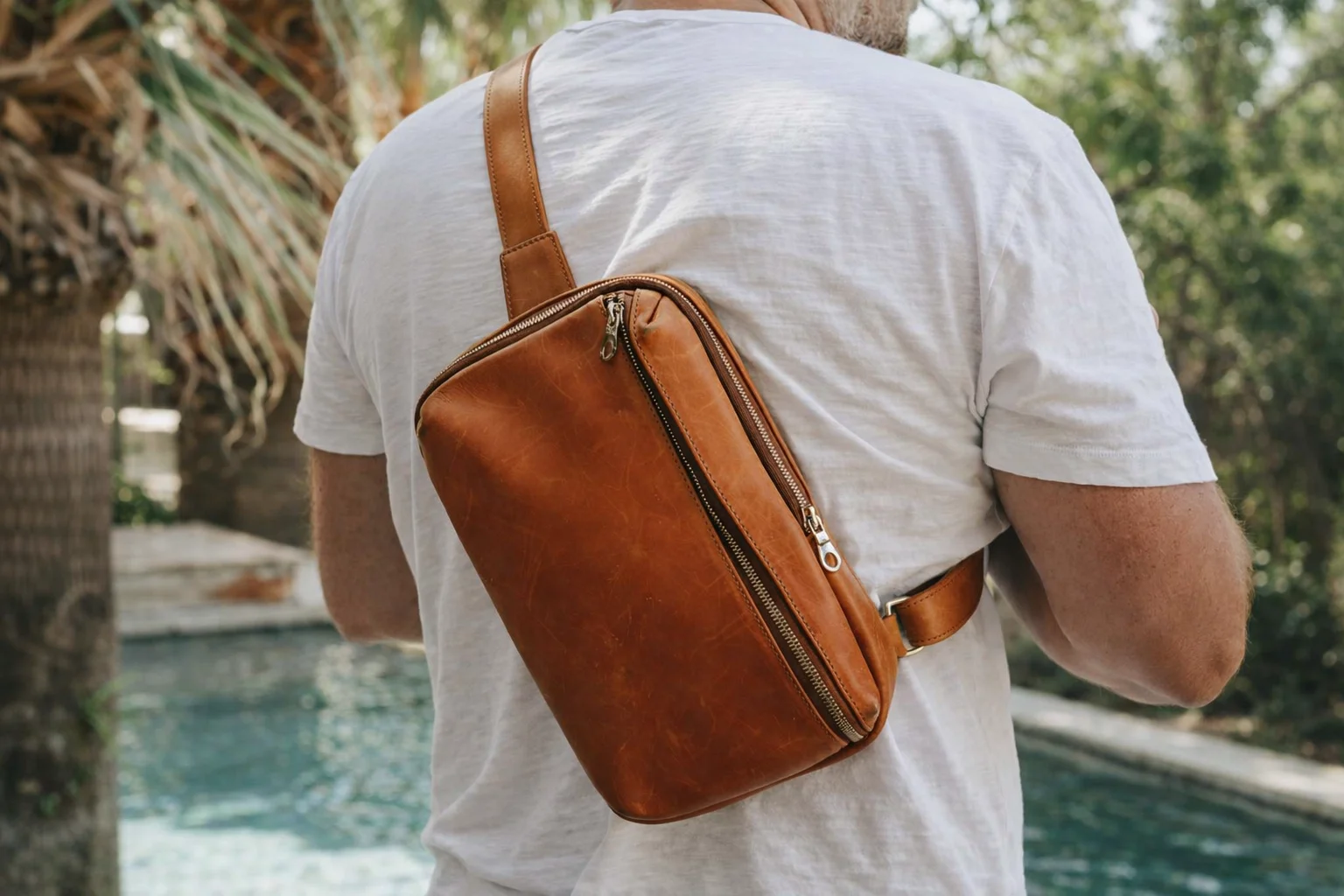
A Leather Sling Bag is a compact, single-strap bag worn diagonally across the torso. It sits on the hip or chest and swings forward for quick access to essentials. It strikes a smart balance between a wallet and a backpack: larger than a belt pack but smaller and more accessible than most crossbody bags. This 2026 guide covers everything from definitions and differences to leather types, buying tips, sizing, styling, care routines, maintenance schedules, checklists, packing ideas for daily and travel use, and more.
Read straight through or jump to sections via the table of contents below.
What is a Leather Sling Bag?
A leather sling bag is a compact bag with a single strap, worn diagonally across the body. It typically rests on the hip or chest for instant access to items like your phone, keys, cards, or passport. Compared to crossbody bags, slings are often smaller, more streamlined, and optimized for quick retrieval. When made from leather, it offers a refined, tactile appeal with warmth and longevity when maintained properly.
Short History From Utility to Fashion
The sling design traces back to practical tools used by couriers, messengers, and soldiers for fast access. Over time, designers transformed this utility into fashion. From minimalist designs to structured boxy styles, soft luxury pieces, and “quiet luxury” options, slings have evolved into versatile statements for commuters, cyclists, travelers, and urban style enthusiasts.
Leather vs Other Materials — Why Choose Leather
Pros
- Premium appearance that develops an attractive patina over time.
- High durability, especially in full-grain and top-grain leathers.
- Repairable — many issues can be fixed by a professional.
- Timeless style that complements casual and smart outfits.
Cons
- Heavier than nylon or polyester.
- Needs regular maintenance like cleaning and conditioning.
- Not inherently waterproof (unless waxed or treated).
For ultra-light or fully waterproof needs (e.g., heavy outdoor use), technical nylon or coated fabrics may suit better. But for an accessory that ages gracefully and remains repairable, leather excels.
Anatomy of a High-Quality Leather Sling Bag
Inspect these key elements
- Material & Leather Type — Full-grain (strongest, natural marks, best patina); top-grain (uniform, high quality); corrected/genuine (lower durability); PU/vegan (synthetic, shorter life).
- Hardware & Zippers — Solid metal (brass/stainless) for corrosion resistance; reliable brands like YKK for smooth, repairable performance.
- Stitching — Tight, even, with reinforcements at stress points.
- Lining — Durable fabrics like cotton twill or nylon to protect contents and prevent dye transfer.
- Strap — Wide and padded for comfort; strong anchors and secure buckles.
- Edge Finish — Burnished or painted to prevent fraying and ensure clean lines.
How to Choose the Best Leather Sling Bag — Quick Checklist
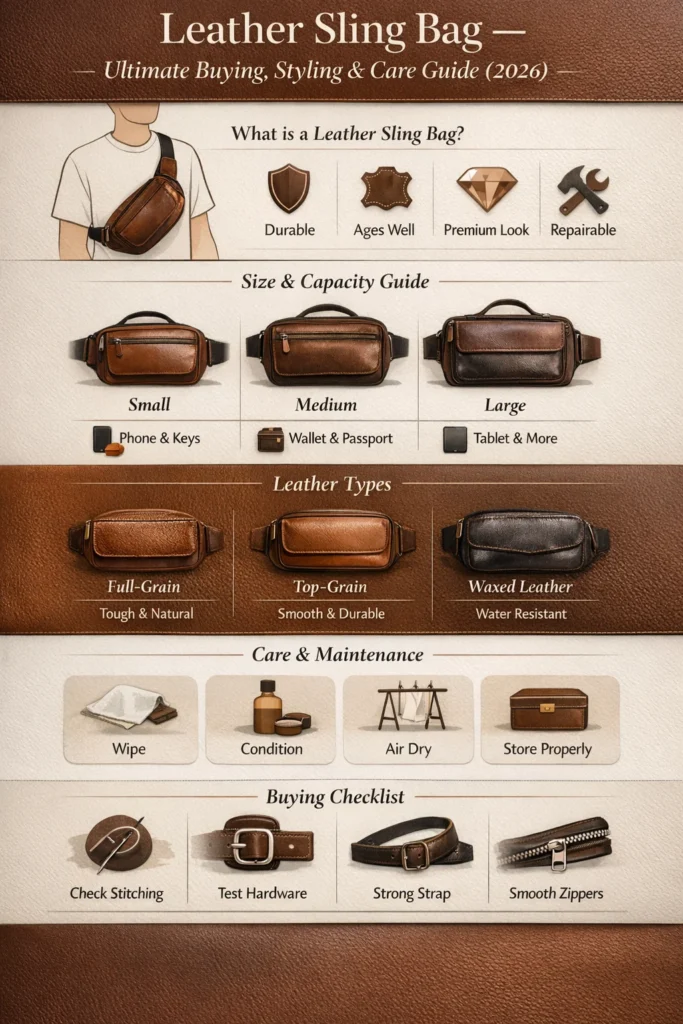
Consider your needs
- Primary use (daily, travel, style-focused)?
- Items to carry (measure phone, passport, etc.)?
- Wear position (front for access, back for discretion)?
- Climate (waxed for rain)?
- Budget (align with leather grade)?
Shopping action steps
- Confirm leather type (prefer full-grain/top-grain).
- Check stitching and strap anchors.
- Test zippers/buckles.
- Match internal dimensions to your items.
- Inquire about warranty/repairs.
- Smell test: real leather has an organic scent; synthetics smell chemical.
Size & Capacity Guide — What Fits
Use this as a rough reference
- Small (0.5–1.5 L, ~18×11×4 cm) — Phone, cards, keys, lip balm.
- Medium (1.5–4 L, ~22×14×6 cm) — Phone, wallet, passport, power bank.
- Large (4–8 L, ~28×18×8 cm) — Small tablet (e.g., iPad Mini), slim notebook, travel docs.
Tip: Place heavier items close to your body; use pouches for organization.
Styles & How to Wear Them
- Minimal compact — Clean lines for a smart city look.
- Box sling — Structured flap top for smart casual.
- Slouchy sling — Soft leather for relaxed weekends.
- Tactical/tech — Mixed materials/pockets for gadgets.
- Designer statement — Logos/unique shapes for fashion-forward vibes.
Pairing ideas: Dark brown/black full-grain with neutrals for quiet luxury; small chest-high slings for streetwear boldness.
How Leather Type Affects Performance
- Full-grain — Top strength/longevity; natural marks deepen with patina; condition regularly, avoid soaking.
- Top-grain — Good Performance, cleaner surface; easier to clean, occasional conditioning.
- Vegetable-tanned — Robust, rich color development; avoid excess oils/sun.
- Corrected/bonded — Lower performance; prone to peeling.
Tanning (chrome vs vegetable) and dye (aniline vs semi-aniline) influence aging and care.
Manufacturing & Craftsmanship — How a Sling is Made
Artisan process steps
- Hide selection (grade/origin key).
- Tanning (chrome fast; veg traditional/slower).
- Cutting to minimize waste.
- Edge finishing (burnishing/painting).
- Assembly (stitching, rivets, lining).
- Finishing (dyeing, waxing, hardware).
- Quality checks (zippers, straps, stitches).
Brands disclosing origins/tanning build trust.
Spotting Real vs Fake Leather
Real cues — Organic smell; irregular grain; warm touch; fibrous suede-like back; subtle darkening with a water drop; grain changes on bend.
Fake cues — Uniform repeated grain; chemical smell; peeling/flaking; instant water beading.
Use tests cautiously.
Care & Maintenance
Daily/Weekly — Wipe with a soft dry cloth; avoid overstuffing.
Monthly — Apply neutral conditioner (sparingly) to full/top-grain.
If wet — Blot, air dry naturally (no heat); re-wax treated leather.
Stains — Oil: cornstarch overnight, brush, condition; mud: dry then brush; ink: professional help.
Deep clean (6–12 months) — Empty/vacuum; mild cleaner (spot test); condition after.
Storage — Breathable dust bag; stuff with acid-free tissue; avoid sun/humidity.
Repairs — Stitches/tears/hardware are often fixable professionally.
Rule: Clean as needed, condition regularly (not excessively), protect from moisture.
Price Ranges & What to Expect (2026 Snapshot)
- Budget ($20–$80) — PU/bonded; short lifespan.
- Entry ($80–$200) — Corrected/decent top-grain.
- Mid ($200–$500) — Full-grain/high-quality top-grain; solid hardware.
- Luxury ($500+) — Premium hides, artisanal details, strong warranties.
Mid-range full-grain often delivers the best value/durability/style balance. In 2026, quality Italian leather options start around $90–$100 for standout pieces.
Top Countries & Brands Known for Leather Slings
- Italy — Refined tanning/finishing (e.g., Florence/Tuscany influences in brands like Quince Italian Leather options).
- United Kingdom — Heritage veg-tanning.
- USA — Modern/quiet-luxury ateliers (e.g., Latico Leathers, Portland Leather).
- India & Pakistan — Skilled artisans, competitive quality.
- China & Vietnam — Volume from budget to premium.
Prioritize transparent brands on origins/tanning.
Who Should Use a Leather Sling Bag?
Ideal for: commuters (quick phone/wallet access); travelers (passport/docs); fashion enthusiasts (polished accessory); students (essentials like notebook/phone/keys).
Less ideal for: heavy loads (prefer backpack); constant heavy rain (unless waxed/treated).
Buying Checklist — Step-by-Step
- List/measure daily items.
- Compare to internal dimensions.
- Balance leather grade with budget.
- Inspect stitching/edges/anchors.
- Test zippers/buckles.
- Check Warranty/repair policy.
- Choose retailers with good returns.
- Add protective spray/wax for wet areas.
Decision Table
| Use Case | Option A: Full-grain | Option B: Waxed Travel | Option C: Budget PU |
| Price | $200–$350 | $150–$250 | $25–$60 |
| Durability | Very high | High water resistance | Low |
| Best for | Daily premium use | Travel in the rain | Occasional fashion |
| Maintenance | Moderate | Low–moderate | Very low |
Packing Examples & Use Cases
- Every day (medium) — Phone, wallet, keys, earbuds, mini notebook, pen, lip balm.
- Travel light (large) — Passport, slim wallet, phone, power bank, boarding pass, earphones.
- Night out (small) — Card holder, phone, lipstick, keys.
Use internal pouches for cords/batteries to prevent scratches/organization issues.
Comparison: Leather Sling vs Canvas/Nylon Sling
| Feature | Leather Sling | Canvas/Nylon Sling |
| Aesthetics | Premium, patina | Sporty, casual |
| Weight | Heavier | Lightweight |
| Water resistance | Lower (unless treated) | Often high |
| Repairability | High | Moderate |
| Price | Medium–High | Low–Medium |
| Best for | Style & longevity | Performance & weather |
FAQs
A: Yes, especially for short trips as a secure spot for passport/phone. Opt for medium/large with zip pockets and anti-theft features.
A: With proper care, full-grain versions often last a decade or more, depending on use, grade, and maintenance.
A: They handle light moisture but suffer if soaked. Waxed or treated versions perform better; dry gently and reapply wax.
A: Every 3–6 months for regular use (adjust for veg-tanned per manufacturer).
A: Not exactly — slings are typically smaller and positioned higher for faster access; crossbodies often hang lower and are larger.
Conclusion
For a compact bag that ages beautifully and delivers years of use, choose a full-grain leather sling bag. A medium full-grain in the $150–$400 range offers the ideal mix of Quality, durability, and value in 2026. Focus on verified leather, sturdy hardware, and reinforced anchors — these outperform logos. Measure essentials first, set your budget, and match it to your routine. For rainy areas, prioritize waxed/treated options or hybrid weatherproof linings. Invest wisely, maintain it, and enjoy a timeless piece.