Introduction
Buying a Long Leather Jacket is similar to constructing a high-performing NLP model: gather quality data (style inspiration and references), select optimal representations (leather type as your core feature space), preprocess thoughtfully (fit adjustments, lining choices, hardware), and evaluate the final output (comfort, durability, and everyday versatility). A long leather jacket—often termed a longline coat, duster, leather trench, or extended overcoat—features a hemline that falls below the hips, typically reaching mid-thigh, knee, or calf. This added length transforms the garment’s overall profile, influencing silhouette balance, drape dynamics, movement, and layering potential.
What Is a Long Leather Jacket?
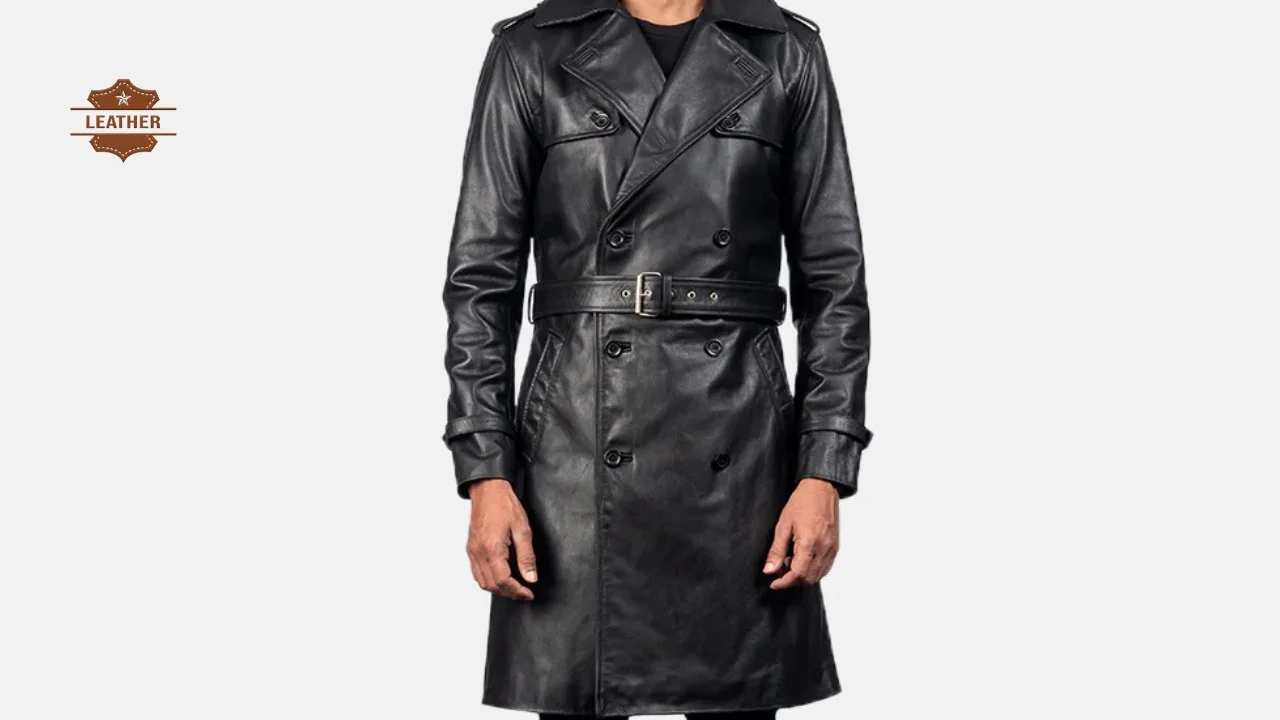
A long leather jacket refers to any leather outerwear with a hem below the hip line—most commonly extending to mid-thigh, knee, or calf. In classification terms, length serves as the primary distinguishing attribute within the broader leather outerwear category. It can resemble a structured trench (with belt and notched lapels), a relaxed duster (loose and fluid), a precise midi coat (tailored lines), or a substantial overcoat (insulated for warmth).
Common use-case categories include
- Style-focused / urban wear — tailored trench styles.
- Layering/casual streetwear — lightweight dusters or elongated cuts.
- Warmth / colder regions — fully lined, insulated long coats.
Brief History
The origins trace back to early 20th-century military greatcoats and trench designs, plus Western-style dusters worn by riders for protection against dust. Over decades, these evolved through cultural influences like film noir, motorcycle culture, and rebellious icons. Today, modern runways and street style reinterpret longline silhouettes with contemporary touches—structured shoulders, mixed-material panels, and advanced weather-resistant treatments—for city sophistication and functional outerwear.
Main Types — Comparative Overview
Use this feature-style table to quickly compare popular long leather jacket variations:
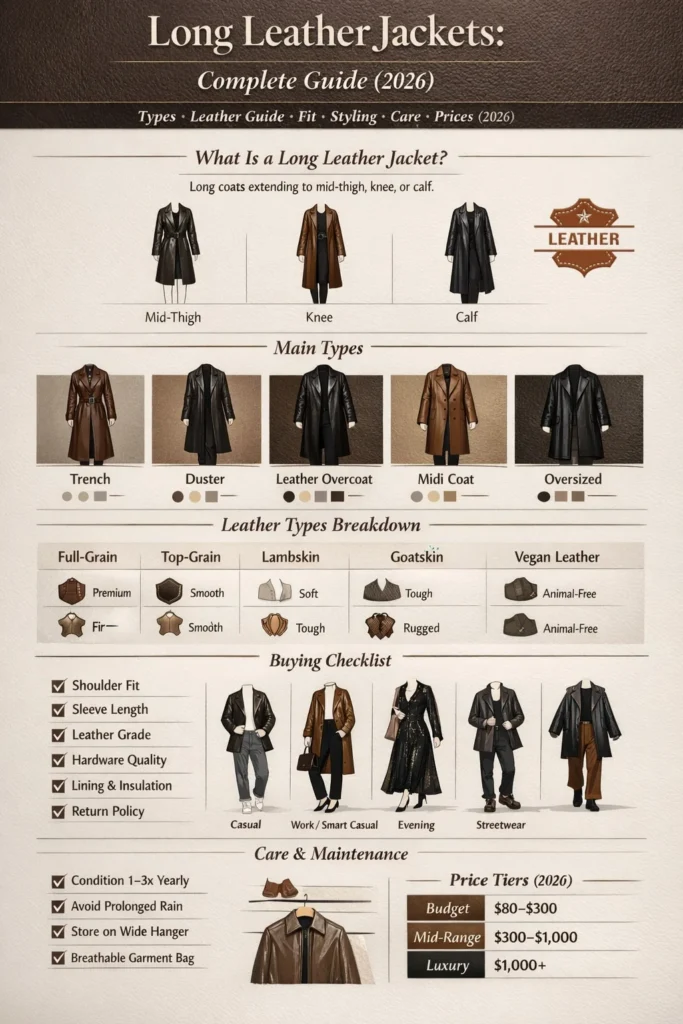
- Trench — Structured silhouette; Knee to calf length; Ideal for polished city looks; Signature elements: belted waist, lapels.
- Duster — Loose and flowing; Mid-thigh to calf; Great for layering and effortless street style; Key trait: lightweight drape.
- Leather Overcoat — Heavy and warm; Knee to calf; Suited to cold weather and formal occasions; Features: full lining, insulation.
- Midi Jacket — Tailored fit; Mid-thigh; Highly versatile; Clean lines with hem just below the hip.
- Oversized Longline — Boxy shape; Varies; Trend-driven streetwear; Dropped shoulders for a relaxed vibe.
- Belted Longline — Defined waist; Varies; Flattering for many shapes; Adjustable belt for customization.
- Hybrid Styles — Mixed materials; Varies; Functional casual wear; Textile inserts, hoods, or panels.
Quick recommendation: Opt for a trench if seeking a timeless investment piece; select lambskin or goatskin dusters for superior drape and easy layering.
Leather Types — Feature Space Breakdown
Leather varieties can be viewed as a multidimensional space, with each type scoring differently on softness, durability, drape, weight, upkeep needs, and patina development.
- Full-Grain Leather — Premium choice; Retains natural grain; Extremely durable; Builds rich patina over time (high-value, evolving “embedding”).
- Top-Grain Leather — Lightly sanded for uniformity; Softer feel; Strong durability with less natural character.
- Corrected-Grain / Genuine Leather — Budget-friendly real leather; Surface-treated for an even look; Reduced longevity.
- Lambskin — Ultra-soft; Beautiful fluid drape; Lower resistance to wear; Perfect for elegant dusters and luxury trenches.
- Goatskin — Lightweight yet tough; Attractive natural grain; Balanced for structured yet mobile longlines.
- Cowhide / Steerhide — Heavier and rugged; Ideal for insulated overcoats and sturdy trenches.
- Suede / Nubuck — Velvety nap finish; Soft but delicate; Less weather-resistant.
- Faux / Vegan Leather (PU, PVC, bio-based) — Animal-free; Varying water resistance; No natural patina; Different aging profile.
Best matches: Full-grain or top-grain for lasting structure; lambskin/goatskin for graceful flow; high-end vegan options for ethical or budget priorities.
Manufacturing Process — Step-by-Step Pipeline
Quality production mirrors model development stages:
- Hide selection and grading (curate high-quality raw data).
- Tanning (chrome or vegetable methods for stability).
- Dyeing and fatliquoring (tune color and softness).
- Splitting and shaving (normalize thickness).
- Pattern making and cutting (optimize usable material).
- Edge preparation and skiving (smooth for clean seams).
- Assembly and stitching (reinforce high-stress areas).
- Lining and interfacing (add structure or warmth).
- Hardware attachment and finishing (zips, belts, polishing).
- Final quality inspection (fit, function, and visual checks).
Hand-finishing remains common in artisanal workshops, while factories rely on automation.
How to Spot Real Leather vs. Faux — Authenticity Classifier
Combine these checks for reliable classification:
- Label and transparency — Reputable Brands disclose grade and source.
- Smell — Real leather has a natural hide scent; faux often smells synthetic.
- Grain texture — Genuine shows natural variations; faux patterns repeat.
- Edge inspection — Real leather reveals fibrous layers; faux is uniform and smooth.
- Wrinkle test — Real leather creases naturally and darkens slightly; faux snaps back uniformly.
- Tiny water droplet test — Real absorbs slowly; faux beads (test discreetly).
Extra clues: Realistic pricing for claimed grade, warranties, reviews, and certifications (e.g., Leather Working Group).
Buying Checklist — Key Inspection Points
Score these factors when evaluating:
- Desired silhouette (trench, duster, overcoat, etc.).
- Stated leather type and grade.
- Shoulder alignment (critical fit anchor).
- Sleeve and chest ease for layering.
- Hardware durability (zips, snaps, buttons).
- Stitching quality and reinforcements.
- Lining/insulation type.
- Return policy, warranty, and care details.
- Sustainability certifications and origin.
- High-resolution photos of seams, grain, and details (online shopping).
Fit and Sizing Guidelines — Tailor to Your Silhouette
Fit determines overall impact:
- Shoulders — Seam should align with your natural shoulder edge.
- Sleeves — Reach wrist bone (or slightly beyond for layers).
- Chest/torso — Room for sweaters without sagging.
- Length — Petite: mid-thigh preferred; Tall: knee-calf for elegance.
- Belted options — Enhance waist definition.
- Movement check — Test sitting, reaching, walking for comfort.
- Layering trial — Wear with your bulkiest sweater.
Styling Ideas — Outfit Use-Cases
- Casual Daily — Women: Midi trench + jeans + boots + sweater. Men: Overcoat + crewneck + tapered jeans + boots.
- Smart-Casual / Work — Belted trench + trousers + shirt + loafers or Chelseas.
- Evening — Leather coat over dress/skirt + heels.
- Streetwear — Oversized duster + wide-leg pants + sneakers or combats.
Body-type tips: Petite — shorter longlines + belt; Tall — full lengths; Curvy — belted/single-breasted; Athletic — flowing dusters.
Mix textures (leather + knit + denim) for depth.
Care and Maintenance — Routine Protocols
- Daily — Hang on wide hanger; Avoid sun/damp; Brush dust.
- Spot cleaning — Damp cloth or type-specific cleaner (test first).
- Conditioning — 1–3 times yearly with products like Bick 4 or Leather Honey.
- Waterproofing — Apply leather-specific protectant; Dry naturally after rain.
- Professional — For deep cleaning or repairs.
- Storage — Breathable bag; Stuff sleeves; Use cedar blocks.
Price Tiers and Expectations (USD, 2026)
- Budget — $80–$300: Often faux or entry-level; Shorter lifespan.
- Mid-range — $300–$1,000: Solid top-grain; Good construction.
- High-end — $1,000–$4,000+: Full-grain; Premium details.
- Bespoke — $2,000–$10,000+: Custom, top hides.
Italy/Spain excel in craftsmanship; Turkey/Eastern Europe offer Value; South Asia varies widely.
Top Countries and Brands
Strong regions: Italy (tanning heritage), Spain/Portugal (quality/price balance), Turkey/Eastern Europe (capability), Pakistan/India/Bangladesh (volume), US/UK (heritage).
Notable brands: Burberry (trench heritage), Max Mara (luxury coats), Mackage/Acne Studios/The Row (contemporary), Zara/Mango/Quince (accessible seasonal options).
Pros and Cons
Pros
- Striking, elegant silhouette
- Added warmth and coverage
- Adaptable from casual to formal
- Quality pieces last decades with beautiful patina
Cons
- Higher investment for premium options
- Demands regular care
- Ill-fitting can overwhelm proportions
- Faux versions often lack longevity
FAQs
A: Yes—especially structured overcoats and lined versions. Heavier hides like cowhide/steerhide with quilted insulation excel in cold weather.
A: Shoulders align naturally; Allow layering room in chest/arms without excess; Hem complements height and style goals.
A: Light rain is fine with treated leather, but avoid prolonged exposure. Apply waterproofing and air-dry slowly.
A: Yes, for ethics or budget—high-quality PU looks stylish. Note, they won’t patina like full-grain and may wear faster.
A: $400–$1,500 gets a reliable, well-made piece. Luxury exceeds this—focus on construction and materials over price alone.
Conclusion
A long leather jacket is more than a seasonal trend — it’s a timeless outerwear investment that combines style, function, and Longevity. With its extended length and strong silhouette, it offers better coverage, a more refined look, and endless styling flexibility compared to shorter jackets.