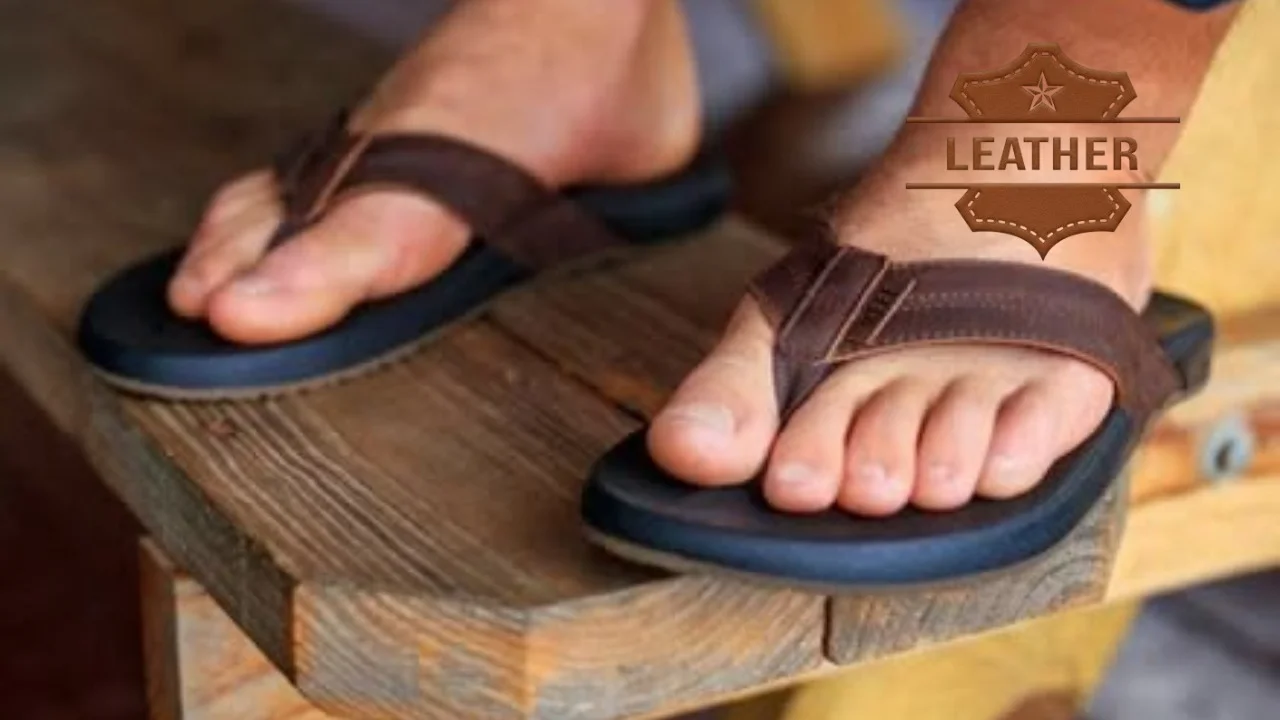
Leather Flip Flops Men
Leather Flip Flops For Men are no longer just beach footwear. In 2026, the best pairs can work for travel, errands, resort wear, and easy smart-casual looks when the leather, footbed, and outsole are all built well. That is exactly why this keyword deserves more than a simple product list. The live market already shows demand for leather-based designs with arch support, contoured footbeds, and better traction, but most pages still stop at “top pick” and never explain what makes one pair truly worth buying.
The real decision is not just “leather or not.” It is about which leather type you are buying, how the sandal supports your foot, how fast it breaks in, and whether it can handle heat, sweat, and occasional water exposure without falling apart. Good leather flip flops can age beautifully and feel better over time, but poor construction can mean slipping, rubbing, cracking, and disappointment. This guide breaks down the difference in plain English so readers can choose with confidence.
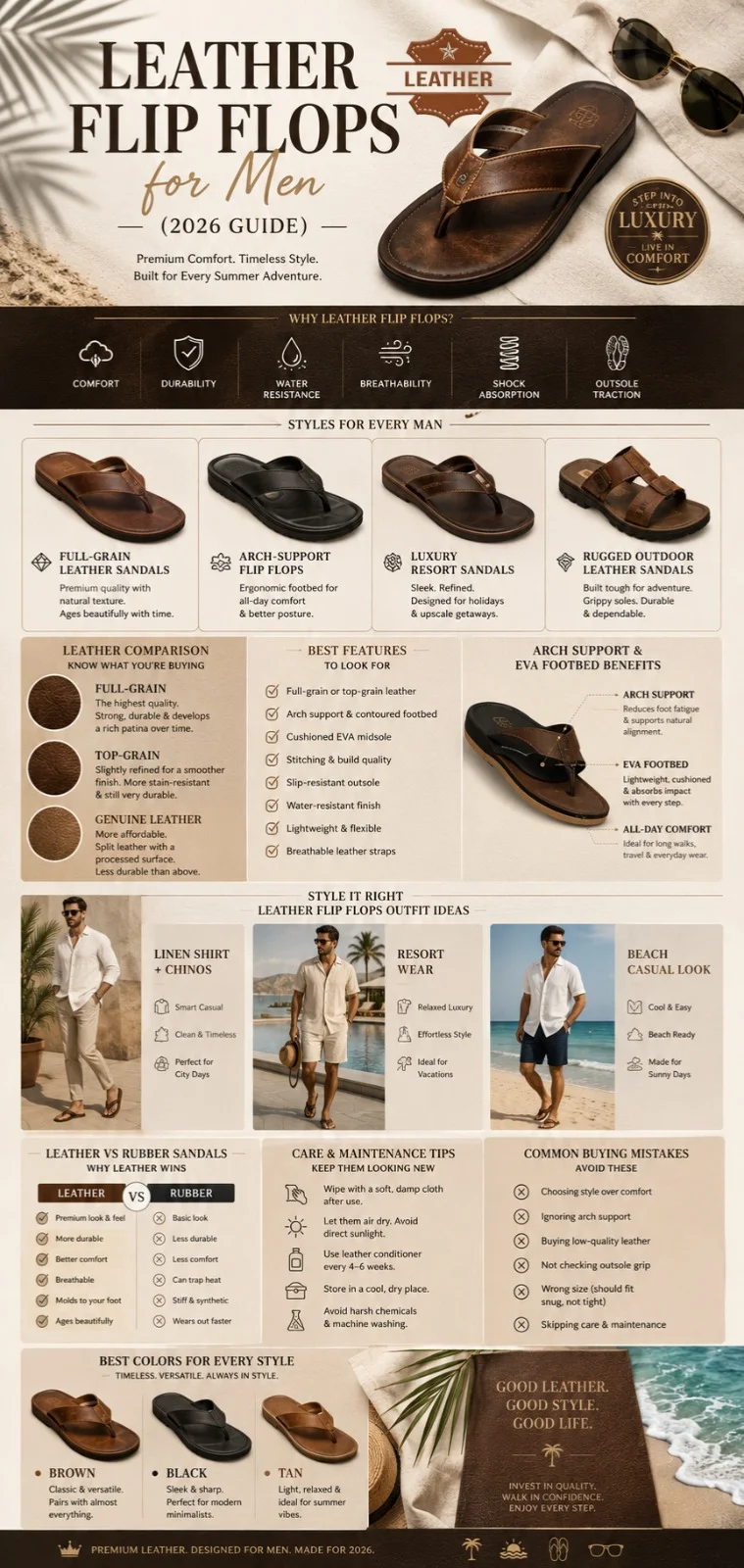
What Are Leather Flip Flops for Men?
Leather flip flops are thong-style sandals that use leather somewhere in the upper, strap, insole, or footbed build. In the current market, brands often combine leather with comfort-driven parts like arch support, EVA or foam cushioning, and rubber outsoles so the sandal feels more stable than a basic flat beach flip flop. Hari Mari highlights nubuck leather straps with memory foam core and molded rubber soles, Chaco uses a full-grain leather upper with LUVSEAT arch support and a rubber traction outsole, Rainbow sells top-grain nubuck leather models, and Birkenstock’s Arizona oiled leather is built around a contoured support footbed.
That is the big reason leather versions have a stronger style ceiling than cheap rubber pairs. They look more refined, age more naturally, and can move from beach to café to airport lounge with far less visual friction. Current fashion and gear coverage keeps placing leather models near the top of men’s sandal lists for exactly that reason.
Why Leather Flip Flops Matter in 2026
In 2026, buyers want footwear that does more than one job. They want sandals that feel good, photograph well, travel well, and last longer than a season. That is why leather flip flops continue to hold a premium place in the men’s sandal market. Live product pages and reviews keep emphasizing support, comfort, and all-day usability, while style coverage keeps pairing leather sandals with summer tailoring and resort outfits.
The other reason they matter is value. A well-made leather pair may cost more upfront, but it can deliver better aging, a more polished look, and stronger long-term wear than disposable foam sandals. Brands like Birkenstock explicitly frame oiled leather as something that looks better with wear, while Rainbow and Hari Mari position their leather lines around durability and comfort rather than throwaway fashion.
Leather Types Used in Men’s Flip Flops
| Leather type | What it means | Best for |
| Full-grain leather | The highest-grade layer of the hide, left intact and not sanded smooth; it is strong, breathable, and develops patina over time. | Premium sandals, long-term wear, natural aging |
| Top-grain leather | A refined leather with the surface sanded for a smoother finish; it is more uniform and often more resistant to stains, but less breathable and less likely to develop a strong patina. | Cleaner-looking sandals, mainstream premium pairs |
| Genuine leather | A broad, ambiguous label; it can mean lower-grade split leather or, in some cases, a real leather product, so the term alone does not guarantee quality. | Budget-conscious buyers who still want real leather, but only if the grade is disclosed |
| Nubuck leather | A top-grain leather that is buffed or sanded for a soft, velvety finish. Several men’s sandal brands use nubuck because it feels premium and wears well. | Soft, matte, upscale casual looks |
| Suede | A soft, napped leather made from the underside of the hide; it feels luxe but is usually more porous and more sensitive to water and staining. | Fashion-led sandals, dry conditions |
| Faux / PU leather | Not real hide leather; often used for lower cost and easier cleaning, but it usually lacks the aging quality and long-term character of real leather. | Low-cost fashion pairs |
Mini summary: For the best men’s leather flip flops, full-grain is the strongest choice, top-grain is the safest mainstream premium choice, and genuine leather should only be trusted when the product page clearly explains what it actually means.
Why Leather Beats Cheap Rubber for Many Buyers
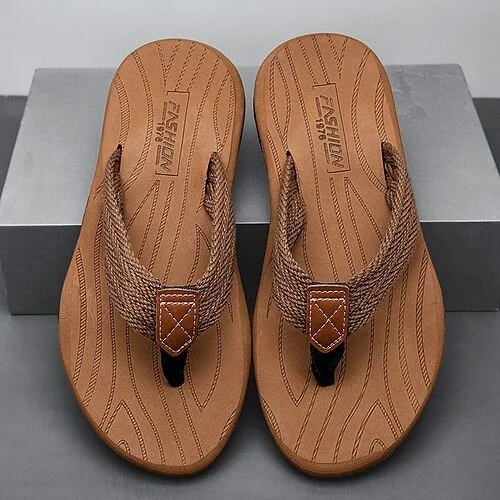
Leather flip flops usually win on appearance, aging, and long-term comfort. Premium Leather can soften and mold better over time, while quality footbeds and support systems reduce the “flat, floppy” feeling many basic sandals have. Brand and review pages repeatedly point to contoured support, arch support, and better traction as the features that separate real daily-wear sandals from throwaway beach pairs.
Pros
- More refined look for travel and casual dinners.
- Better aging if the leather is high-grade.
- Better support when the footbed is contoured.
- Often more versatile than sporty foam sandals.
Cons
- Usually more expensive.
- Can require break-in time.
- Water and sweat can damage certain leathers faster than synthetic materials.
How Leather Flip Flops Are Made
- The hide is selected and graded. Higher-quality sandals usually start with better leather grades, especially full-grain or top-grain.
- The leather is tanned. The Leather Working Group notes that modern tanning may use chrome tanning for supple, water-resistant, durable leather, or vegetable tanning for a richer, more organic character.
- The leather is cut into straps, uppers, or footbed panels. This is where consistent cutting matters because thin or badly cut leather can stretch unevenly. This is a practical inference from the way premium brands specify their leather parts and construction.
- Comfort layers are added. Many premium models use memory foam, EVA, cork, or sculpted support footbeds. Hari Mari, Chaco, and Birkenstock all highlight comfort-focused construction.
- The outsole is bonded or stitched. Rubber outsoles and traction patterns are common in better models because they improve grip and wear.
- The sandal is finished and tested. This includes edge finishing, strap alignment, fit, and walkability. Current review coverage makes clear that sizing, break-in, and traction are not minor details; they affect the final wearing experience.
How to Identify Original Leather vs Fake Leather
Real leather is usually easier to spot when you know what to look for. Picard notes that genuine leather often has an uneven natural grain, small pores, fibrous cut edges, a warm, soft feel, and a distinctive leather smell, while artificial leather tends to look more uniform, feel cooler or stiffer, and show smoother cut edges.
Quick checklist
- Look at the grain. Natural grain is rarely perfectly uniform.
- Check the cut edges. Real leather usually looks fibrous or rougher.
- Feel the surface. Real leather often feels warm and soft rather than cold and plastic-like.
- Smell the material. A strong plastic odor is a warning sign.
- Read the label carefully. “Genuine leather” is not always a quality guarantee.
Snippet-ready answer: Real leather usually shows natural grain, fibrous edges, and a warm, soft touch, while fake leather looks more uniform and often smells like plastic.
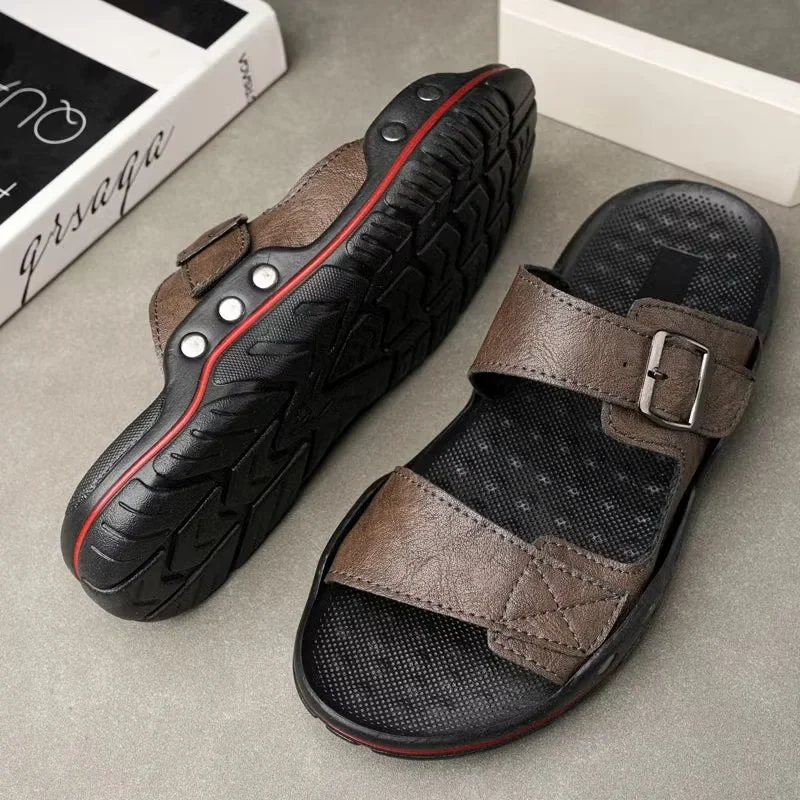
What to Check Before You Buy
| Buying check | Why it matters | What to look for |
| Arch support | Support reduces foot fatigue on longer wear. Review pages repeatedly highlight arch support as a key difference. | Contoured footbed, visible arch shape, LUVSEAT-style support, molded support |
| Toe-post comfort | The toe post can make or break comfort in thong sandals. Hari Mari even builds a patented MemoryFoamToe post into its Fields line. | Soft post, no hard edges, no friction points |
| Footbed cushioning | Cushioning affects shock absorption and all-day wear. | EVA, memory foam, cork, molded rubber, foam layer |
| Outsole grip | Traction matters on wet sidewalks, pool decks, and travel days. | Rubber outsole, textured tread, non-marking sole |
| Fit and sizing | Several reviewers mention sizing quirks, especially in leather pairs. | Secure straps, stable heel position, no toe overhang |
| Water exposure | Some leather sandals are beach-friendly, but not ocean-safe forever. OluKai explicitly warns that prolonged contact with water may cause damage. | Water-safe use only when the brand says so |
Best Leather Flip Flop Styles for Men
Classic leather thong sandals
These are the cleanest and most versatile. They work for beachwear, weekend errands, and simple summer outfits. Rainbow and Hari Mari both lean into this easygoing, everyday lane.
Arch-support leather sandals
This is the best choice for buyers who actually walk. Chaco, Birkenstock, and Rainbow all show how a support-focused footbed can turn a flip-flop into a much more usable daily sandal.
Luxury resort leather flip flops
These are the Style-First Pairs. They usually use premium leather, a cleaner silhouette, and a more polished finish. OluKai’s Mea Ola is a good example of a premium leather beach sandal with a strong heritage story and a refined look.
Rugged outdoor leather sandals
These are for travelers and outdoor walkers who still want a leather look. Chaco’s leather flip flop and similar outdoor-leaning designs focus on traction, support, and durability instead of pure minimalism.
How to Style Leather Flip Flops for Men
Leather flip flops look best when the rest of the outfit feels intentional. Style coverage around men’s sandals keeps pointing toward relaxed tailoring, travel looks, beach looks, and resort wear rather than formal clothing.
Easy outfit formulas
- Linen shirt + tailored shorts + leather thong sandals.
- Polo shirt + chinos + brown leather flip flops.
- Cuban collar shirt + lightweight trousers + tan leather sandals.
- Simple tee + drawstring resort pants + premium leather flip flops.
What not to wear
- Formal suits
- Business meetings
- Heavy athletic gear
- Anything that looks like you grabbed beach footwear by accident for a dressed-up event
Mini summary: The goal is not to make leather flip flops “fancy.” The goal is to make them look clean, deliberate, and seasonally appropriate.
Are Leather Flip Flops Comfortable for Walking?
Yes, but only when the design is right. Reviewers consistently reward pairs that combine arch support, shaped footbeds, supportive midsoles, and good traction. OutdoorGearLab highlights leather footbeds that mold to the feet and notes break-in behavior. The Inertia praises the comfort and arch support of a full-grain leather upper with a supportive footbed, and People calls out arch support, comfort, and traction in its top picks.
The important caveat is that not every leather flip-flop is a long-walk sandal. A flat leather thong with no contour may look great, but still fatigue the foot. The best walking-ready pairs are the ones with contoured support, a secure fit, and a non-slip outsole.
Best for walking: arch-support leather flip flops, contoured footbed designs, and leather sandals with rubber traction outsoles.
How Long Do Leather Flip Flops Last?
Lifespan depends on leather grade, outsole quality, how much you sweat, and whether the pair gets soaked often. Brands themselves give clues here: Rainbow markets leather sandals with warranty and repair-related messaging, Hari Mari says its leather Fields are built to last but should be spot-cleaned and dried indoors, and OluKai explicitly warns that prolonged water exposure may damage the sandal.
In practical terms, a well-made pair used carefully in summer can last a lot longer than cheap rubber flip flops. But if the sandal is repeatedly hit with saltwater, soaked sweat, or harsh drying heat, leather and glue both suffer. That is why durability is not just about the leather; it is about the whole build.
How to Care for Leather Flip Flops
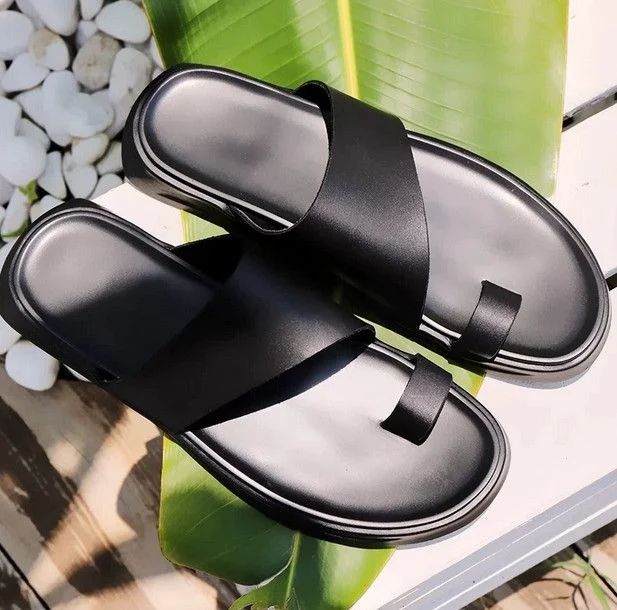
- Brush off dust and sand after wear. This prevents grit from wearing the leather surface down.
- Spot clean gently. Hari Mari specifically recommends a damp rag rather than machine washing.
- Let them dry indoors. OluKai warns against prolonged water exposure, so avoid leaving leather sandals wet in the sun or in a damp car.
- Keep them away from direct heat. Heat can stiffen leather and weaken adhesives over time.
- Store them in a dry place. Moisture and humidity shorten the life of leather footwear.
- Rotate pairs. This gives the leather time to recover between wears.
Snippet-ready answer: The safest care routine is to wipe leather flip flops clean, air-dry them indoors, avoid harsh heat, and keep them out of constant water exposure.
Common Mistakes Buyers Make
- Buying a pair because it says “genuine leather” without checking the actual grade.
- Ignoring arch support and then regretting it on longer walks.
- Choosing a flat sole when the wearer actually needs cushioning.
- Wearing leather sandals in water too often.
- Picking style over traction, then slipping on wet pavement.
Price Range Worldwide
Live listings show a clear premium band for men’s leather flip flops. GQ includes Hari Mari Fields at about $65, PEOPLE lists Rainbow Sandals Leather at about $70, Hari Mari’s own site places Fields around $75–$80, Chaco’s Lowdown Leather Flip Flop is $80, Rainbow’s Luxury Leather Double Layer Arch Support sits around $74.99–$84, and Hari Mari’s higher-end lines can go above $100. That suggests the core market for Quality Leather Flip Flops is roughly the mid-$60s to low-$100s, with luxury pairs climbing higher.
Best Brands and Countries Famous for Leather Flip Flops
Birkenstock is strongly associated with Germany, Rainbow with California-made heritage, Hari Mari and Chaco with the U.S. premium casual/outdoor lane, OluKai with island-inspired beach sandals, and Reef with surf-inspired comfort footwear. Those names show up repeatedly in current style and review coverage because they each solve a slightly different buyer need.
Budget-Friendly vs Premium Picks
Budget-friendly options are usually the ones that still offer basic support but use simpler materials or lighter builds. In the current market, some non-leather comfort models appear in review roundups below the premium leather range, while leather options themselves generally start around the mid-$60s.
Premium options usually justify the price with better leather, stronger support, and more refined styling. Birkenstock’s leather Arizona, OluKai’s Mea Ola, Rainbow’s leather arch-support styles, Hari Mari Fields, and Chaco’s Lowdown Leather are all built around that premium comfort-plus-style position.
Future Trends in Leather Sandals and Flip Flops
The biggest trend is responsible sourcing and traceability. The Leather Working Group says its certified supplier system helps brands source leather from audited manufacturers, and its current activity includes traceability and due diligence work. That points to a future where buyers care not only about style and comfort, but also about where the leather came from and how it was made.
The other trend is better comfort engineering in casual footwear. Brand pages are already showing the direction: contoured footbeds, memory foam toe posts, molded rubber outsoles, and arch-support-focused designs are becoming standard rather than special. That means future leather flip flops will likely continue moving toward “all-day wearable” instead of just “summer-only.”
FAQs
A: Yes, when you want a sandal that looks better, ages better, and can handle more than one kind of summer outfit. Premium live listings show strong demand for leather models with support and durability features.
A: Usually no. Some are water-friendly, but several leather brands warn that prolonged water exposure can damage the material.
A: Yes, if they have good arch support, a durable outsole, and a comfortable toe post. That is why support-led models keep winning review roundups.
A: Full-grain is the strongest premium choice, while top-grain is the best mainstream premium option for many buyers.
A: They can be, but only if the footbed, lining, and fit are right. Breathability and moisture management depend heavily on the leather grade and overall construction.
Conclusion
Leather flip flops for men are a smart buy when the leather is real, the footbed is supportive, and the outsole is built for daily use. The strongest current market examples do not rely on leather alone; they pair Quality Materials with arch support, comfortable toe posts, and durable traction. That is the combination your article should have from top to bottom.
For theleatheritems.com, this topic can become a genuine pillar page because it connects fashion, comfort science, leather education, durability, and buying guidance in one place. That is the kind of article readers finish instead of bouncing back to search. Invest in quality leather flip flops once, and they can become your go-to summer footwear for years.