Introduction
Men’s Knee High Leather Boots are one of the most underrated footwear categories in modern menswear. They combine bold style, weather protection, heritage appeal, and serious craftsmanship in a way that shorter boots simply cannot match. Yet most buyers still feel uncertain: Will they fit my calf? Are they comfortable for long wear? Which leather is worth paying for? And how do you style tall boots without looking costume-like?
That is exactly where this guide helps. In the next sections, you will learn how mens knee high leather boots are made, which leather types actually hold up, how tall boots should fit, what styles work in real life, and how to care for them so they last for years. The goal is simple: help you buy smarter, wear them better, and avoid the expensive mistakes that weak competitor pages rarely explain. Tall riding boots also have a clear fit logic: they are meant to end just below the knee, and sizing should account for calf width and shaft height, not just foot size.
What Are Mens Knee High Leather Boots?
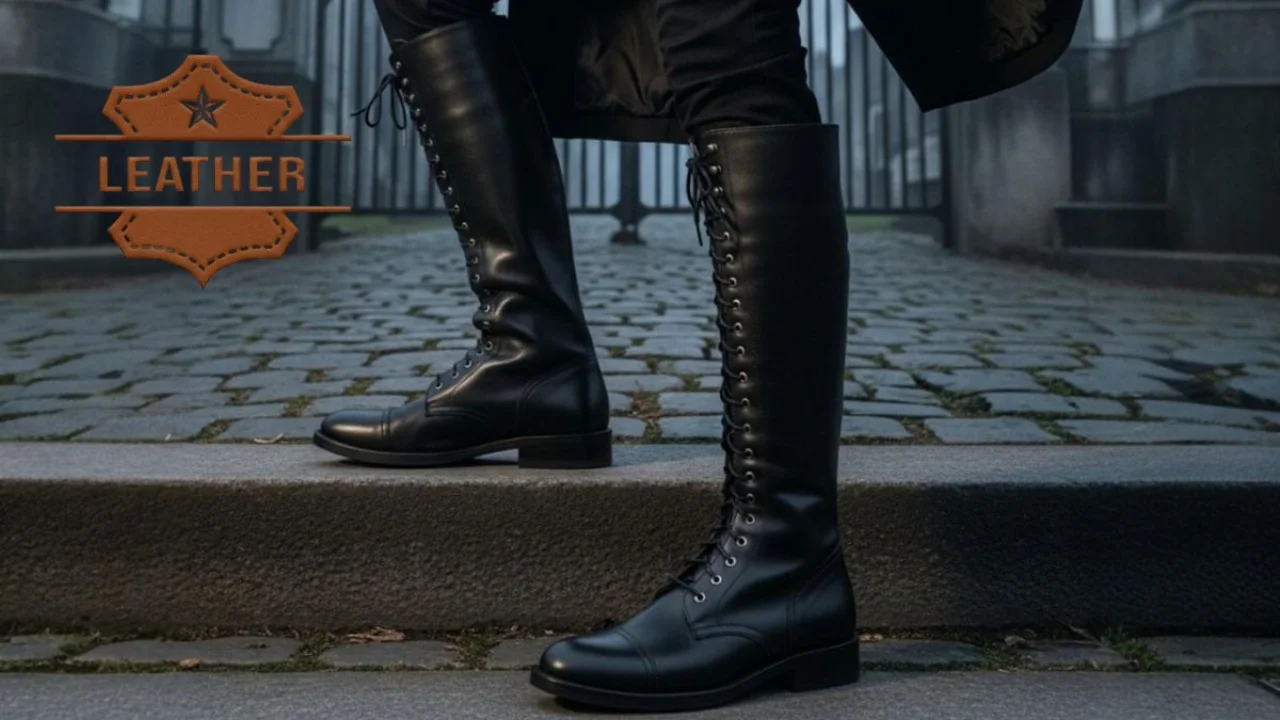
Men’s knee-high leather boots are tall boots designed to rise close to the knee, usually ending just below it. In equestrian use, this silhouette is a classic riding boot shape, while in fashion, it appears in riding, motorcycle, gothic, military-inspired, and statement styling. Brands such as Ariat describe tall riding boots as classic footwear that ends just below the knee, and fashion houses continue to revisit taller boot silhouettes on runways and in editorial coverage.
These boots sit in a useful middle ground. They are more protective than ankle boots, more dramatic than mid-calf boots, and often more refined than rugged work boots. That makes them especially valuable for men who want one boot that can cover style, winter utility, and a strong visual profile. Dr. Martens also groups tall and knee-high boots as part of a heritage-driven men’s collection, which shows how this silhouette has moved beyond niche use into recognizable fashion territory.
Why Men’s Knee High Leather Boots Matter in 2026
Tall boots are having another fashion moment because menswear is leaning into stronger silhouettes, visible craftsmanship, and more expressive footwear. Recent fashion coverage has highlighted over-the-knee and tall leather boots styled with tailored trousers and sleek suits, while other trend reports show bold, statement footwear gaining traction again across fashion weeks and editorial content.
For buyers, that matters for two reasons. First, the boot is no longer just “riding gear” or “alternative fashion.” Second, it is becoming more acceptable to wear tall boots with structured coats, slim trousers, layered knits, and monochrome outfits. In short, this is a silhouette that now works in both style-forward and practical wardrobes.
The Main Types of Men’s Knee High Leather Boots
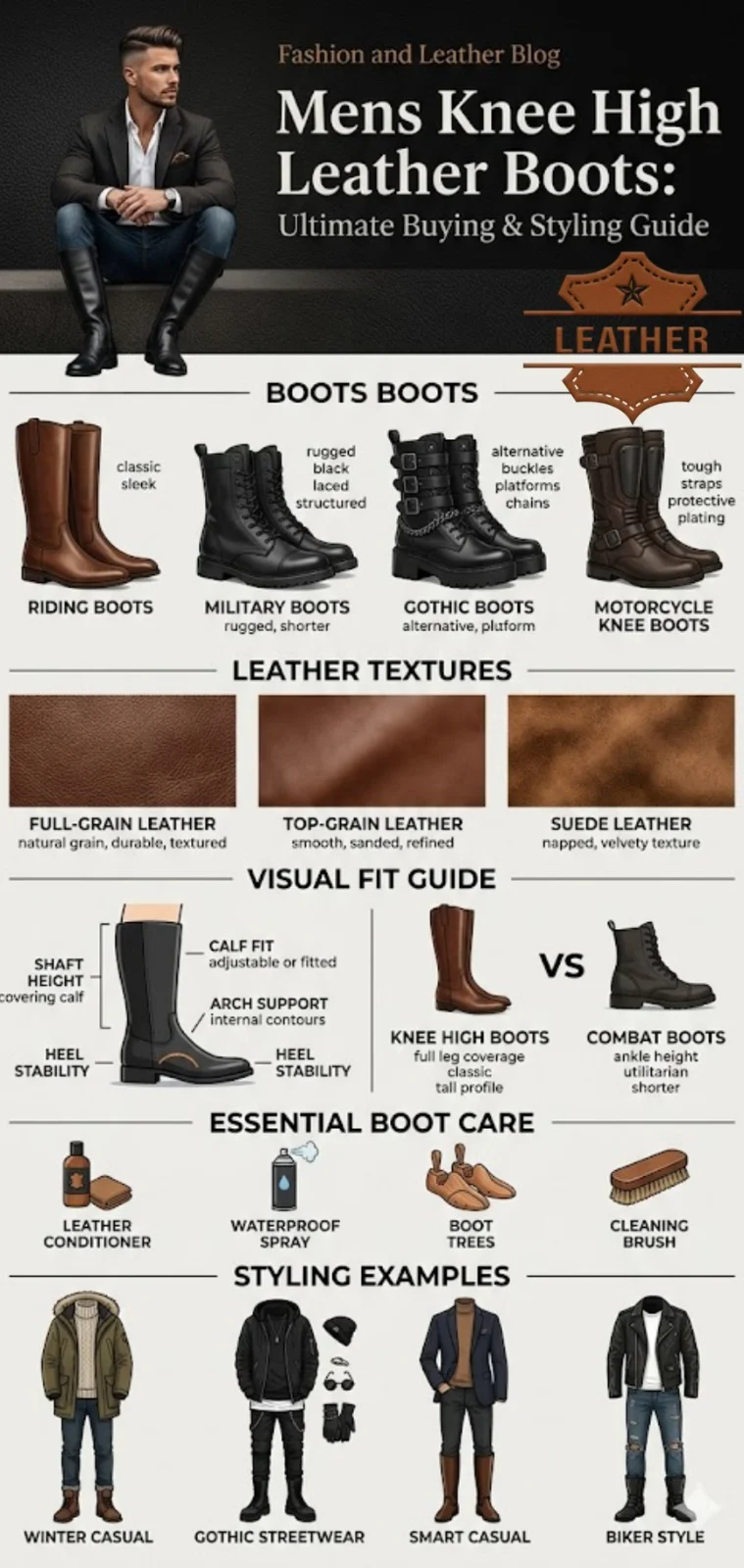
Riding boots
Riding boots are the cleanest and most classic option. They usually have a sleek shaft, low heel, and minimal hardware. Ariat describes tall riding boots as classic riding shoes, with field and dress versions depending on flexibility and formality.
Motorcycle boots
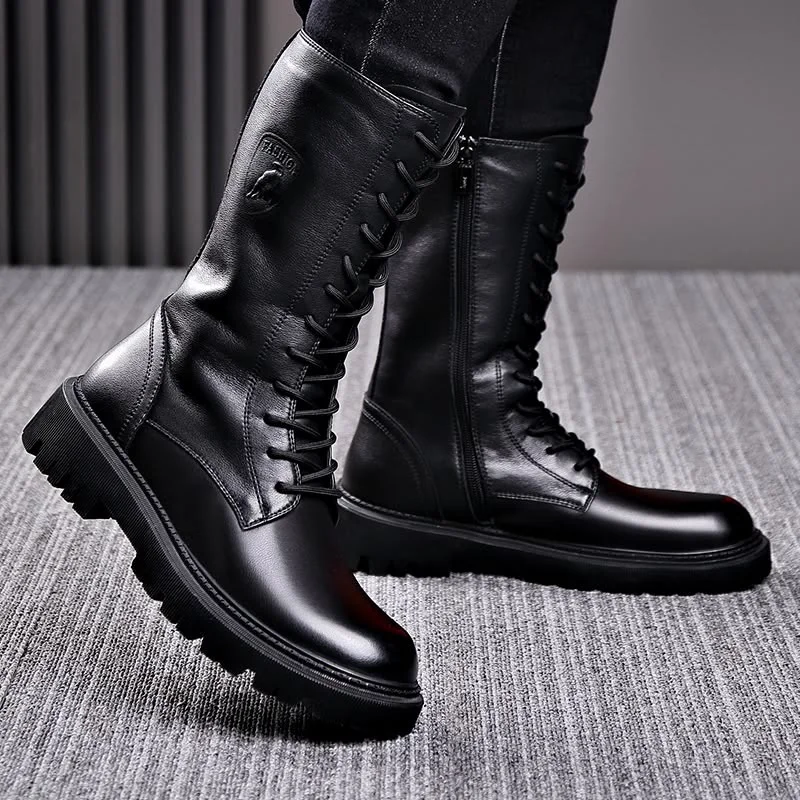
Motorcycle-inspired knee boots prioritize abrasion resistance, structure, and traction. They often include heavier soles, reinforced stitching, and a tougher visual profile. This is a more rugged choice for men who want presence rather than polish. Dr. Martens’ tall-boot lineup shows how biker-coded silhouettes can sit inside a broader fashion collection.
Military-inspired boots
Military-style knee boots usually have firmer construction, plain shafts, and a disciplined, upright look. They work especially well with clean outerwear and dark, structured trousers.
Gothic/alternative boots
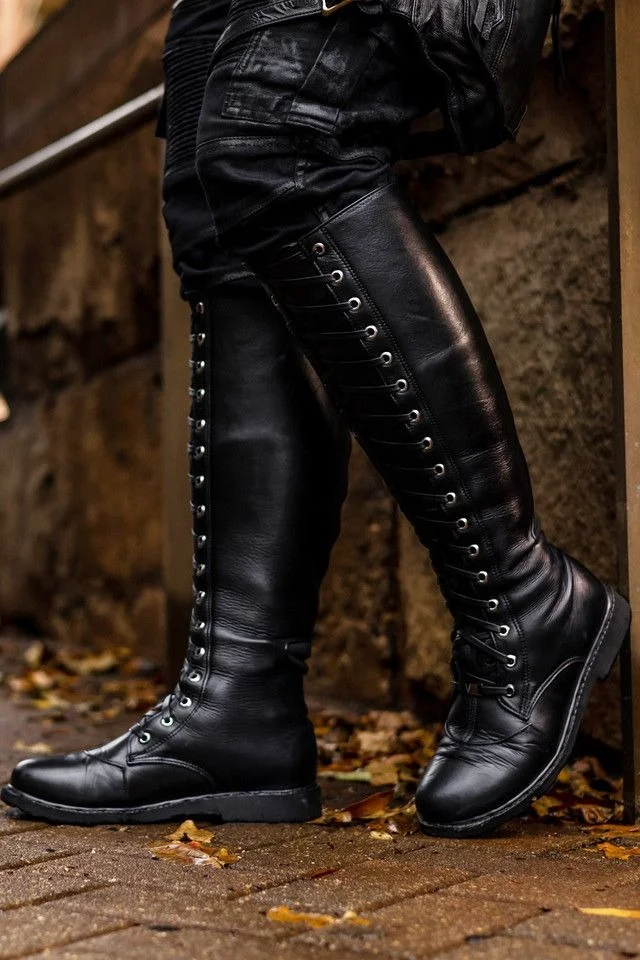
These often include buckles, zippers, thicker soles, and matte black leather or vegan leather. They are common in alternative fashion and show up frequently in the marketplace and niche fashion listings.
Handmade / custom boots
Handmade knee-high boots are often the best route for men with unusual calf widths, broader feet, or very specific style needs. Etsy listings and custom makers regularly show this market segment, with prices that vary widely based on leather, sole, and build method.
Best Leather Types for Tall Boots
Leather quality is one of the biggest reasons one pair of tall boots lasts for years while another cracks, stretches badly, or looks tired too early. Leather Working Group explains that tanning transforms the hide, and that chrome tanning generally produces supple, water-resistant, durable leather, while vegetable tanning uses natural tannins and gives a richer organic character.
| Leather type | What it means | Best for | Watch out for |
| Full-grain leather | Top surface kept intact; strongest natural grain | Premium boots, patina, long life | Usually heavier and more expensive |
| Top-grain leather | Surface is refined/sanded for a smoother look | Dressier boots, more uniform finish | Can lose some natural character |
| Genuine leather | Retail term used inconsistently; often lower-tier or more processed in many markets | Budget boots | Ask what layer and finish it really is |
| Suede | Soft, napped finish | Fashion styling, texture | Needs more protection from weather |
| Nubuck | Sanded outer surface for a velvety feel | Luxury casual wear | Marks more easily than smooth leather |
| PU / faux leather | Synthetic leather alternative | Low-cost fashion use | Usually less breathable and less repairable |
Terminology is not always used consistently across the market. Some leather education sources describe full-grain as the most intact natural surface, while others note that “top grain” is used differently in different standards or retail contexts. The safest buying habit is to ask the seller what layer of the hide is used, whether the surface is corrected, and how the boot is finished.
Expert take: For tall boots, full-grain leather is usually the best long-term value if you want strength and patina. Top-grain is a smart choice when you want a smoother, more polished look with easier first wear.
How the Best Knee High Leather Boots Are Made
A good boot is not just leather glued to a sole. Construction matters just as much as material. Here is the practical version of the process:
- The hide is selected and graded.
- It is tanned, usually through chrome, vegetable, or combination tanning.
- The leather is cut into panels for the shaft, vamp, counter, and lining.
- The upper is stitched and shaped.
- The sole is attached, often with stitching or cementing, depending on the price point.
- The boot is lasted, finished, polished, and checked for fit.
A tall boot also needs good shaft engineering. The upper must hold shape without collapsing, flex where the leg moves, and remain comfortable across the calf. That is why Stitching Quality, lining, and shaft structure are just as important as the leather itself. The stronger the build, the better the boot ages.
How Men’s Knee High Leather Boots Should Fit
Fit is the biggest purchase barrier in this category. Dover Saddlery’s tall-boot guide says to measure calf width at the widest point and height from the floor to the back of the knee while seated with the knee bent, and it also notes that tall boots can lose about 1.5 to 2 inches in height as they break in.
Fit checklist
| Fit area | What to look for |
| Toe room | Slight room, not pinch-tight |
| Heel | Minimal lift, no hard rubbing |
| Calf | Snug but not squeezing |
| Shaft height | Sits just below the knee |
| Instep | Easy enough to slide in without pain |
| Arch | Supportive enough for longer wear |
Ariat also notes that tall riding boots are designed to provide support, protection, and style, which is a useful reminder that fit should serve function, not just appearance.
Common fit mistake: buying by shoe size only. For tall boots, calf width and shaft height matter as much as foot length, and a boot that is perfect in the foot can still fail in the leg.
Best Colors for Men’s Knee High Leather Boots
Black
Black leather is the most versatile option for gothic, biker, military-inspired, and smart monochrome outfits. It also looks most at home in dressier city wardrobes. Dr. Martens’ tall-boot lineup shows how black remains the anchor color in this category.
Brown
Brown leather gives a warmer, heritage feel. It works well with wool, denim, earth tones, and vintage-inspired tailoring.
Oxblood / deep burgundy
A strong choice for men who want character without going full statement mode.
Distressed or waxed finishes
These feel rugged and work well in biker, workwear, and winter layering looks.
How to Style Men’s Knee-High Leather Boots
The main styling rule is simple: let the boot look intentional. The taller the boot, the more structure your outfit usually needs to balance it.
Easy outfit formulas
- Slim black jeans + black knee-high boots + wool overcoat
- Dark trousers tucked over or into riding boots + long coat
- Distressed denim + biker jacket + rugged tall boots
- Tailored trousers + polished boots + knit turtleneck
- All-black outfit + matte leather boots + minimal accessories
Fashion references have repeatedly shown tall boots paired with tailored pants, sleek suits, and layered outerwear. Vogue’s menswear coverage of Saint Laurent’s tall boots even highlighted dress pants tucked into the boots for a sharper silhouette.
Styling by mood
Casual winter
Use slim denim, a heavy knit, and a long coat. Keep the boot simple.
Equestrian-inspired
Use slim trousers, a clean shirt, and a structured jacket. This looks refined and classic. Dover and Ariat both frame tall riding boots as functional, polished footwear with clear fit logic.
Gothic / alternative
Use black layers, buckles, and long outerwear. A matte finish works better than glossy leather here.
Rugged biker
Use leather jackets, heavy knits, and darker washes. The boot should feel tough, not shiny.
Smart casual
Use tailored trousers and a fitted coat. This is the easiest way to keep tall boots modern rather than theatrical.
Knee High Leather Boots vs Combat Boots
| Feature | Knee-high leather boots | Combat boots |
| Shaft height | Taller, more dramatic | Shorter, more practical |
| Weather coverage | Better | Moderate |
| Style impact | Stronger | Rugged and casual |
| Best use | Fashion, winter, riding-inspired looks | Everyday utility |
| Visual effect | Longer leg line, more statement | Heavier, more grounded |
Knee-high leather boots are the better choice when you want presence, warmth, and a more elevated silhouette. Combat boots are easier for everyday rough use, but they do not create the same fashion payoff.
Snippet-ready answer: Knee-high boots are taller and more statement-driven, while combat boots are usually shorter and more utility-focused.
Price Range Worldwide
Prices vary a lot depending on leather quality, construction, country of origin, and whether the pair is mass-produced, handmade, or luxury.
| Segment | Typical range | What you usually get |
| Budget/marketplace | about $60–$150 | Basic materials, less consistent construction |
| Mid-range branded | about $150–$300 | Better leather, better fit systems, stronger styling |
| Handmade / custom | about $150–$400+ | Calf customization, more labor, better uniqueness |
| Luxury designer | $1,000 and up | Fashion prestige, premium design, not always the best value |
Current marketplace listings show handmade knee-high leather boots around the low hundreds, Dr. Martens tall boots clustered roughly around the £150–£250 / $200–$250 range, and Luxury Over-The-Knee menswear boots appearing at far higher levels in editorial coverage.
Best Countries and Brands to Watch
If you are writing this for buyers, it is safer to frame this section around market reputation rather than rigid rankings. Italy, the UK, Spain, Portugal, and India are commonly associated with major leather and leather footwear production, while large global manufacturing volumes are also concentrated in Asia.
Useful brand examples for this category include Dr. Martens for heritage boots, Ariat for riding boots, Dover Saddlery as a fit and sizing authority, and custom makers on Etsy for handmade and specialty calf fits.
How to Identify Real Leather vs Fake Leather
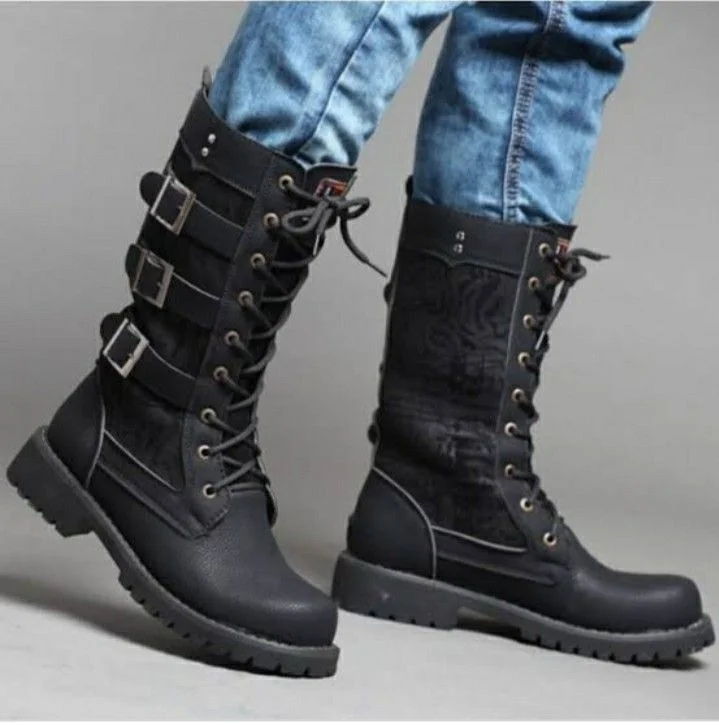
Here is the practical buying test:
- Check the label and material description.
- Look closely at the grain.
- Feel the surface for natural variation.
- Smell the boot.
- Examine the edges and stitching.
Real leather usually has slight irregularities, a more natural grain, and a warmer hand-feel. Faux leather often looks too uniform and can feel plasticky or rigid. Retailers also use “genuine leather” inconsistently, so the label alone is not enough; ask whether the boot is full-grain, top-grain, corrected grain, split, or synthetic.
Important note: Do not use dangerous “burn tests” on footwear. Safer visual and tactile checks are enough for normal buying decisions.
Care, Cleaning & Maintenance Tips
Leather care is where most competitors stay thin, but this section can build real trust. Leather Naturally says regular cleaning and maintenance help extend leather’s life, open-pored leather should be waterproofed, and wet leather should be dried naturally away from direct heat or sunlight. Dr. Martens similarly emphasizes cleaners, polishes, and balsams as part of keeping boots strong over time.
Simple care routine
- Brush off dust after wear.
- Wipe with a soft cloth.
- Condition periodically to keep the leather supple.
- Use waterproofing protection during wet months.
- Store upright so the shaft does not collapse.
- Let damp boots dry naturally.
Storage tips
Boot trees or shaft inserts help tall boots keep their shape. If you store knee-high boots flat or folded for long periods, the shaft can crease badly or slump. That is especially important for softer leather and taller silhouettes.
Pros and cons
| Pros | Cons |
| Strong visual presence | Fit can be harder to get right |
| Better winter coverage | Usually more expensive |
| Can last years with care | Needs maintenance |
| Works across several style directions | Not always easy to wear with every outfit |
Common Mistakes to Avoid
- Buying based on foot size alone.
- Ignoring calf width.
- Choosing style over build quality.
- Skipping waterproofing.
- Using harsh heat to dry wet leather.
- Storing boots without support.
- Assuming “genuine leather” automatically means premium quality.
Expert Tips Most Buyers Ignore
Tall boots often look best when the rest of the outfit is slightly sharper. A well-cut coat, cleaner trouser line, and better leather finish matter more here than they do with shorter boots. Fashion coverage of tall boots repeatedly shows them working best when the silhouette is intentional and balanced.
Another overlooked point is break-in behavior. A boot that feels “perfect” on day one may become too short after the shaft settles, which is why experienced fitters account for height loss in the break-in period.
Future Trends in the Leather Industry
The future of leather boots is not just about style. It is also about transparency, tanning chemistry, and responsible sourcing. The Leather Working Group has been pushing supply-chain improvement, and industry discussion increasingly focuses on better tanning methods, cleaner production, and more traceable leather origins.
For boots specifically, the trend is moving toward:
- better calf-fit options,
- lighter but durable sole units,
- softer break-in,
- waterproof performance,
- and more versatile styling.
FAQs
A: Yes. They are showing up more in fashion-forward menswear, heritage styling, and statement outerwear looks.
A: They should fit the foot securely, hug the calf without squeezing, and end just below the knee. Tall-boot fit should be measured by calf width and shaft height, not only shoe size.
A: Full-grain leather is usually the strongest long-term choice, while top-grain gives a smoother and more refined finish.
A: They can be very comfortable when the fit is correct. Comfort depends on calf room, arch support, heel stability, and leather quality.
A: With proper care, good leather boots can last for years and, in premium cases, much longer. Regular cleaning and maintenance are the biggest factors.
Conclusion
Men’s knee-high leather boots are a rare category that can deliver style, function, and long-term value at the same time. The key is to buy the right leather, measure the calf correctly, and choose a silhouette that fits your wardrobe instead of fighting it. The strongest pairs are not just visually striking; they are well-built, Comfortable, and easy to maintain. Current fashion coverage and brand collections show that tall boots are no longer a niche afterthought. They are a real menswear statement with practical upside, especially in colder months and more expressive wardrobes.
If you publish this on theleatheritems.com, it has strong room to rank because it does what most competitor pages do not: it answers fit, leather quality, styling, care, and buying confidence in one place.