Introduction
A Man’s Leather Necklace is one of those accessories that looks simple at first glance, but it can change the feel of an outfit instantly. The right piece can make a plain T-shirt look sharper, a button-down feel more relaxed, and a jacket look more intentional. In 2026, leather cord and leather-inspired necklace styling is also getting fresh attention again, especially in minimalist and pendant-led looks.
The problem is that most buyers do not know what actually matters. Should you choose real leather or faux leather? Is a thin cord better than a thick one? Does black leather read more modern than brown? And how do you keep the necklace looking good after months of wear? This guide answers those questions in plain English, with the kind of practical detail that helps people buy once and buy better.
Snippet-ready answer: A men’s leather necklace is a neck accessory made from real or synthetic leather cord, often worn plain or with a pendant. It is popular because it feels lighter and more relaxed than metal jewelry, while still adding style and personality.
What Is a Men’s Leather Necklace?
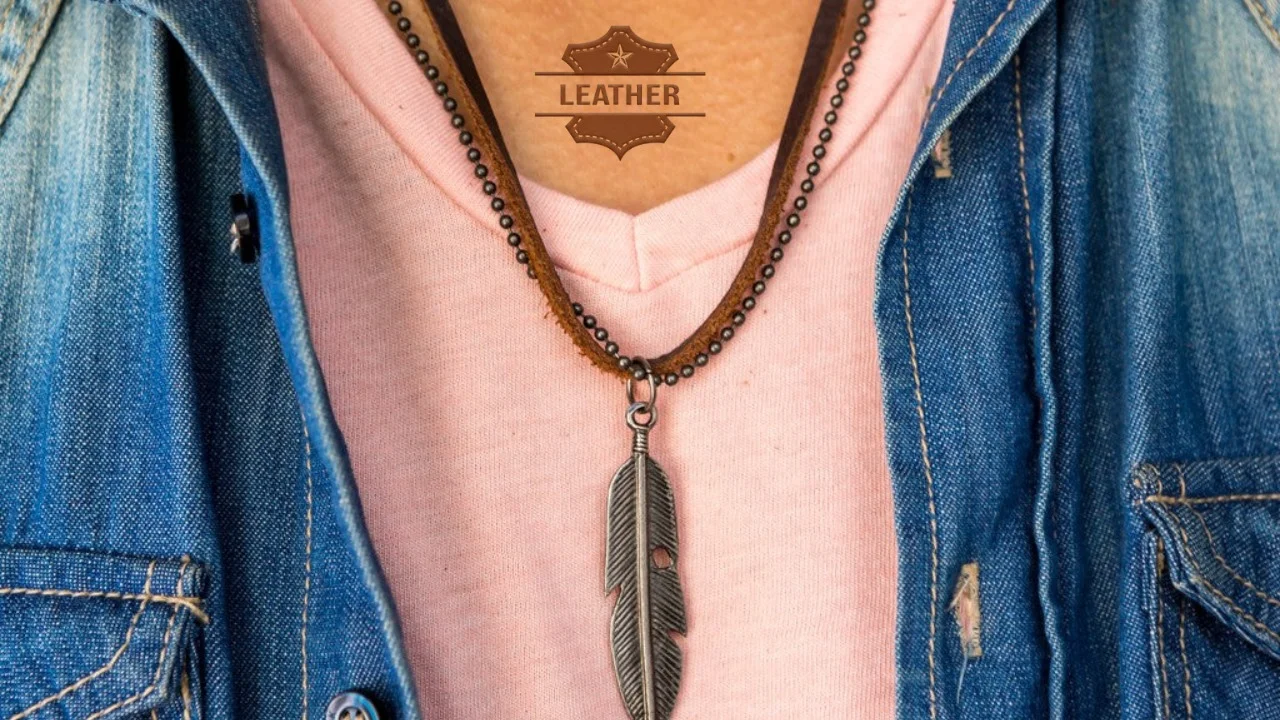
A men’s leather necklace is usually a cord, strand, or strap made from leather or leather-look material that sits around the neck and may hold a pendant, bead, ring, dog tag, or minimalist metal detail. In current retail pages, men’s leather necklaces are commonly shown in black, brown, braided, and distressed finishes, with steel clasps or small metal accents for contrast.
What makes it different from a chain is the texture. Leather looks softer, more grounded, and often more masculine or natural in tone. It works especially well for men who want an accessory that feels less polished than a metal chain and less decorative than statement jewelry. That is exactly why leather necklaces sit comfortably between fashion and function.
History and Evolution of the Leather Necklace
Leather cords and cord-based necklaces have cycled in and out of fashion for decades. Recent fashion coverage shows a strong revival of cord necklaces for Spring 2026, with 1990s styling references, pendant focus, and a move toward simple, wearable pieces. Marie Claire notes that the look is back in a major way, while Byrdie describes it as a versatile trend that works with both casual and polished outfits.
For men, that matters because the modern leather necklace is no longer just a “festival” or “biker” accessory. It now fits into quiet luxury, minimal streetwear, travel wardrobes, and casual smart dressing. The trend is less about flash and more about personal style, proportion, and ease.
Why Men’s Leather Necklaces Matter in 2026
In 2026, men’s jewelry is moving toward pieces that feel expressive but not overworked. Trend and fashion sources point to understatement, meaningful pendants, and balanced proportions. Leather cord styling fits that direction perfectly because it can be subtle, symbolic, and easy to wear every day.
That makes the category valuable for both style and commerce. Buyers are not only looking for decoration; they are looking for an accessory that signals identity, fits their wardrobe, and feels believable in real life. A good leather necklace can do all three.
Different Types, Styles & Variations
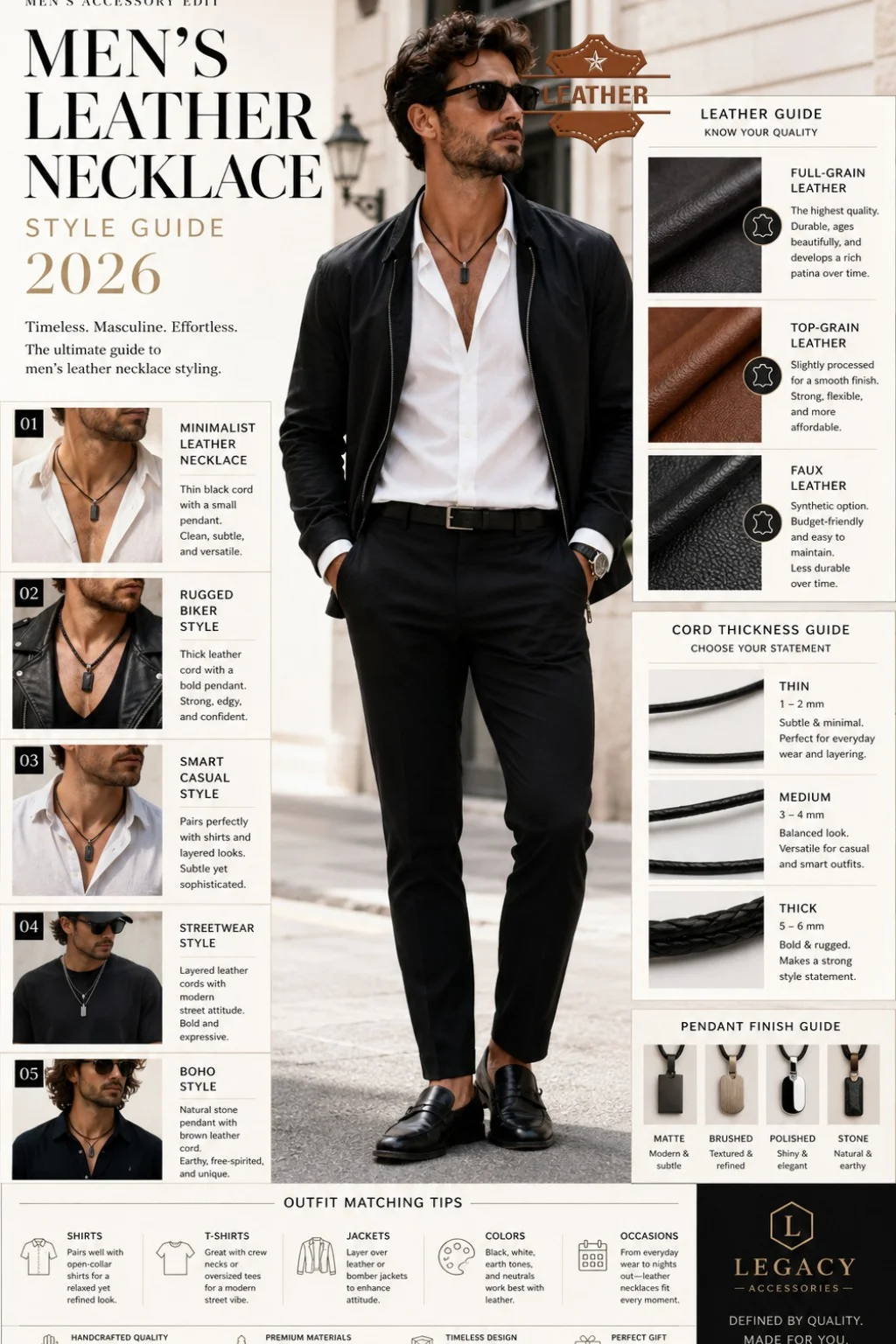
Men’s leather necklaces are not one fixed product. They come in several style families, and each one sends a different message.
1. Minimalist leather cord necklace
This is the cleanest version: a thin black or brown cord, sometimes worn without a pendant. It suits plain tees, open-collar shirts, and understated wardrobes.
2. Leather pendant necklace
This is the most versatile option. It pairs a leather cord with a pendant such as a bar, ring, cross, stone, key, tag, or symbolic charm.
3. Braided leather necklace
Braided cords add more visual weight and a slightly rugged look. They often work well for men who want texture without going full statement chain.
4. Bolo-style leather necklace
This style borrows from Western dress codes and is more niche. It feels expressive and bold, especially with a shirt and jacket.
5. Leather-and-metal hybrid necklace
Many current products use leather with stainless steel clasps, beads, or accents. That mix keeps the necklace from looking too plain and gives it a more modern edge.
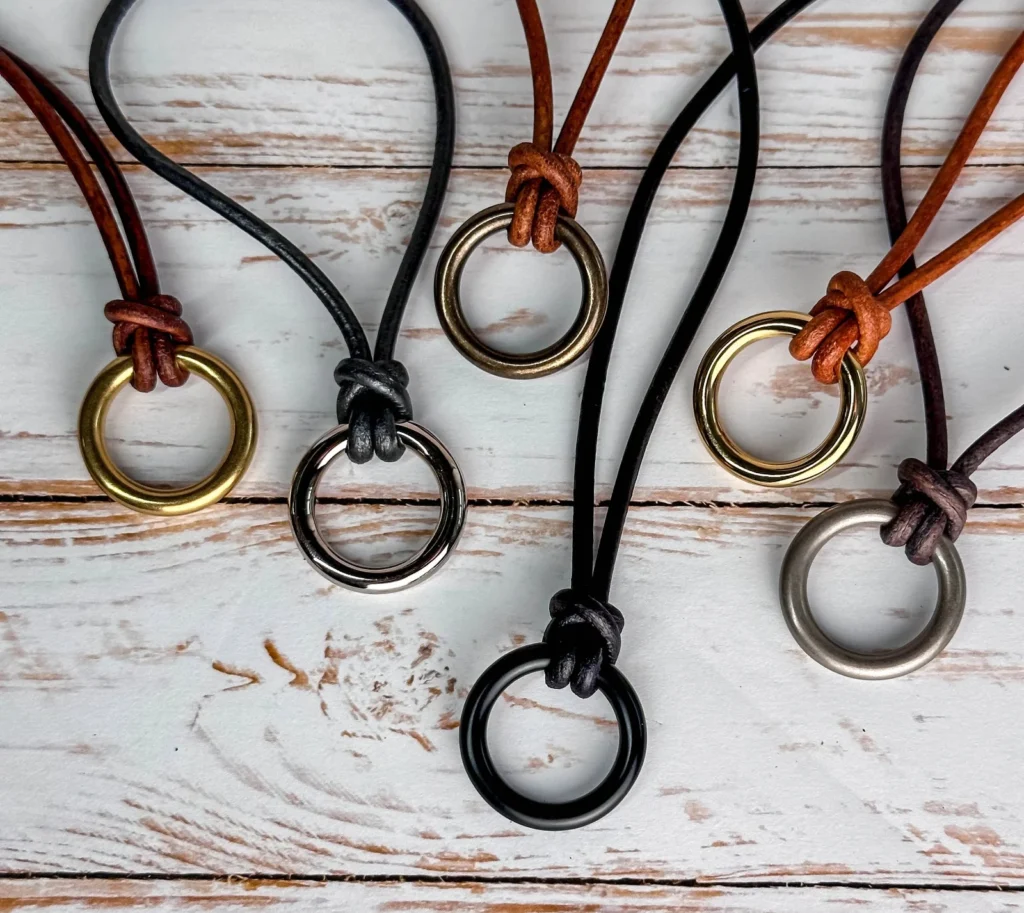
Leather Types Used in Men’s Necklaces
Not all leather is equal. The material you choose affects durability, texture, cost, and how the necklace ages. Naturally’s terminology guide and FAQ are especially useful here because they clarify what the labels actually mean.
Leather Type Comparison Table
| Leather Type | What It Means | Best For | Main Trade-Off |
| Full-grain leather | Top layer of the hide with the natural grain intact | Premium cords, long-term wear, patina lovers | Usually costs more |
| Top-Grain Leather | Top layer with the surface lightly sanded for a smoother look | Clean, refined everyday pieces | Slightly less natural character than full grain |
| Genuine leather | Real leather, not synthetic | Mid-range buyers who want authenticity | The label alone does not tell you grade |
| Suede | Flesh side / split leather with a soft, hairy surface | Soft, textured fashion looks | More delicate in wet conditions |
| Nubuck | Top surface buffed for a velvet-like feel | Luxury texture and matte styling | Needs more careful care |
| PU / faux leather | Synthetic leather-like material, often PVC or polyurethane based | Budget or vegan alternatives | Usually less breathable and less durable |
Leather Naturally states that full grain is leather made from the top layer of the hide, top grain has had the top surface lightly sanded, genuine leather is a term used to show the product is real leather, suede is the flesh side or split leather, nubuck is buffed for a soft velvet-like touch, and faux leather is generally a synthetic imitation.
Which leather type is best for a necklace?
For a necklace, full-grain or high-quality top-grain leather is usually the safest choice if you want durability and a better aging pattern. Genuine leather can still be a good buy, but the label should be checked carefully because it only confirms that the material is real leather, not that it is premium grade. Suede and nubuck look beautiful, but they need more care because they mark more easily.
How a Leather Necklace Is Made
A quality leather necklace is usually made through a sequence that borrows from standard leather manufacturing: the hide is selected, tanned, split or finished, dyed, cut, shaped, and then assembled with cord ends, clasps, or pendants. Leather Naturally explains that tanning stabilizes the hide, and that leather can be produced through chrome tanning, vegetable tanning, or chrome-free methods. It also shows that the grain layer and split layer are separated during processing, which matters when choosing the final feel and strength of the cord.
Step-by-step manufacturing view
- Hide selection: Better hides usually give better cords because the fiber structure is stronger and more consistent.
- Tanning: The hide is stabilized so it becomes leather instead of perishable raw skin. Chrome tanning is the most widely used method, while vegetable tanning is traditional and often chosen for heritage looks.
- Splitting and finishing: The grain layer and split layer are separated, and the chosen surface is finished for the intended look.
- Cutting and shaping: The leather is cut into cords or strips, then braided, stitched, or smoothed.
- Hardware assembly: Clasps, rings, beads, and pendants are attached.
- Quality check: The final piece is checked for symmetry, edge finish, comfort, and durability.
The most important takeaway is simple: a necklace is only as good as the leather underneath it. Attractive styling cannot fully hide weak leather or poor finishing.
How to Identify Original vs Fake Leather
This is one of the biggest buying pain points, and it is where many pages stay too vague. Leather Naturally is clear that genuine and real leather refer to natural leather, while faux leather is usually synthetic, often PU or PVC-based. Real leather also ages differently: it develops patina, does not peel like plastic-based materials, and can often be repaired or conditioned.
Real vs Fake Leather Checklist Table
| Sign | Real Leather | Fake Leather |
| Surface | Natural grain variation | More uniform and often plasticky |
| Aging | Develops patina | Often cracks, flakes, or peels |
| Feel | Soft, organic, breathable | More coated, less breathable |
| Smell | Natural leather smell | Chemical or plastic-like smell |
| Repairability | Can often be conditioned and repaired | Usually harder to restore |
| Label | Full-grain, top-grain, genuine leather | PU, PVC, faux leather, vegan leather |
Leather Naturally notes that faux leather is primarily made from synthetic polymers, that real leather is breathable and durable, and that peeling is a common failure in plastic-based materials rather than in authentic leather.
Practical buying test
If the listing only says “leather” but gives no grade, no tanning detail, no hardware detail, and no care guidance, treat it cautiously. Strong products usually explain the leather type, the cord thickness, the clasp material, and the fit. That level of transparency is a good sign.
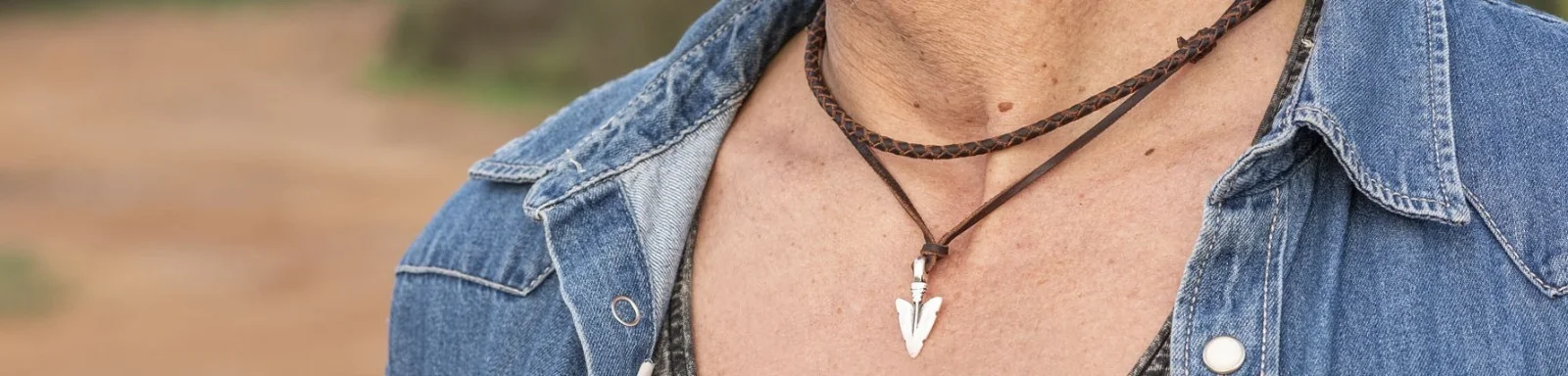
Complete Buying Guide
Buying a men’s leather necklace is easy if you know what to check first.
Choose the right length
Trendhim’s live size guide shows common men’s necklace ranges around close-fitting, collarbone, and chest-length options, while its leather category lists adjustable and S-length pieces that sit fairly close to the neck. For leather necklaces, the practical sweet spot is usually around the collarbone for everyday wear, unless you want a stronger statement or a layered look.
Match the cord thickness to your style
Thin cords feel quieter and more refined. Mid-weight cords feel balanced. Thick cords feel rugged and more visually dominant. The Modest Man and Trendhim both emphasize that width and length should stay proportional to the pendant and the outfit.
Pick the right pendant size
A small pendant is better for Minimal Outfits. A larger pendant works when you want the necklace to be the focal point. If the pendant is too heavy or oversized for the cord, the necklace can look unbalanced.
Choose a color that fits your wardrobe
Black leather feels sharper and more modern. Brown leather feels warmer, more natural, and often more casual. Distressed leather gives a vintage or rugged effect. Trendhim’s leather range shows that black and brown remain the most common retail colors.
Check the hardware
Steel clasps, stainless accents, and secure closures improve wearability and make the necklace feel more finished. That small detail often separates a fashion accessory from a piece that looks cheap.
Consider personalization
Engraving and personalized pendants are a strong gifting angle in current retail. Trendhim highlights engraving as a major feature in its leather line, and The Men Thing also shows a strong personalized, symbolic pendant style.
Best Uses of This Product
A men’s leather necklace is especially useful in outfits that need texture without too much shine.
- Casual streetwear: with T-shirts, hoodies, cargos, and denim
- Smart casual: with open-collar shirts, knit polos, and light jackets
- Edgy looks: with leather jackets, black boots, and darker layers
- Travel outfits: because leather feels relaxed and easy to wear
- Gift styling: because personalization makes it feel meaningful
Current fashion reporting also shows cord necklaces working with both tailored and casual looks, which supports leather cord styling as a flexible accessory rather than a niche one.
Worldwide Price Ranges
Prices vary by country, material quality, hardware, and branding. In the live pages I checked, leather necklaces ranged from budget-friendly and mid-range pieces into modest premium territory. Trendhim’s leather necklaces include examples at $19.90, $29.90, $39.90, and $54.90, while The Men Thing shows Indian market examples from roughly Rs. 400 to Rs. 1,439. That gives a practical current-market spread for positioning.
Price Positioning Table
| Market Tier | Typical Current Example | What You Usually Get |
| Budget | Around $20 or similar entry pricing | Simple cords, basic hardware, lighter finishing |
| Mid-range | Around $30-$55 | Better leather feel, stronger clasp, more design detail |
| Premium | Above $55 and up | Better finishing, stronger branding, more refined materials |
| Value markets | Around Rs. 400-Rs. 1,500 in current Indian retail examples | Strong price-to-style ratio, often more pendant-led |
These are market examples, not fixed global rules, because pricing changes by country, taxes, and brand strategy.
Best Countries & Brands Famous for It
A fair way to answer this is to look at where the live search ecosystem is strongest today. The current results show active leather necklace retail and content pages in the UK/Europe, the US, Australia, and India, which suggests those markets are commercially mature for the category. That is an inference from the current search landscape, not a formal global ranking.
Brands and market signals worth watching
- Trendhim for European-style men’s accessories and leather necklace merchandising.
- The Modest Man for beginner-friendly men’s style advice.
- RoseGold & Black for fashion-oriented men’s necklace guidance.
- The Men Thing for value-led, pendant-heavy leather necklace products.
Budget-Friendly vs Premium Options
Budget-friendly necklaces are usually best when you want to test the style first. They are ideal for experimenting with length, color, and outfit pairing. Premium options make more sense when you already know you like the silhouette and want better leather, better hardware, and longer wear. Leather Naturally’s durability guidance makes the case for investing in materials that age well, especially if you plan to wear the piece often.
Budget option usually means:
- simpler cord construction
- lighter pendant
- fewer finishing details
- lower risk if you are trying the style for the first time
The premium option usually means:
- better leather grade
- more reliable hardware
- stronger finishing
- better aging and patina potential
Pros and Cons
Pros
- Lightweight and Comfortable
- Easy to pair with casual outfits
- Adds texture without heavy shine
- Can look minimal, rugged, or symbolic
- Often feels more personal than a standard chain
Cons
- Can wear out faster if the leather is low quality
- More sensitive to water and rough treatment
- Suede and nubuck need extra care
- Cheap faux leather can peel and look tired quickly
Leather Naturally’s material guidance supports the durability and repair advantages of authentic leather, while also making clear that synthetic alternatives behave very differently over time.
Common Buyer Mistakes to Avoid
- Buying by photo only. A nice image does not tell you the leather grade or hardware quality.
- Ignoring pendant weight. A heavy pendant can pull a thin cord out of balance.
- Choosing the wrong length. Too short feels tight; too long can look accidental.
- Picking faux leather without checking durability. It may look fine at first but age badly.
- Skipping care instructions. Leather needs basic maintenance to stay attractive.
Care, Cleaning & Maintenance Tips
Leather necklaces need gentle care, not complicated routines. Leather Naturally recommends simple maintenance such as cleaning, conditioning, and protecting, plus storing leather in a cool, dry place away from direct sunlight and intense heat. For suede and nubuck, avoid wet conditions when possible and use appropriate brushing and protection.
Easy care routine
- Wipe the necklace with a soft, dry cloth after wear.
- Let it dry naturally if it gets damp.
- Store it flat or hanging in a dry place.
- Keep it away from perfume, harsh chemicals, and long water exposure.
- Use conditioner sparingly and test in a hidden area first.
Tiffany’s leather care guidance also warns against harsh cleaners and recommends testing cleaning methods in an unseen area first, while Trollbeads notes that leather jewelry should be wiped gently and kept dry. Those are good real-world maintenance principles for leather accessories of this size.
Expert Tips Most Buyers Ignore
A lot of necklace advice focuses on style alone, but real-world wear depends on small decisions.
- Match the necklace to your watch, belt buckle, or other metal accents for a more cohesive look.
- Use black leather when you want a cleaner visual line; use brown when you want softness and warmth.
- Choose a pendant that sits proportionally on the chest, not one that overwhelms the cord.
- If you layer, keep the textures different so the look does not become noisy.
- For daily wear, buy the best leather you can reasonably afford, because leather rewards quality over time.
Who Should Buy This Product
A men’s leather necklace is a smart buy for:
- men who want a more relaxed alternative to metal chains, style beginners who want a low-risk accessory, buyers who like minimalist, rugged, or earthy fashion, gift shoppers who want something personal, men who prefer a lighter necklace feel
The live retail pages also show that leather necklaces are often positioned as symbolic, personalized, and easy to wear, which makes them especially useful as gifts or first jewelry purchases.
Who Should Avoid This Product
A leather necklace may not be the best choice for:
- people who want a High-Shine Luxury look
- buyers who need jewelry that can handle heavy water exposure
- anyone who does not want to maintain leather at all
- those who prefer ultra-formal or very ornate accessories
If you want a piece with almost zero upkeep, a metal necklace may be a better fit. Leather is still easy to care for, but it is not maintenance-free.
Future Trends in the Leather and Necklace Space
The strongest future signals are sustainability, traceability, and simpler styling. Leather Working Group says it is continuing to evolve its audit and certification systems and that responsible leather production is built around standards, traceability, and continuous improvement. Leather Naturally also emphasizes durability, repairability, and lower-impact use over frequent replacement.
On the style side, 2026 fashion coverage points toward cord necklaces, understated pendants, and wearable pieces that work across casual and smart outfits. That means men’s leather necklaces are likely to stay relevant as long as they keep balancing simplicity, identity, and comfort.
People Also Ask
A: Wear it with simple necklines first: crew neck tees, open shirts, hoodies, or light jackets. Keep the pendant size proportional to the cord, and let the necklace support the outfit instead of fighting it.
A: It depends on the look you want. Leather feels softer, lighter, and more casual, while metal chains feel shinier and usually more formal or bold. Leather is often the better choice for relaxed, everyday styling.
A: Full-grain and good top-grain leather are the strongest options for long-term wear. Genuine leather can still be good, but the label alone does not guarantee premium quality.
A: Yes, but keep it minimal. A thin cord or small pendant works better than a heavy, chunky piece. The necklace should stay subtle enough to feel intentional, not distracting.
A: For everyday wear, a collarbone or slightly below-collarbone fit is usually the most versatile. Shorter lengths feel more fitted, while longer ones are better for layering or a looser look.
Conclusion
A men’s leather necklace works because it gives men an easy way to add texture, meaning, and style without overcomplicating the outfit. The best pieces are the ones that fit the wearer’s wardrobe, use honest materials, and age well instead of falling apart after a few months. That is why leather grade, cord thickness, pendant balance, and care matter more than most shoppers realize.
For TheLeatherItems.com, this topic is a strong opportunity to build trust and topical authority across leather accessories, care, and buying advice. Readers who want a relaxed, masculine, wearable accessory will find the best value in a Well-Made Leather Necklace that is simple, honest, and built to last. Explore more leather guides on the site, compare materials carefully, and choose the piece that fits your style instead of chasing trends alone.
Legal disclaimer: Leather quality, pricing, manufacturing standards, and product availability may vary by country, brand, and supplier. Always verify authenticity, material details, and care instructions before purchase.