Introduction
If you are shopping for an Apple Watch Bracelet in Leather, the hardest part is not finding options. The real challenge is choosing a band that looks good, fits your case size, feels comfortable every day, and ages the way you want. Many bands look similar at first glance, but the difference between a cheap strap and a well-made leather bracelet shows up in the leather itself, the stitching, the hardware, and how well it matches your Apple Watch case. Apple’s own guidance makes compatibility especially important, and Apple also notes that leather bands are not water resistant and are not recommended for water or workouts.
This guide is built for buyers who want more than a product listing. You will learn how leather grades differ, which Apple Watch sizes work together, how to measure your wrist correctly, how leather ages, and what separates a true premium band from a marketing-heavy one. You will also see how to choose a strap for business, casual, luxury, men’s, and women’s styling, plus how to care for it so it lasts longer. Apple no longer sells leather bands directly, which makes third-party knowledge even more important for modern buyers.
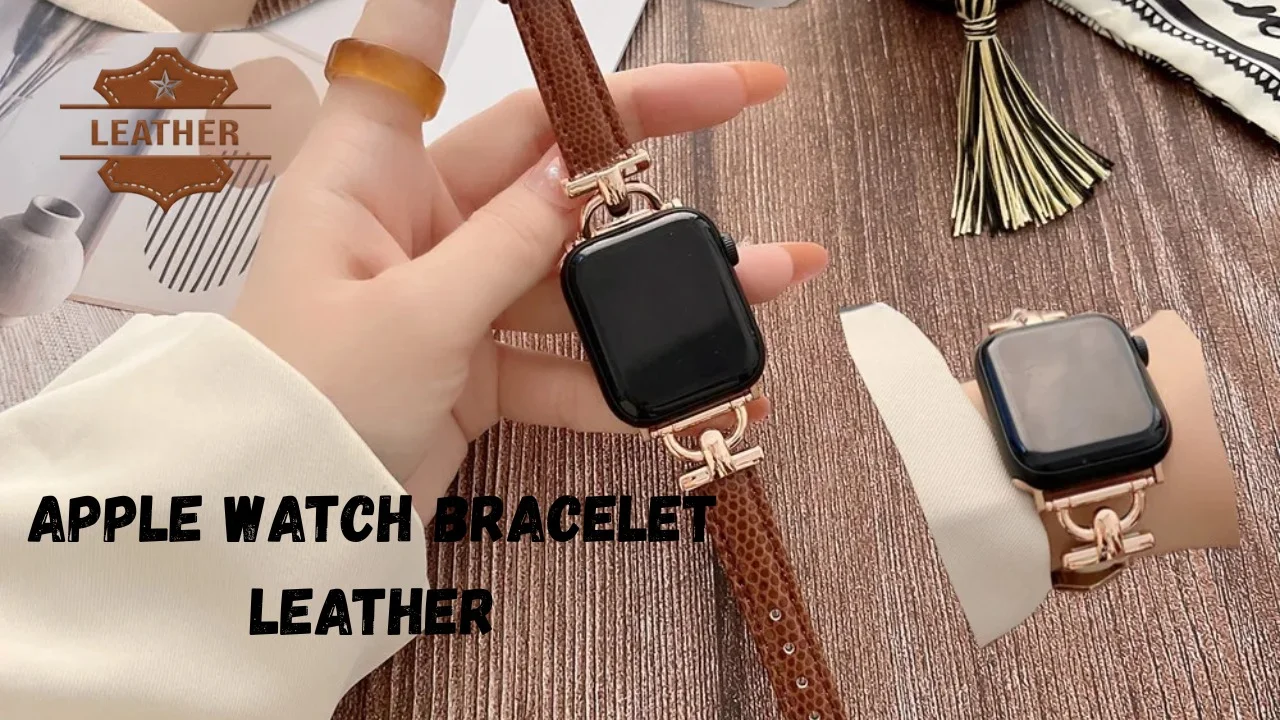
What Is an Apple Watch Bracelet Leather?
An Apple Watch bracelet leather is a leather strap or bracelet-style band designed to attach to the Apple Watch lugs. In normal conversation, people say bracelet, band, strap, or wristband almost interchangeably. The important part is not the label. It is how the band is built, how it connects to the watch, and whether the leather is chosen for daily wear rather than only for appearance.
A good leather bracelet should do three things well: it should connect securely, fit the case size correctly, and wear comfortably on the wrist. The best examples also use leather that is thick enough to hold shape, flexible enough to break in, and finished in a way that resists early cracking or ugly edge wear. For premium references, current market pages often highlight patina, stainless steel hardware, and case-specific sizing as signs of a higher-quality product.
Why Leather Apple Watch Bracelets Still Matter in 2026
Leather remains popular because it solves a style problem that silicone and sport bands do not. It gives the Apple Watch a more refined look for offices, dinners, travel, and everyday fashion. It also softens the high-tech appearance of the watch and helps it feel more like a personal accessory than a gadget.
A second reason is aging. Apple notes that leather usually takes on a patina after normal wear, and many premium makers highlight patina as a design feature rather than a defect. That is one reason leather is so loved by collectors and style-conscious buyers: it changes with use instead of staying flat and synthetic-looking.
A Quick History of Apple Watch Leather Styling
The Apple Watch started as a tech product, but its band ecosystem quickly became a style ecosystem. Over time, leather bands became the bridge between smartwatch utility and classic watch culture. That is why leather is often preferred by people who wear the Apple Watch with blazers, office shirts, denim, boots, and minimalist fashion.
The category shifted again when Apple stopped selling leather bands directly in 2023. That move pushed the leather market more firmly into the hands of third-party makers, where the best brands now compete on leather quality, fit, hardware, and design language.
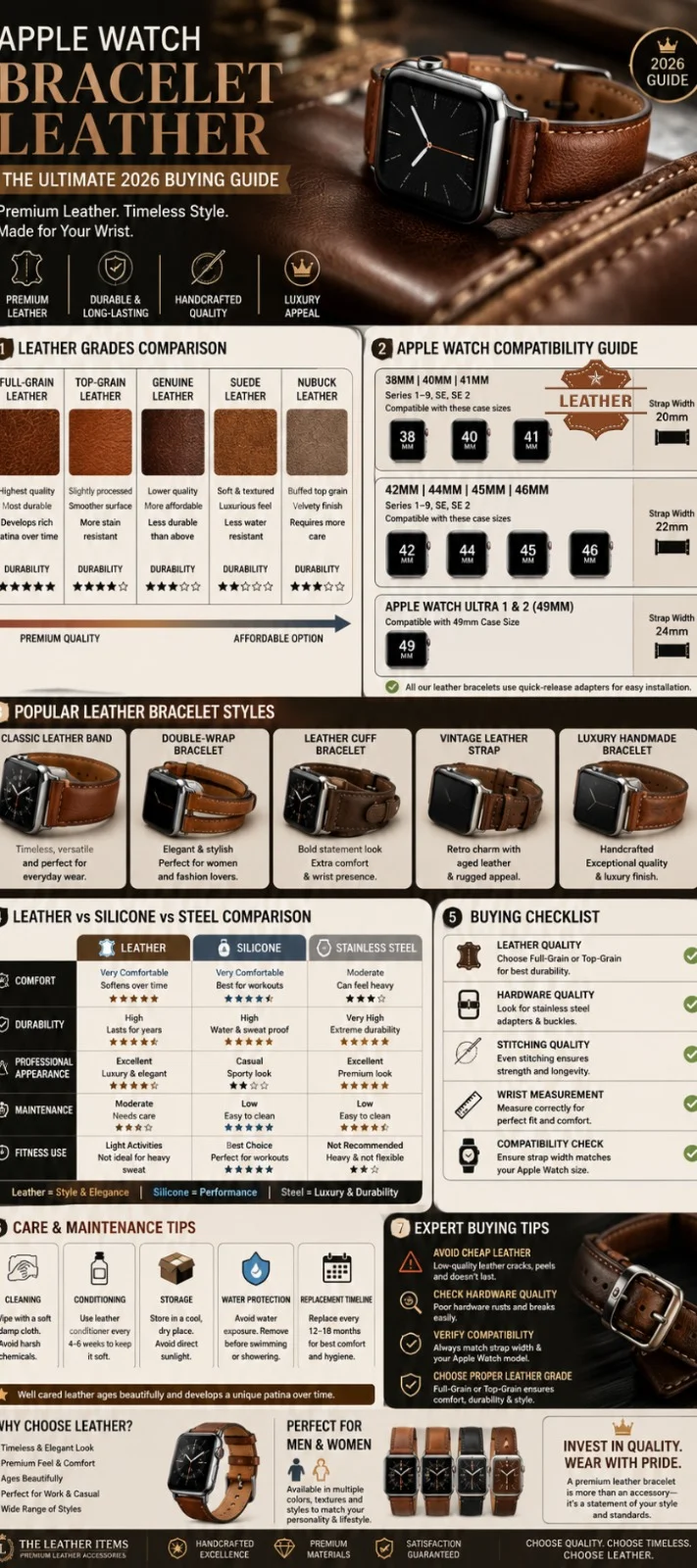
Types of Apple Watch Leather Bracelets
There is no single “best” leather bracelet. There are only different styles for different users.
Classic leather bands are the safest choice. They work for most buyers who want a clean, simple look.
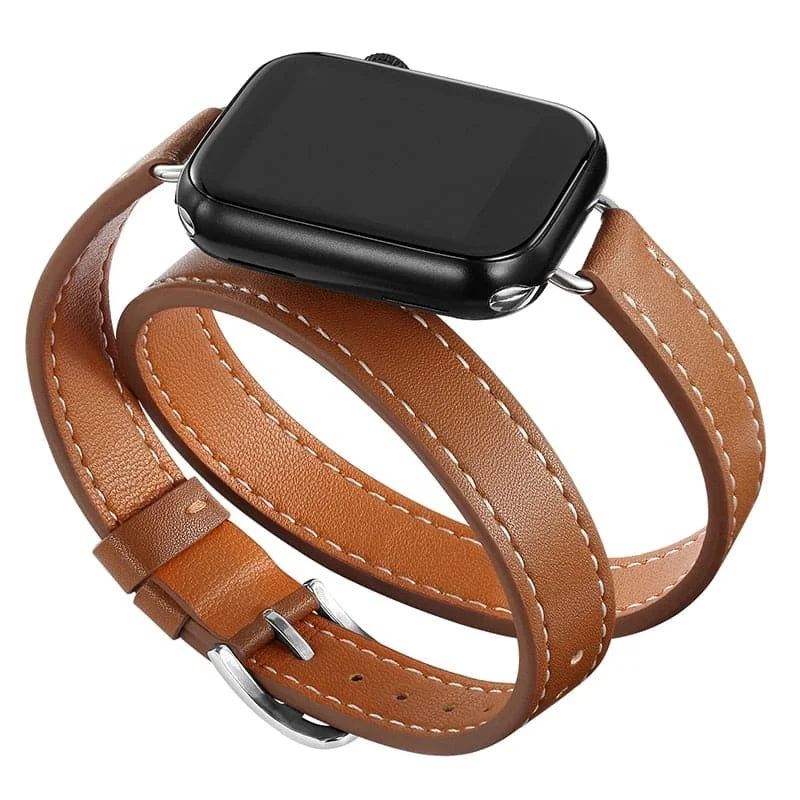
Double-wrap leather bracelets create a fashion-forward feel and add visual detail. They suit slimmer wrists and more expressive outfits.
Leather cuff styles feel bolder and more rugged. They work well for vintage looks, boots, and heavier accessories.
Minimalist leather straps are thin, clean, and easy to wear every day. These are ideal if you want the Apple Watch to stay understated.
Luxury handmade leather bracelets use better hides, better edge finishing, and stronger hardware. These are the best choices for buyers who care about long-term ownership.
Vintage leather designs often lean into visible grain, darker tones, distressed finishes, or antique-style buckles. They are great for people who want character rather than a glossy, modern look.
Leather Grades Explained
This is the section that separates a smart purchase from a disappointing one.
| Leather Type | What It Usually Means | Best For | Watch Band Verdict |
| Full-grain leather | The grain split of the hide, with only hair and epidermis removed | Premium straps, patina lovers, long-term wear | Excellent |
| Top-grain leather | Full grain that has been buffed or corrected for a more even look | Smooth, refined everyday bands | Very good |
| Genuine leather | A broad marketing term that can mean lower layers or more treated leather | Budget-minded buyers | Depends on build |
| Suede | A velvet-like nap finish is usually made from split leather | Soft fashion looks | Good, but delicate |
| Nubuck | Grain-side leather that has been buffed to create a velvety surface | Premium soft-touch straps | Very good, but needs care |
Full-grain leather is the strongest, Most Natural-Feeling option for many straps. The Leather Research Laboratory defines full grain as the grain split of a hide from which nothing has been removed except the hair and associated epidermis. Bellroy explains that top grain is full grain that has been buffed back to remove imperfections, while “genuine leather” can be a marketing umbrella that sometimes refers to lower layers of leather. Suede and nubuck are not the same either: suede is normally made from split leather with a velvet-like nap, while nubuck is grain-side leather that has been buffed to create a similar soft surface.
Which Leather Grade Is Best?
If you want the most natural aging and the strongest premium feel, full-grain leather is usually the best choice. As you want a smoother and more uniform look, top-grain leather is often the better fit. If you are buying on a budget, read the product details carefully when you see “genuine leather,” because the term alone does not tell you enough about quality.
Apple Watch Compatibility Guide
This is one of the most important parts of the buying process.
| Apple Watch Case Size | Official Compatibility |
| 38 mm, 40 mm, 41 mm | Compatible with each other |
| 42 mm, 44 mm, 45 mm | Compatible with each other |
| 46 mm | Compatible with 44 mm, 45 mm, and 46 mm cases |
| 49 mm | Compatible with 44 mm, 45 mm, or 46 mm cases |
This compatibility chart follows Apple’s official support guidance. Before buying any leather bracelet, confirm the case size first, then confirm the band listing says it supports that same connector group.
Why Compatibility Matters More Than Most Buyers Think
A lot of return requests come from simple size mistakes. The band may look stylish online, but if the connector group does not match, it will not be the right fit. That is why smart product pages should always show the Apple Watch case size clearly and not hide it inside the description.
How to Choose the Best Apple Watch Bracelet Leather
The best leather Apple Watch band is the one that matches your life, not just your outfit.
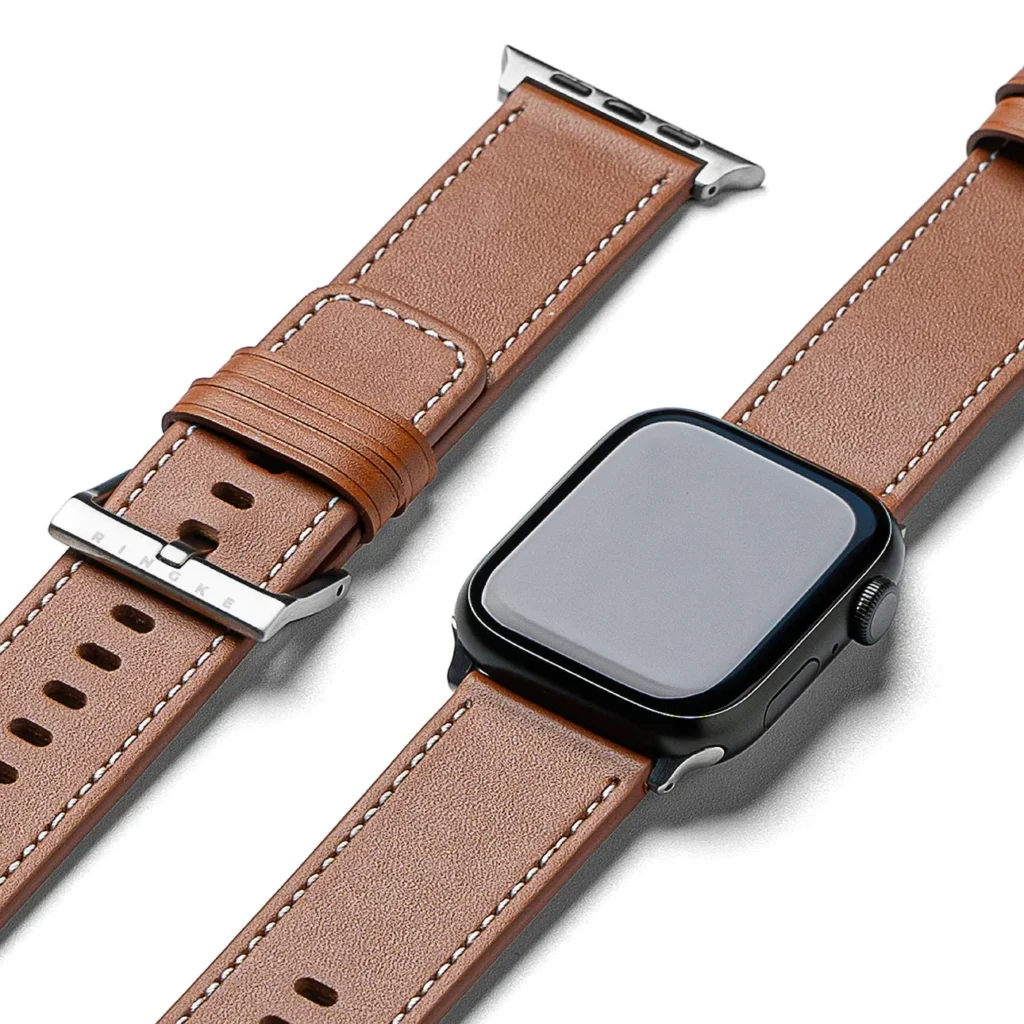
Look for leather quality first. If the seller does not explain the hide type, tanning method, or finish, that is a warning sign. Look next at hardware, because buckles, adapters, and spring bars should feel solid and align cleanly with the watch. Then inspect stitching. Even stitching, tidy holes, and reinforced stress points usually signal better build quality.
Next, think about thickness. Very thin leather can feel elegant, but it may crease too early. Very thick leather can look premium, but it may take longer to break in. For many buyers, the sweet spot is a strap that feels firm but not stiff.
Finally, choose the right closure style. Buckles feel classic. Deployment closures feel more refined. Magnetic systems feel modern, but they are not always the best choice for people who want a traditional bracelet look. Bellroy and Nomad both show how much value buyers place on hardware, fit, and finish when they shop in this category.
Best Apple Watch Leather Styles for Men
Men usually want one of four outcomes: a clean professional look, a minimalist daily strap, a rugged vintage feel, or a luxury finishing touch.
For business wear, choose dark brown, black, or deep tan leather with simple stitching and understated hardware. Minimalist styling, go for a smooth strap with low visual noise. For vintage enthusiasts, distressed leather, visible grain, and antique-style buckles work best. As luxury collectors, premium full-grain leather with excellent edge finishing and a thoughtful profile is the smartest choice.
A leather Apple Watch bracelet should support your wardrobe, not fight it. If you wear leather shoes, belts, briefcases, or jackets often, matching the tone and finish of your strap can make the watch feel much more intentional.
Best Apple Watch Leather Styles for Women
Women’s leather Apple Watch styling often balances elegance, versatility, and proportion.
For everyday wear, slim leather straps in black, taupe, blush, brown, or soft neutrals are easy to pair with most outfits. Fashion-forward looks, double-wrap designs, lighter colors, and more visible stitching can make the watch look like a fashion accessory. For luxury styling, choose clean lines, high-quality hardware, and leather that looks polished rather than bulky.
Double-wrap styles are especially good for buyers who want the watch to feel more like jewelry. The key is to keep the design balanced so it complements the wrist rather than overpowering it.
Leather Bracelet vs Silicone Band
| Factor | Leather Bracelet | Silicone Band |
| Style | More refined and dressy | Sporty and casual |
| Comfort | Comfortable for daily wear once broken in | Very flexible from day one |
| Water use | Not ideal | Excellent |
| Workouts | Not recommended by Apple | Best choice |
| Aging | Develops patina | Usually stays the same |
| Maintenance | Needs care | Easy to wipe clean |
Apple’s guidance is clear here: leather bands are not recommended for water or workouts, while bands intended for active use should be cleaned and dried differently. That makes silicone the better choice for gym sessions, rain, and sweat-heavy days. Leather wins when style matters more than moisture resistance.
Leather Bracelet vs Stainless Steel Bracelet
| Factor | Leather Bracelet | Stainless Steel Bracelet |
| Weight | Lighter | Heavier |
| Feel | Softer and warmer | Cooler and more rigid |
| Style | Casual to luxury | Formal to luxury |
| Maintenance | Requires leather care | Easier to Clean, but scratches can show |
| Best use | Daily fashion, office, travel | Dressier looks, metallic styling |
Apple also notes that stainless steel bands are not recommended for water or workouts either, so steel does not automatically solve the moisture question. The main difference is style and weight. Leather feels warmer and more versatile, while steel feels more jewelry-like and structured.
Apple Watch Ultra Leather Bracelet Guide
Apple’s Ultra line sits in the larger compatibility group, which means buyers should pay extra attention to case size and connector fit. Apple states that 46 mm cases are compatible with 44 mm, 45 mm, and 46 mm bands, and 49 mm cases are compatible with 44 mm, 45 mm, or 46 mm bands.
For Ultra buyers, leather can work beautifully for office wear, dinners, and daily commuting. It is less ideal for hiking in rain, swimming, or gym-heavy routines because Apple does not recommend leather bands for water or workouts. If you want an Ultra leather bracelet, look for stronger hardware, thicker leather, and a design that does not look too delicate beside the larger case.
How to Measure Your Wrist Correctly
Apple’s sizing guide is simple and practical. Print the size tool at 100%, cut it, place the wider end where you would wear the watch, and wrap it tightly around your wrist so it feels snug without sliding. Apple says to note the number the arrows point to and use that as your band size.
Wrist Measurement Steps
- Print the size guide at full scale.
- Cut the tool carefully.
- Place the wider end where the watch sits.
- Wrap it snugly around the wrist.
- Read the arrow number and match it to the band size.
A technically compatible strap can still feel wrong if it is too long, too short, or too stiff for your wrist shape. That is why wrist measurement matters as much as case compatibility.
Leather Bracelet Care and Maintenance
Apple’s care guidance is the safest baseline. For leather bands, Apple recommends wiping the leather with a nonabrasive, lint-free cloth, lightly dampening the cloth only if needed, never soaking the band, and letting it air-dry thoroughly before use. Apple also advises storing leather bands away from direct sunlight, high temperatures, and high humidity.
Simple Care Routine
- Wipe the band after wear.
- Let it breathe before storing.
- Keep it away from water, lotions, perfume, and sunscreen.
- Rotate between bands if you wear the watch every day.
- Store it flat or in a dry box, not in a hot bathroom or car.
Apple also notes that leather may change color over time because of normal wear and exposure to perfume, insect repellent, oil, lotion, or dyed fabrics such as denim. That is not automatically a defect. It is part of leather’s natural aging process.
How to Spot Better Craftsmanship
A high-quality Apple Watch leather bracelet usually shows the same signs as a good leather wallet or belt.
Look for:
- Even stitching
- Clean edge finishing
- Solid adapters
- Strong buckle plating
- Symmetry around the lug area
- Leather that bends smoothly instead of creasing sharply
Brands that emphasize Horween leather, patina development, warranty support, and purpose-built sizing are usually signaling a more serious construction standard than generic marketplace listings.
Worldwide Price Ranges
The market is wide, and current product pages show that clearly. In the sample reviewed, Maison Eternel lists Apple Watch bands from about €24.95 up to €179, Bellroy’s leather strap sits around $49 to $85, Nomad highlights premium Horween leather, and Apple’s own Hermès bands appear at $349. That spread shows the category running from affordable fashion buys to luxury accessories.
A practical way to think about pricing is this:
- Budget: simple leather, basic hardware
- Mid-range: better leather, better finishing, more reliable fit
- Premium: full-grain leather, stronger brand design, better warranty
- Luxury: fashion-house positioning, signature detailing, very high markup
Best Countries and Brands Famous for Apple Watch Leather Bracelets
The strongest premium leather band markets in the sample set come from Germany, France, and the United States. Fluco markets Apple Watch leather straps made in Germany, Maison Eternel emphasizes bands made in France, and Nomad highlights Horween leather, a famous American leather name used in premium accessories.
For buyers, the country matters less than the actual proof of quality. What matters most is whether the seller explains the leather type, the sizing, the hardware, the care rules, and the warranty.
Pros and Cons of Leather Apple Watch Bracelets
Pros
- Elegant and versatile
- Works with office and casual clothing
- Develops character over time
- Often looks more premium than silicone
- Can become a signature accessory
Cons
- Not good for water or workouts
- Needs maintenance
- May darken or patina with wear
- Quality varies a lot by brand
- Bad leather can crack or fray early
Apple’s own care guidance makes the trade-off clear: leather is beautiful, but it is not the right material for Moisture-Heavy use.
Common Buyer Mistakes to Avoid
- Buying by appearance only
A nice product photo does not prove good leather. - Ignoring case compatibility
Always match the band to the correct Apple Watch group. - Using leather for workouts
Apple does not recommend it. - Forgetting wrist size
Fit affects comfort more than most buyers expect. - Choosing weak hardware
A premium leather band can still fail if the adapters or buckle are poor. - Not checking care instructions
Leather needs proper drying and storage.
Who Should Buy an Apple Watch Leather Bracelet?
Leather is ideal for:
- Office professionals
- Style-focused buyers
- Watch collectors
- People who want a softer, warmer feel than steel
- Buyers who wear leather shoes, belts, or jackets often
Who Should Avoid It?
Leather is not ideal for:
- Gym-first users
- Swimmers
- People who sweat heavily all day
- Buyers who want one band for every activity
- Anyone who prefers low-maintenance, wipe-clean accessories
Future Trends in the Leather Watch Band Market
The future of premium leather accessories is moving toward traceability, responsible sourcing, and better audit standards. The Leather Working Group says it is a global not-for-profit, multi-stakeholder organization focused on sustainable leather sourcing and production, and it offers multiple standards across the leather supply chain. That makes certification and transparency increasingly important for premium buyers.
The style side is also moving toward cleaner profiles, better hardware, and more versatile colors. Buyers want leather that looks elevated in the office but not too formal on weekends. That is why minimalist straps, fine stitching, and balanced thickness are likely to remain strong in the market.
People Also Ask
A: Yes, if you want style, comfort, and a more refined look. They are especially worth it for office wear and everyday fashion. They are not the best choice for water or workouts.
A: They can get wet, but Apple does not recommend it. Leather bands are not water resistant, and soaking can damage the material.
A: That depends on leather grade, wear habits, sweat exposure, and care. Well-made leather can last a long time if it is rotated, cleaned gently, and kept dry. Apple also notes that leather naturally ages and changes over time.
A: In general, full-grain leather is the strongest and most natural-feeling option, while top-grain is a smoother, more refined alternative. The right choice depends on whether you value character or uniformity.
Conclusion
The best Apple Watch bracelet leather is not the Flashiest One. It is the one that fits your case properly, suits your wrist, uses the right grade of leather, and matches how you actually live. If you want style, warmth, and a more refined look than silicone, leather is still one of the best Apple Watch upgrades you can buy. If you want one band for sports and water, it is the wrong material. Apple’s current guidance makes that distinction very clear.
For TheLeatherItems.com, this topic is a strong pillar opportunity because it can connect product advice, leather education, maintenance, and style into one authoritative page. Add supporting articles, link them together, and keep the advice practical. That is how this topic becomes a real topical authority page instead of another thin shopping guide.
Legal disclaimer: Leather quality, pricing, manufacturing standards, and product availability may vary by country, brand, and supplier. Always verify authenticity, material details, compatibility, and care instructions before purchase.