Introduction
A Leather Chesterfield Sofa is one of those rare furniture pieces that never really disappears. It changes with the room, the era, and the styling, but the silhouette stays unforgettable: deep button tufting, rolled arms, and a low, stately profile. That is exactly why the Chesterfield still matters in 2026. It is part heritage piece, part luxury anchor, and part practical seating solution for homes that want both character and durability.
What most shoppers need today is not just a definition. They need to know which leather is worth paying for, how to spot a well-made sofa, whether the style works in modern interiors, how to size it correctly, and how to keep it looking rich instead of tired. That is what this guide covers in detail, so you can choose a Chesterfield that feels timeless, fits your room, and still makes sense for everyday living.
What Is a Leather Chesterfield Sofa?
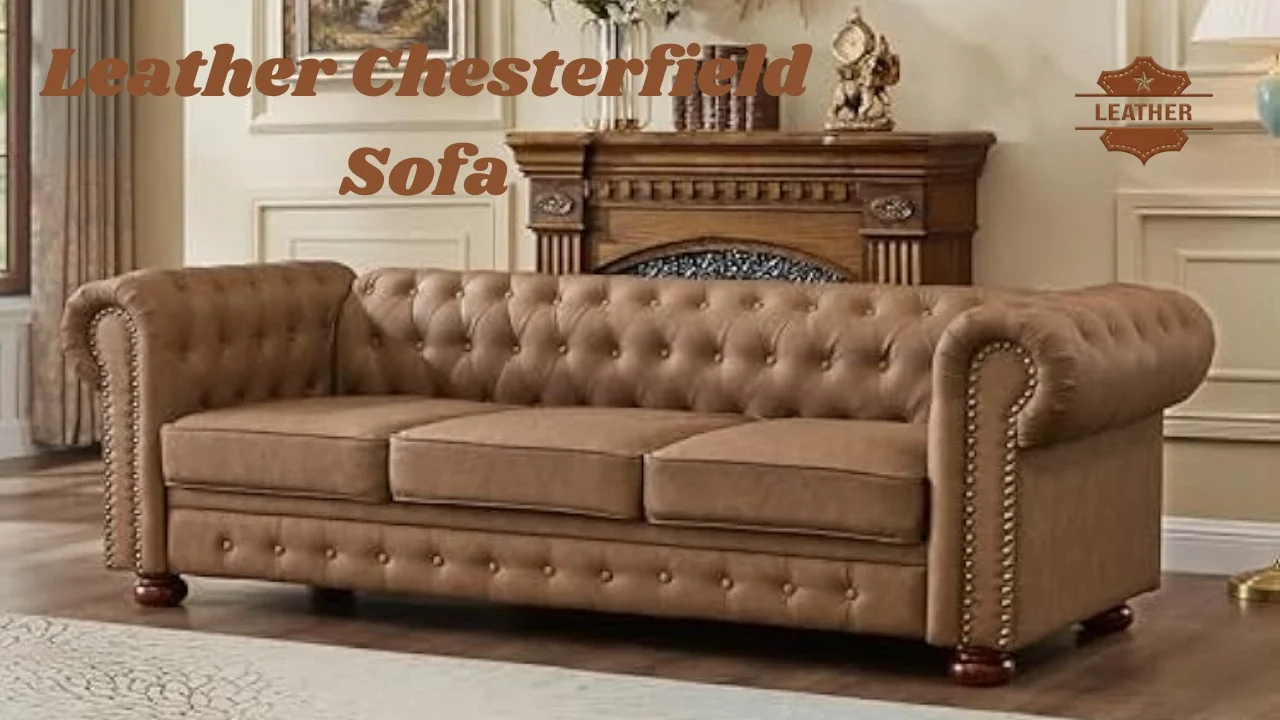
A Chesterfield sofa is a classic upholstered sofa style usually identified by deep button tufting, rolled arms that sit at the same height as the back, and a structured, upright shape. In modern usage, the term is often applied to large, tightly stuffed sofas upholstered in leather, though the style now appears in fabric, velvet, and contemporary reinterpretations too.
The leather version is the most iconic. Traditionally, it is associated with rich brown tones, formal rooms, libraries, clubs, and masculine interiors, but modern designers now use it in living rooms, apartments, and open-plan spaces where a strong focal point is needed.
History and Evolution of the Chesterfield Sofa
The Chesterfield’s origin story is closely tied to late 18th-century England, although historians still debate the exact provenance. The widely repeated story links it to Lord Philip Stanhope, the 4th Earl of Chesterfield, who wanted a seat that let guests sit upright without wrinkling their clothes. That story may be partly folklore, but the design’s association with British sophistication is well established.
The sofa’s early construction relied on firm stuffing and tufting to hold shape, and later versions evolved as materials changed. Horsehair filling gave way to foam, coil spring systems were updated, and designers began varying seat depth, arm height, and upholstery to suit modern tastes. That is why the Chesterfield survives: the silhouette stayed recognizable while the comfort profile kept adapting.
Today, the Chesterfield appears in classic homes, luxury apartments, clubs, hotel lobbies, and modern interiors. Designers continue to reinterpret it in new materials and cleaner shapes, which is a big reason the style still feels current instead of old-fashioned.
Why Leather Chesterfield Sofas Still Matter in 2026
The Chesterfield still works because it solves two problems at once: it delivers visual drama and it brings lasting function. Leather adds warmth, depth, patina, and a premium feel that many shoppers want in a statement sofa. It also ages in a way that can look better over time, especially when cared for properly.
It also fits today’s design language better than many people expect. Modern interiors often use leather sofas as an anchor against softer textures like wool, cashmere, linen, rugs, and warm lighting. That mix of hard and soft materials gives the room balance and makes the sofa feel intentional rather than heavy.
Types of Leather Used in Chesterfield Sofas
1) Full-Grain Leather
Full-grain leather keeps the outer natural grain intact. It is generally considered the most premium, durable, and character-rich option because it preserves the hide’s natural surface and develops patina over time.
2) Top-Grain Leather
Top-grain leather is still high quality, but the outer layer is corrected or refined for a smoother, more uniform look. It remains durable and is often chosen when buyers want a cleaner finish with less visible natural marking.
3) Genuine Leather
“Genuine leather” is real leather, but the term is much broader and usually sits below full-grain and top-grain in the market conversation. Because the label can be vague, buyers should always ask what layer of the hide was used and what finish is on it.
4) Split Leather / Corrected Leather
These are more processed leathers that may be smoothed, coated, or adjusted for appearance consistency. They can work for budget-conscious buyers, but they usually do not age with the same depth of character as premium full-grain or quality top-grain leather.
5) Faux Leather / PU
Faux leather is synthetic, which means it is not the same as natural leather in feel, aging, or Breathability. It can be more affordable and easier to standardize, but it does not develop the same patina as real leather and may wear differently over time.
Leather comparison table
| Leather type | Look and feel | Durability | Aging over time | Best for |
| Full-grain | Natural, rich, premium | Very high | Develops strong patina | Luxury buyers, heirloom pieces |
| Top-grain | Smooth, refined, cleaner | High | Ages well, less rustic | Most premium practical buyers |
| Genuine leather | Real leather, but variable | Medium to high | Depends on finish | Mid-range shoppers who want real leather |
| Corrected/split leather | More uniform, processed | Medium | Less character | Budget-sensitive buyers |
| Faux leather | Synthetic, consistent | Variable | No natural patina | Lower-cost, easier-maintenance purchases |
This table is a practical buying summary based on the leather-grade descriptions and authenticity guidance from the manufacturer and the leather industry sources.
How to Identify a High-Quality Leather Chesterfield Sofa
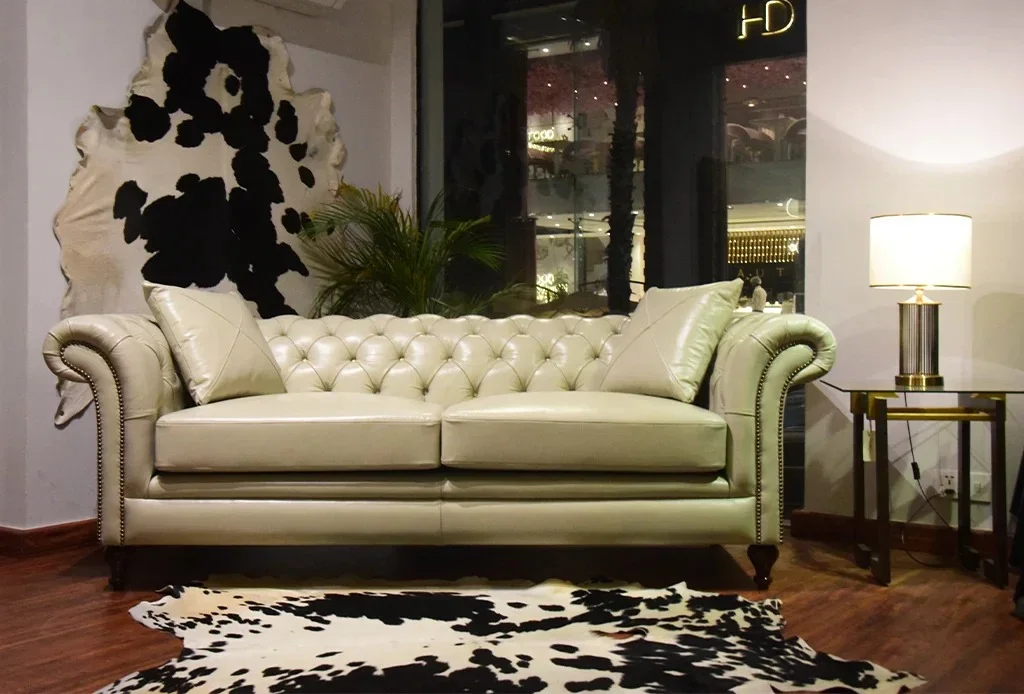
A good Chesterfield should feel solid before you even sit on it. Quality makers commonly use a solid hardwood, kiln-dried frame, hand-built joinery, strong stitching, and quality spring systems. S.W. James describes this style of construction with dowelled and stapled hardwood frames, hand-stitching, and no-sag springs, which is the kind of detail buyers should look for when comparing options.
Look for these signals:
- a firm, stable frame with little movement,
- deep, even tufting,
- neat stitching and clean button placement,
- leather that looks natural rather than overly plastic,
- and cushioning that supports the body without collapsing immediately.
Architectural Digest notes that Chesterfields are often favored by people who like a firmer seat rather than a soft, sink-in sofa, so comfort expectations should match the design.
Buyer shortcut
If the sofa feels light, overly shiny, or too perfectly uniform, treat that as a warning sign. Authentic premium leather usually shows more depth, grain, and natural variation.
Best Leather Chesterfield Sofa Colors
Brown Leather Chesterfield Sofa
This is the most traditional choice. It feels warm, classic, masculine, and easy to pair with wood, brass, navy, olive, cream, and deep green. It is still the color most people imagine when they picture a Chesterfield.
Black Leather Chesterfield Sofa
Black feels sharper and more modern. It works well in contemporary living rooms, offices, and moody interiors where the sofa should look sophisticated rather than rustic. Recent interiors coverage shows black leather sofas being styled successfully with soft textiles and warm light to keep the room from feeling cold.
Cognac / Tan / Oxblood
These shades are especially strong for Pinterest-friendly interiors. They add depth, warmth, and a vintage feel without being too dark. They also work well with wood, linen, vintage rugs, and matte metal finishes.
Green or Cream
Green creates a moody luxury look. Cream and white create a softer, more contemporary version of the Chesterfield, especially in bright interiors. DFS notes that modern tastes increasingly include lighter, more contemporary shades, especially in fabric versions, and the same styling logic carries over to leather-like finishes and modern leather tones.
Modern vs Traditional Chesterfield Sofas
| Feature | Traditional Chesterfield | Modern Chesterfield |
| Shape | Upright, formal, classic | Slightly relaxed, sometimes lower and slimmer |
| Arms | Rolled | Rolled or softened |
| Tufting | Deep and prominent | May be lighter or less dense |
| Materials | Often rich leather | Leather, velvet, mixed materials |
| Best room style | Classic, British, library, club | Contemporary, transitional, luxury modern |
| Mood | Formal, heritage, masculine | Fresh, versatile, design-led |
DFS describes Chesterfields as falling broadly into timeless/traditional and modern/contemporary camps, while AD shows how designers keep reworking the silhouette with new materials, seat depth, and arm details.
Best Rooms for a Leather Chesterfield Sofa
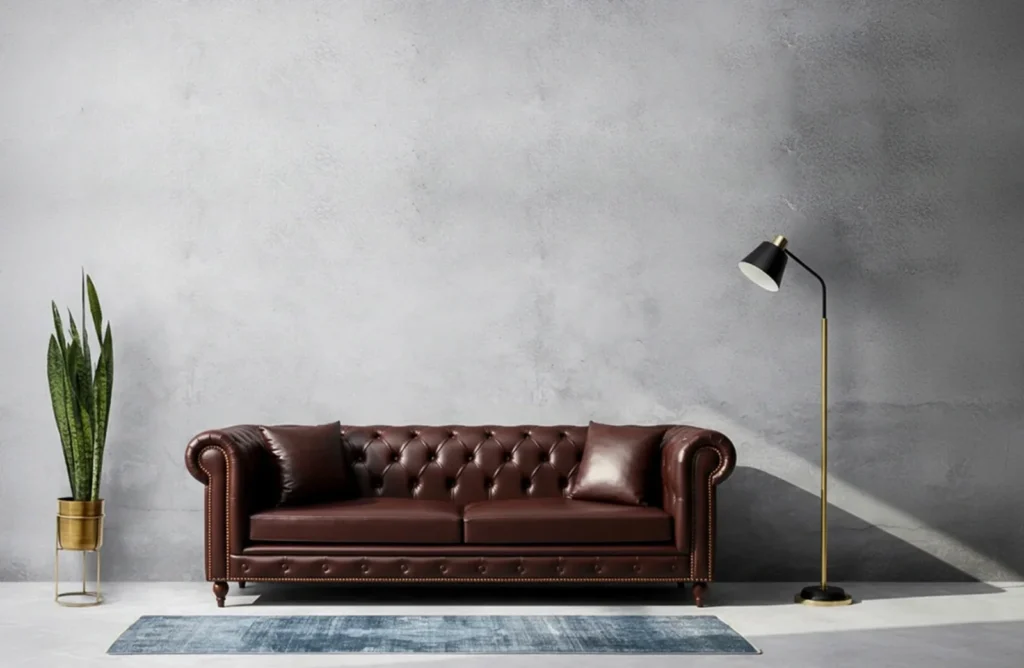
A leather Chesterfield works best where you want a clear focal point:
- living rooms,
- home offices,
- studies,
- libraries,
- Boutique Hospitality spaces,
- and luxury apartments.
Its shape creates instant presence, which is why it appears so often in rooms that want a formal or curated feel. DFS also notes that a 2-seater version can fit smaller living rooms or home offices, while 3-seaters suit more relaxed family use.
Leather Chesterfield Sofa Living Room Ideas
A Chesterfield does not need to make a room look old. In fact, it often looks best when you contrast its heritage shape with modern materials. Architectural Digest shows Chesterfields paired with floral sectionals, stripes, velvet, and contemporary design elements, proving the silhouette can move across multiple interior styles.
Here are the strongest styling directions:
Industrial modern
Use dark leather, black metal, aged wood, and a textured rug.
Scandinavian luxury
Use warm neutral walls, light wood, linen curtains, and simple decor.
Dark academia
Use walnut, antique brass, book storage, moody paint, and layered textures.
Organic modern
Use natural fiber rugs, muted cushions, stone, wood, and warm lamps.
Masculine luxury
Use deep brown or black leather, oversized art, thick rugs, and a low coffee table.
Recent design coverage also shows that leather sofas feel most contemporary when balanced with soft textiles, warm lighting, and layered texture rather than heavy matching furniture.
Styling tips that actually work
Use:
- two to three cushions,
- one throw blanket,
- a textured rug,
- a wood, glass, or stone coffee table,
- and warm table or floor lamps.
Swyft and homes-and-gardens style coverage both point to cushions, tactile layers, and warm light as simple ways to soften the formal presence of a leather Chesterfield.
Chesterfield Sofa Sizes Explained
| Size | Best for | Notes |
| Loveseat / 2-seater | Small rooms, offices, apartments | Keeps the Chesterfield look in a smaller footprint. |
| 3-seater | Family rooms, everyday living | Gives more stretch-out room and guest seating. |
| 4-seater / grand | Large living rooms | Strong statement piece for bigger interiors. |
| Sectional / corner Chesterfield | Modern open-plan spaces | More contemporary, more flexible. |
A 2-seater is a smart choice for smaller rooms or home offices, while a 3-seater is the safer all-rounder for daily lounging and guests. That sizing logic is already reflected in leading buying guides, but most competitors stop there instead of explaining how the room actually feels with each size.
Chesterfield Sofa vs Other Sofa Styles
Chesterfield vs Modern Sofa
A Chesterfield has more visual weight, more heritage, and a stronger statement profile. A modern sofa usually feels softer, lighter, and less formal. Choose a Chesterfield when the room needs character; choose a modern sofa when the room needs quiet minimalism. This is an expert design inference based on how current editors and designers describe the style’s adaptability.
Chesterfield vs Lawson Sofa
The Chesterfield is more structured and upright. A Lawson sofa usually feels more casual and cushion-forward. If you want a tailored, luxury focal point, the Chesterfield wins. If you want relaxed lounging, Lawson is the easier daily companion.
Chesterfield vs Tuxedo Sofa
Both can look formal, but the Chesterfield is more traditional and ornate. A tuxedo sofa is cleaner-lined and more modern. The Chesterfield brings heritage texture; the tuxedo brings simplicity.
Chesterfield vs Sectional
A Chesterfield sectional is more practical for big families or open rooms, but the classic Chesterfield sofa has a stronger icon factor. If your goal is design impact, the classic silhouette still wins.
Pros and Cons
Pros
- timeless design,
- premium appearance,
- strong visual identity,
- durable when well-made,
- Patina can improve character over time,
- works in both Classic and Modern rooms.
Cons
- usually more expensive,
- can feel firm,
- may dominate small rooms,
- heavy and harder to move,
- Cheap versions can look fake or flat.
Complete Buying Guide
When buying a leather Chesterfield sofa, focus on the order below:
- Frame first
Look for a kiln-dried hardwood or another strong hardwood frame. - Leather second
Ask whether it is full-grain, top-grain, or another finish. Do not assume “genuine leather” automatically means premium. - Seat feels third
Decide whether you want firm support or a softer seat. Chesterfields are often firmer by design. - Size fourth
Measure wall length, walking clearance, and doorway access before buying. - Finish last
Choose a color that matches your room’s lighting and material palette. Brown and oxblood feel heritage-heavy, while black and cream feel more contemporary.
Quick buying checklist
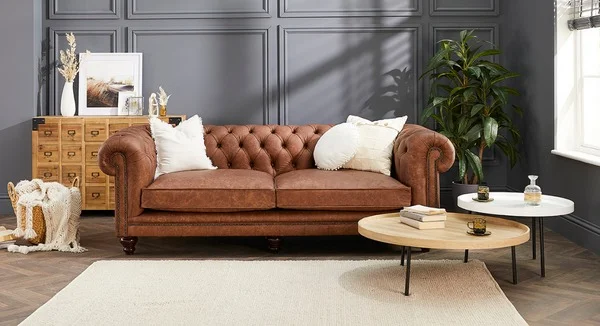
- solid frame,
- even tufting,
- strong stitch lines,
- quality leather with natural depth,
- comfortable seat height,
- correct room scale,
- clear warranty or authenticity details.
If the listing does not explain construction, leather type, or dimensions clearly, that is usually a warning sign rather than a bargain.
Worldwide Price Ranges
Prices vary a lot by country, leather grade, maker, and craftsmanship level. In the sources reviewed, DFS shows UK Chesterfield pricing examples around £800 to £4,000 for 3-seater models, while Architectural Digest’s shopping examples show Chesterfield-style pieces from about $2,499 to $7,700. That gives a practical market picture: entry-level, mid-range, and premium pieces can differ dramatically depending on build and brand.
A useful buying framework is:
- Budget: entry leather or leather-look construction,
- Mid-range: quality top-grain leather and decent framework,
- Premium: full-grain or hand-finished leather with stronger construction,
- Luxury: handmade pieces with high-end leather, custom sizing, and stronger comfort engineering.
Best Countries and Brands Famous for Chesterfields
The style is strongly associated with England and the broader British furniture tradition, but Italy also plays an important role in modern reinterpretation. AD notes the design’s British roots and global evolution, while its coverage of Poltrona Frau highlights how Italian makers modernized the Chesterfield spirit for local tastes.
Well-known makers in the research sample include DFS, Timothy Oulton, S.W. James, Chesterfield Sofa Company, and Chesterfield.com. Each leans into a different angle: retail convenience, modern luxury, craftsmanship, maintenance support, or heritage authenticity.
Budget-Friendly Options
If budget matters, prioritize top-grain or well-finished genuine leather over vague “premium” language. A simpler leather finish, a smaller size, or a 2-seater format can preserve the Chesterfield aesthetic without pushing you into luxury pricing. DFS’s size and style guidance makes clear that smaller versions are a practical route for compact rooms.
Premium and Luxury Options
Premium Chesterfields usually stand out because of the frame, the leather, and the handwork. S.W. James emphasizes hand-finished top-grain leather, solid hardwood framing, and hand-stitched spring work, while AD shows that high-end designs may also be customized in modern colors, materials, or seat profiles. That combination is what turns a sofa into a true investment piece.
Common Buyer Mistakes to Avoid
1) Buying on appearance alone
A sofa can look expensive online and still have weak internals. Always ask about the frame and springs.
2) Ignoring room size
A Chesterfield is visually strong, so a large model can overwhelm a small room. DFS explicitly recommends 2-seaters for smaller spaces and home offices.
3) Choosing the wrong comfort profile
If you want a deep, sink-in sofa, a classic Chesterfield may disappoint. AD notes the style is often preferred by people who like a firmer seat.
4) Not checking the leather type
“Real leather” is not enough information. Ask what grade and finish you are buying.
5) Forgetting maintenance
Leather looks better when it is cleaned gently and conditioned appropriately. Ignore care, and cracks or dullness arrive faster than they should.
How to Clean and Maintain a Leather Chesterfield Sofa
A simple routine works best. Chesterfield Sofa Company recommends removing dust with a soft dry cloth, using a vacuum with a soft brush attachment for seams and deep buttoning, and doing a deeper clean with a leather-specific cleaner. They also warn against harsh all-purpose sprays or supermarket wipes because those can damage the surface.
A practical care routine:
- Dust weekly with a dry Microfiber Cloth.
- Vacuum seams and tufting with a soft brush attachment.
- Blot spills immediately.
- Use a leather-specific cleaner sparingly when needed.
- Condition based on environment and use, not on a rigid calendar.
Avoid direct sun where possible, keep the sofa away from extreme heat, and do not use harsh alcohol-based cleaners. Leather ages beautifully when the moisture balance is respected, not stripped.
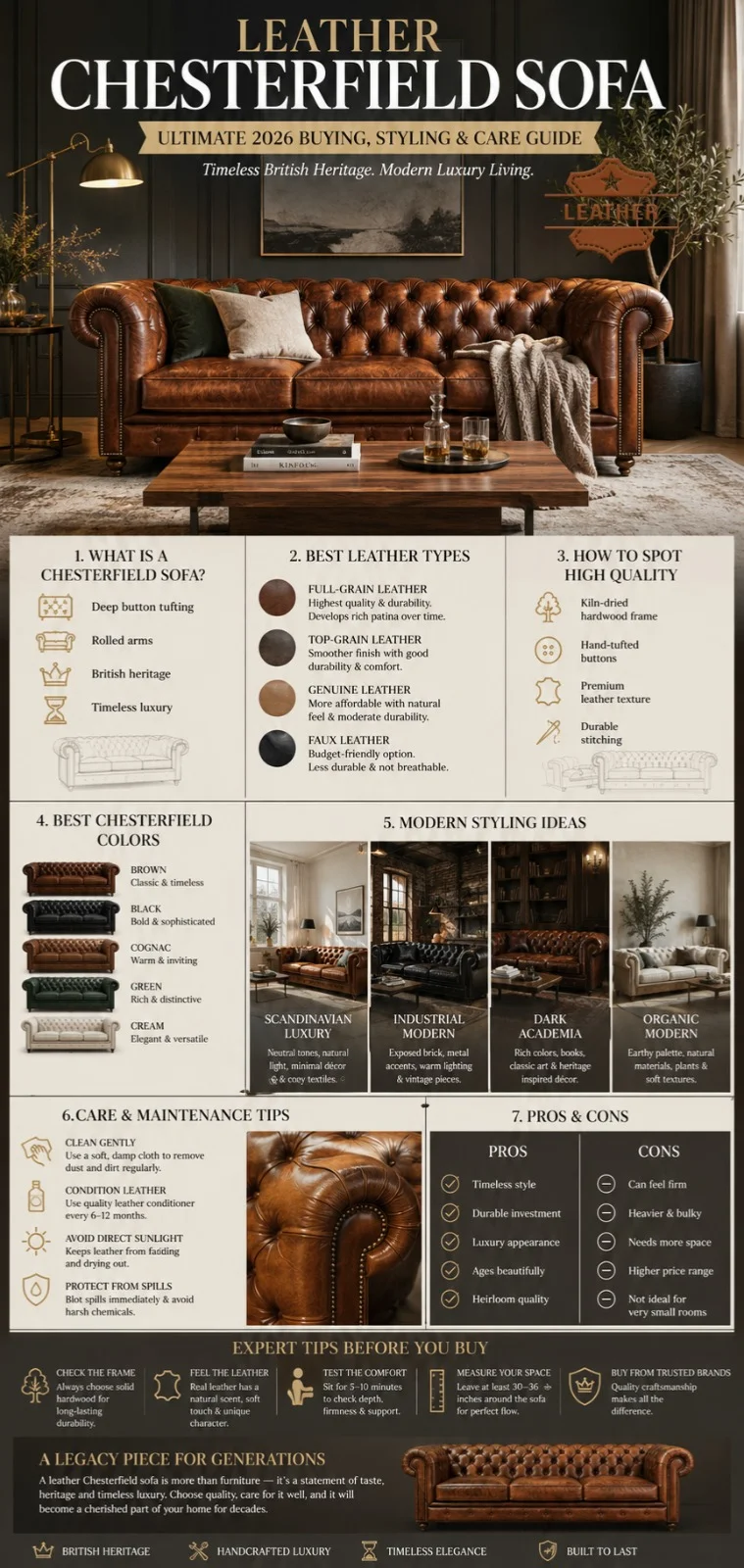
Expert Tips Most Buyers Ignore
- Choose the sofa after checking the room from the doorway, not just from the center of the room.
- Match the sofa’s visual weight to your coffee table and rug size.
- Use one or two accent textures that contrast with leather, such as wool, linen, or boucle.
- For a modern look, add fewer but larger accessories instead of many small ones.
- If the room is dark, choose a warmer leather tone instead of an almost-black finish.
These tips align with the design pattern seen in current interior coverage: leather sofas feel strongest when balanced by texture, light, and contrast rather than left to dominate a room alone.
Who Should Buy a Leather Chesterfield Sofa
A leather Chesterfield is a great fit for someone who wants:
- a statement sofa,
- a classic luxury look,
- a durable long-term piece,
- a more structured seat,
- and a sofa that adds instant character to a room.
It is especially good for buyers who like heritage style, masculine interiors, rich materials, and furniture that can age into the room instead of fighting it.
Who Should Avoid It
A leather Chesterfield may not be the best fit if you want:
- a very soft, sink-in lounge sofa,
- ultra-light minimalism,
- a low-budget disposable piece,
- or a sofa that disappears visually into the room.
AD’s comfort commentary makes it clear that Chesterfields are not for everyone, especially buyers who want a softer, deeper sit.
Future Trends in Chesterfield Design
The Chesterfield is not going away. The future is about refinement: lighter silhouettes, flexible dimensions, updated leather finishes, mixed materials, and modern colors that still respect the original form. AD’s 2025 coverage and designer commentary show the style continuing to evolve with new back, leg, arm, and upholstery combinations.
Expect to see more:
- contemporary brown and black leather tones,
- softer seat depth options,
- mixed-material Chesterfields,
- apartment-size versions,
- and luxury reinterpretations that keep the tufting but reduce the heavy club-room look.
People Also Ask
A: Yes, but they are usually more structured than plush. Many buyers like the firmer seat and upright support, while others prefer a softer sofa with deeper cushioning.
A: No. Current design coverage shows Chesterfields still being used in modern homes, clubs, and luxury interiors because the silhouette adapts well to new materials and styling.
A: Full-grain is the most premium and character-rich, while top-grain is often the best balance of quality, appearance, and practicality. The best choice depends on your budget and how much natural patina you want.
A: A well-made Chesterfield can last many years, especially when it uses a strong frame, quality leather, and proper care. Construction and maintenance matter more than the style name alone.
A: Brown is still the safest timeless choice because it fits the Chesterfield’s heritage story and works with wood, brass, and neutral interiors. Black is more modern; cream is softer; green feels moodier and more design-led.
Strong Practical Summary
A leather Chesterfield sofa is worth considering when you want a sofa that feels iconic, durable, and visually powerful. It is not the softest sofa, and it is not the lightest style, but that is exactly why it works. When the frame is strong, the leather is honest, and the room styling is balanced, the Chesterfield becomes one of the most rewarding furniture investments you can make.
For readers on TheLeatherItems.com, this is the kind of article that can build trust around leather craftsmanship while also opening the door to more related leather education content. The smartest next pages to internally link are your guides on Full Grain vs Genuine leather, how to clean leather, leather care mistakes, and best leather gifts.
Legal disclaimer: Leather quality, pricing, manufacturing standards, and product availability may vary by country, brand, and supplier. Always verify authenticity, material details, and care instructions before purchase.