Introduction
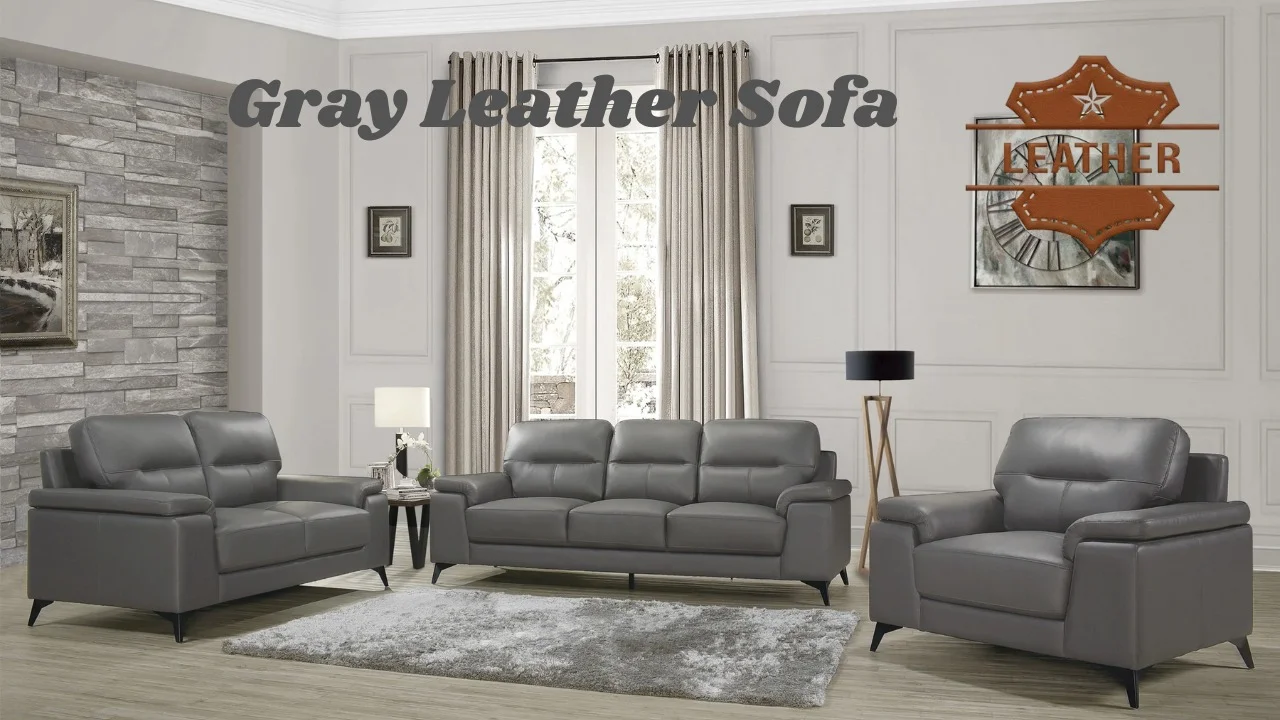
A Gray Leather Sofa is one of the safest and smartest furniture choices for a modern home. It looks elevated, works with almost every décor style, and gives you a neutral base that can be restyled again and again without replacing the sofa itself. In 2026, buyers are not just asking, “Does it look good?” They are asking, “Will it fit my room, my lifestyle, my pets, my budget, and my long-term plans?”
That is exactly why this guide exists. Gray leather is still popular because it can feel sleek, calming, and premium at the same time, while leather itself remains valued for durability, easy cleaning, and its ability to develop character over time. The right choice depends on the gray shade, the leather grade, the sofa shape, and the way you actually live day to day.
This guide gives you the full picture: how to choose the right gray leather sofa, how to style it, how to maintain it, what leather types to avoid, and how to make sure it still feels timeless five or ten years from now.
What Is a Gray Leather Sofa?
A gray leather sofa is simply a sofa upholstered in leather that falls somewhere in the gray family, from pale misty gray to deep charcoal. The appeal is that gray acts as a flexible neutral, so the sofa can support modern, minimalist, industrial, Scandinavian, transitional, or even classic interiors without fighting the rest of the room. Styling articles consistently show gray leather working in light neutral spaces, industrial rooms, mid-century settings, and monochrome luxe interiors.
Snippet-ready answer:
A gray leather sofa is a neutral seating piece that blends durability with style. It works well in modern, minimalist, industrial, Scandinavian, and luxury interiors because gray is easy to coordinate and leather is easy to maintain.
Why Gray Leather Sofas Matter in 2026
Gray is still one of the most useful colors in interior design because it can look cool and contemporary, or warm and inviting, depending on undertone and styling. Recent design coverage also shows a shift toward softer neutrals such as greige and warm gray, which makes gray leather even more relevant when paired with wood, textured fabrics, and warmer accents.
Leather also stays attractive in 2026 because buyers want furniture that feels premium but still works for everyday life. Industry and retailer guidance continues to emphasize leather’s durability, cleanability, and long-term aging potential, especially when buyers choose the right grain and finish for their lifestyle.
Different Types of Gray Leather Sofas
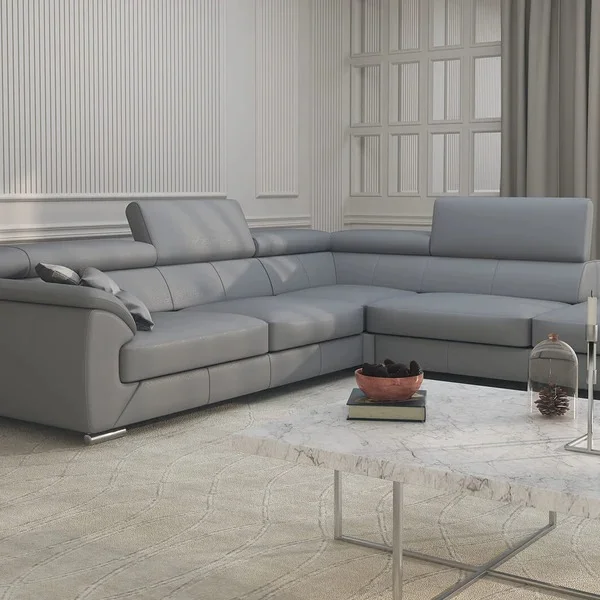
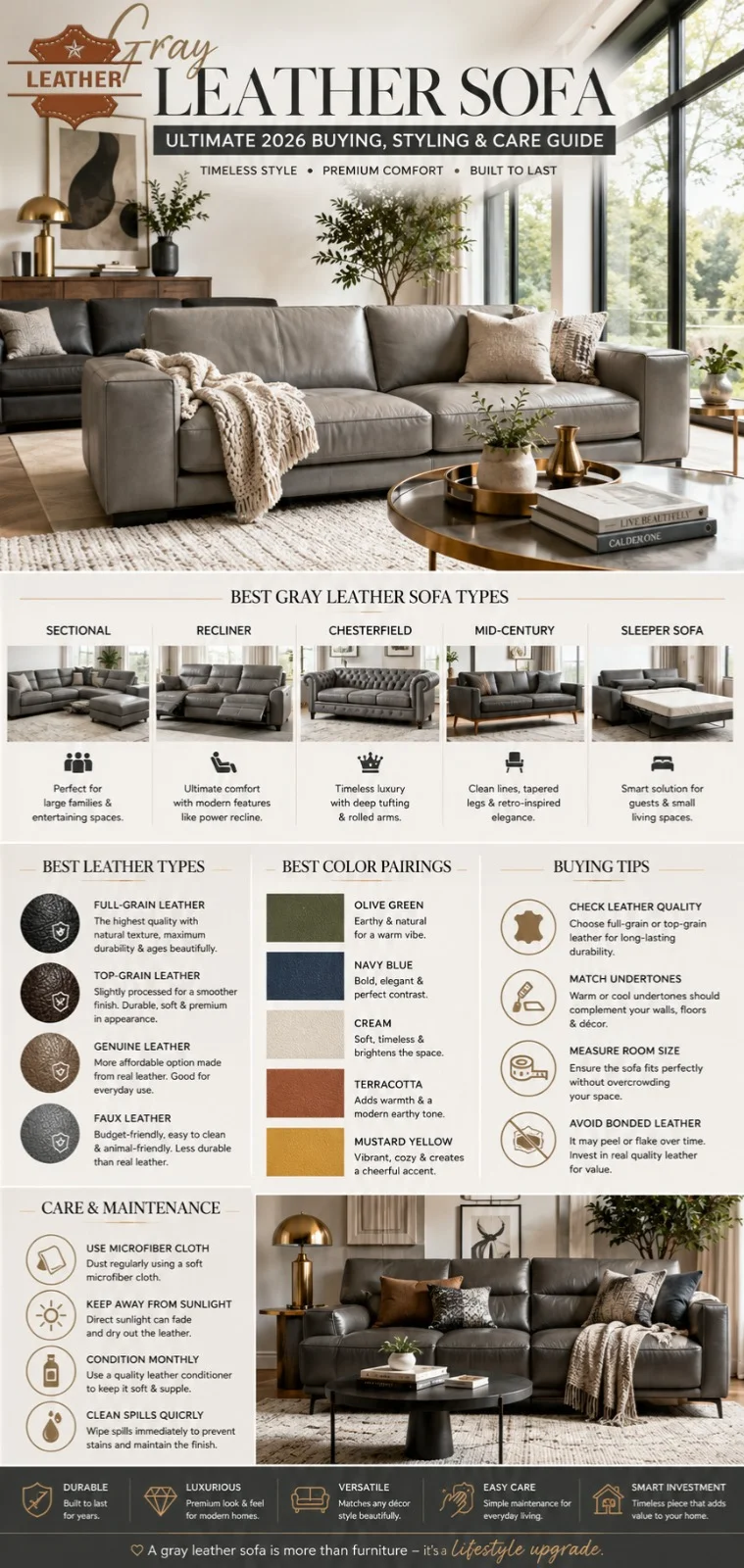
1. Gray Leather Sectional Sofa
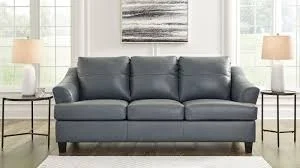
Best for open-plan living rooms, family homes, and entertainment spaces. Sectionals create a strong focal point and offer more seating, which is why they are common in modern homes and large living rooms.
2. Gray Leather Recliner Sofa
Best for movie rooms, comfort-first homes, and family spaces. Modern recliners now often include power features and concealed comfort upgrades while still keeping a sleek profile.
3. Gray Leather Sleeper Sofa
Best for apartments, guest rooms, and multifunctional living spaces. A sleeper adds versatility without sacrificing the visual calm of a gray leather finish. This is a smart option when one room must do several jobs.
4. Gray Leather Chesterfield Sofa
Best for classic, masculine, or luxury interiors. The button-tufted look gives the sofa more formality and makes it feel more decorative.
5. Gray Leather Mid-Century Sofa
Best for clean-lined homes, urban apartments, and Scandinavian spaces. Tapered legs and lower profiles keep the design light and modern.
Choosing the Right Shade of Gray
Not all gray sofas look or feel the same. The undertone determines whether the room feels warm, crisp, moody, or airy.
| Gray Shade | Room Effect | Best For | Pairs Well With |
| Light gray | Airy, soft, open | Small rooms, bright spaces | White walls, oak wood, cream textiles |
| Mid gray | Balanced, flexible, timeless | Most living rooms | Wood, black accents, beige, muted colors |
| Dark gray / charcoal | Dramatic, grounded, sophisticated | Large rooms, lofts, media spaces | Brass, black, glass, walnut |
| Warm gray / greige | Cozy, welcoming, adaptable | Transitional and family homes | Beige, taupe, natural textures |
| Cool gray | Crisp, modern, sharp | Contemporary interiors | Chrome, black, glass, concrete |
This shade logic is strongly supported by current gray-sofa styling content, which shows that lighter grays work well for compact or airy rooms, while charcoal and dark gray create stronger contrast in larger or more dramatic layouts.
Leather Types Used in Gray Sofas
This is where many buyers make expensive mistakes. A gray sofa can look amazing in photos and still be a poor purchase if the leather type is wrong for the household.
| Leather Type | Main Benefit | Main Drawback | Best For |
| Full-grain leather | Most natural, most durable, develops rich patina | Usually more expensive and shows character | Long-term buyers, premium homes |
| Top-grain leather | Smooth, refined, easier day-to-day care | Less natural texture than full-grain | Families, modern homes |
| Genuine leather | Real leather category, usually more affordable | Quality can vary widely | Mid-budget buyers |
| Suede/nubuck | Soft, upscale feel | More delicate, harder to care for | Low-traffic, style-focused spaces |
| PU / faux leather | Budget-friendly, easy wipe-down | Can wear, crack, or peel faster | Short-term or budget-conscious use |
| Bonded leather | Lowest entry price | Most likely to peel and age poorly | Generally not ideal for a Long-Term Sofa |
Full-grain leather keeps the natural grain and is repeatedly described as the most durable and breathable option; top-grain is sanded and refined for a smoother appearance and easier everyday care. Bonded and faux leather are far more likely to peel or flake over time because they rely on synthetic coatings or composite construction.
Practical takeaway:
If this is a forever sofa, look first at full-grain or top-grain. If your budget is tighter, choose carefully and avoid bonded leather for anything you expect to keep long term.
How a Gray Leather Sofa Is Made
A quality leather sofa is not just a cover over foam. The tanning, finishing, frame, cushioning, and stitching all matter.
Step-by-Step Manufacturing Overview
- Hide selection — the manufacturer chooses hides with the right thickness and surface quality.
- Tanning — the hide is treated so it becomes stable, durable, and usable as leather.
- Grading and finishing — the surface may be kept natural, sanded, or coated, depending on the final look.
- Cutting and panel matching — panels are cut and matched for color consistency.
- Frame building — a solid internal frame supports the sofa.
- Cushioning and suspension — foam, springs, or webbing affect comfort and support.
- Upholstery and stitching — the leather is attached and detailed.
- Inspection — quality control checks symmetry, seams, tension, and finish.
When buying, do not focus only on color. The best sofa is the one that combines good leather with a solid frame and comfortable support. Retailer buying guides consistently remind shoppers to look at construction, leather grade, and daily use needs together rather than isolating one feature.
How to Identify Original vs Fake Leather
Many buyers only discover the truth after the sofa starts peeling, cracking, or looking tired too soon.
Signs of Real Leather
- Natural grain variation
- Slight imperfections
- Softer, more organic feel
- Aging that looks like patina rather than flaking
- Usually, a more natural smell
Signs of Fake or Low-Quality Leather
- Uniform printed surface
- Plastic-like feel
- Peeling or flaking
- Very low price compared with claims
- Vague labeling, such as “leather look” without details
Peeling is commonly linked to faux or bonded leather rather than real leather, and bonded leather is a composite product made with leather scraps and synthetic backing. That is why many buyers regret choosing the cheapest option without checking the material specification closely.
Complete Buying Guide: How to Choose the Right Gray Leather Sofa
1. Start with room size
Measure the room, doorway, and walking paths before you buy. A sectional can be beautiful in a large open space and overwhelming in a compact apartment.
A sofa that fits the room scale will always look more expensive than one that is too big or too small.
2. Match the sofa to your lifestyle
Ask yourself:
- Do you have children?
- Do you have pets?
- Do you entertain often?
- Do you want easy cleaning or the richest natural look?
For families and pets, smoother and more Protective Finishes are usually more forgiving. For style-first buyers, full-grain or aniline-influenced looks can be especially rewarding but may need more careful upkeep.
3. Check the finish
Retail buying advice consistently shows that finish matters as much as grain. Semi-aniline and pigmented leather are usually easier to live with than pure aniline in homes with more daily wear.
4. Inspect cushioning and comfort
A beautiful sofa that sits badly becomes a regret. Test:
- Seat depth
- Back support
- Cushion firmness
- Arm height
- Edge support
5. Think about sunlight
Leather can fade over time in direct sun, so placement matters.
Best Uses of a Gray Leather Sofa
Gray leather works especially well in:
- Living rooms
- Family rooms
- Home offices
- Media rooms
- Loft apartments
- Luxury rentals
- Guest lounges
It is especially effective when you want one piece of furniture to feel neutral but not boring. Styling sources repeatedly show gray leather anchoring rooms with modern, industrial, rustic, Scandinavian, or eclectic accessories.
Worldwide Price Ranges
Prices vary widely by leather grade, frame quality, country, and brand positioning. Instead of chasing the cheapest number, buyers should compare the construction, leather type, and warranty together. Premium leather sofas can range into several thousand dollars, while more accessible models sit much lower depending on market and materials.
Simple buying rule:
If the price seems unusually low for a “genuine leather” sofa, verify the grade, finish, and backing material carefully. Bonded and faux leather are much more common at lower price points.
Best Countries & Brands Famous for Leather Furniture
Global leather manufacturing is broad, and responsible production is increasingly tracked through standards like the Leather Working Group, whose audit system is used across many countries and accounts for a meaningful share of global finished leather production.
Rather than naming “best” countries absolutely, it is smarter to look for:
- clear leather-grade disclosure
- transparent sourcing
- frame and cushion specs
- care instructions
- credible certification or tannery standards where applicable
That approach is more useful than relying on country labels alone.
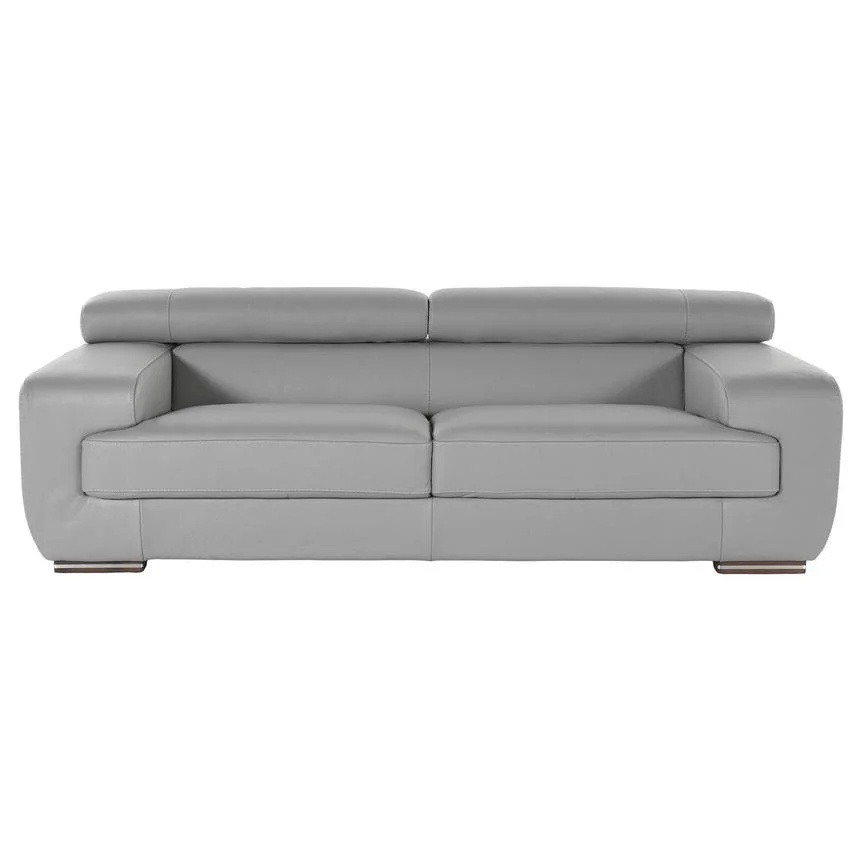
Budget-Friendly vs Premium Options
Budget-Friendly Gray Leather Sofa
Best for buyers who want the look first and are willing to compromise a little on aging, breathability, or long-term patina. Faux leather and lower-cost genuine leather options are common here.
Premium Gray Leather Sofa
Best for long-term ownership, better aging, and stronger overall material quality. Full-grain and top-grain options dominate this tier.
Pros and Cons
Pros
- Timeless neutral style
- Easy to coordinate with many colors
- Often easier to wipe clean than fabric
- Can age beautifully when the leather quality is good
- Works across many interior styles
Cons
- Poor-quality versions can peel or crack
- Leather can feel cooler or firmer at first touch
- Scratches may show on some finishes
- Direct sunlight can cause fading over time
How to Style a Gray Leather Sofa
Gray leather is Strong Enough to stand alone, but it looks better when you intentionally add warmth and contrast.
Use warm textures
Add:
- chunky knit throws
- wool rugs
- bouclé cushions
- wood side tables
- woven baskets
Design coverage on gray sofas repeatedly shows that texture is what prevents the room from feeling flat or cold.
Use the right accent colors
Strong pairings include:
- gray + olive green
- gray + navy
- gray + terracotta
- gray + cream
- gray + mustard
- gray + black and brass
Use the right finishes
- Brass for warmth
- Matte black for the edge
- Chrome for a sharper modern look
- Walnut or oak for balance
Use the right rug
A rug should soften the sofa, not compete with it. Good options include:
- cream textured rugs
- natural jute
- Persian-style rugs
- subtle geometric patterns
Mini summary:
Gray leather works best when it is balanced by warmth, texture, and one or two intentional accent colors. That is the difference between a room that feels styled and one that feels unfinished.
Gray Leather Sofa for Small Spaces
For compact homes and apartments:
- Choose slim arms
- use raised legs
- prefer light gray or mid-gray
- Avoid oversized sectionals unless the room is open
- consider a two-seater or compact chaise
Styling guides on gray leather repeatedly show that lighter gray tones and cleaner silhouettes help small rooms feel larger and less crowded.
Is a gray leather sofa pet-friendly?
Often, yes, but only if you choose the right type of leather.
Leather is generally easier to wipe clean than fabric and does not trap fur as easily, which makes it attractive to pet owners. But claws can scratch the surface, and delicate finishes may show wear faster. For pet households, tougher finishes and more forgiving colors usually perform better.
Best choice for pets:
Top-grain or a more protective finish, plus a mid-tone gray that hides everyday marks better than very light or very dark options.
Leather Sofa vs Fabric Sofa
| Feature | Leather Sofa | Fabric Sofa |
| Cleaning | Usually easier | Often harder |
| Luxury feel | More premium | More casual |
| Pet hair | Less cling | More cling |
| Durability | High when quality is good | Depends heavily on fabric |
| Comfort feel | Can feel cooler at first | Softer and warmer immediately |
| Aging | Can develop patina | Usually shows wear differently |
This comparison is consistent with retailer buying guides and leather-care guidance, which emphasize that leather can be easier to maintain while fabric may feel Softer and Warmer right away.
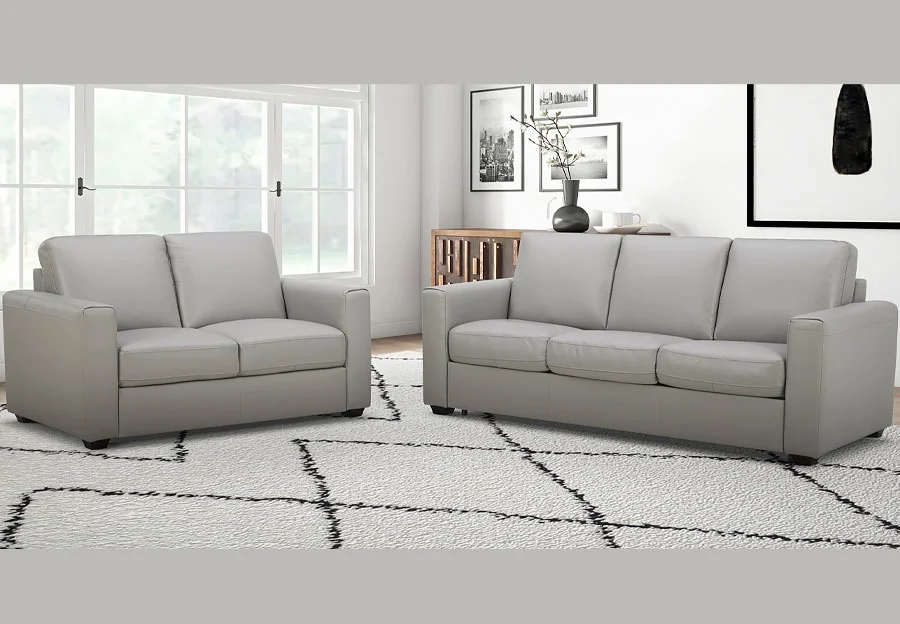
How to Maintain a Gray Leather Sofa
Weekly care
- Dust with a dry microfiber cloth
- Wipe visible marks promptly
- Keep crumbs and dirt out of seams
Monthly care
- Check seams and corners
- Use a leather-safe protector or conditioner if recommended by the manufacturer
- Move cushions and check for uneven wear
Avoid
- harsh household cleaners
- bleach
- too much water
- scrubbing with abrasive tools
- direct sunlight for long periods
Care guidance from furniture specialists is consistent on these points: keep leather out of direct sun, wipe spills quickly, and use leather-friendly products rather than generic cleaners. Dust and dirt can dull the finish and increase wear, so regular maintenance matters.
Mini summary:
The best leather sofa care is simple: protect it from sun, clean it gently, and never wait for a stain to become a project.
Expert Tips Most Buyers Ignore
- Ask about the finish, not just the leather name.
Two sofas can both be “leather,” yet one is far more practical for family life. - Check the leather sample in your room’s lighting.
Gray can look cooler or warmer depending on the room. Design articles repeatedly note that lighting changes how gray leather reads. - Measure the sofa with walking space in mind.
A beautiful sofa that blocks circulation will never feel premium. - Buy with aging in mind.
Full-grain and top-grain leather are valued because they can age better than lower-grade synthetic options.
Common Buyer Mistakes to Avoid
- Choosing by color only
- Ignoring the leather grade
- Buying bonded leather without realizing it
- Picking the wrong gray undertone
- Forgetting the room scale
- Ignoring sunlight exposure
- Skipping care instructions
These are the most common reasons buyers end up disappointed, even when the sofa looked perfect online.
Who Should Buy a Gray Leather Sofa?
A gray leather sofa is ideal for:
- people who want a timeless neutral
- buyers who like modern, clean interiors
- families that want easier wipe-down care
- apartment dwellers who need flexibility
- homeowners who like changing accent colors over time
Who Should Avoid a Gray Leather Sofa?
It may not be the best choice for:
- buyers who want a very soft, fabric-like feel
- households that prefer ultra-warm seating at first touch
- People are unwilling to maintain leather properly
- buyers who choose the cheapest option without checking the material specification
Future Trends in the Leather Industry
The direction of the market is clear: buyers are becoming more selective. Responsible sourcing, better transparency, and more practical finishes matter more now than ever. The Leather Working Group continues to set audit standards for leather manufacturers and emphasizes that certification applies to the manufacturing facility rather than a random product claim. That matters because consumers want both style and accountability.
On the design side, 2026 is moving toward warmer neutrals, layered texture, and more grounded interiors. Gray still fits that direction well, especially when it shifts toward warmer gray, greige, or charcoal paired with wood and natural textiles.
People Also Ask
A: Yes, especially if you choose good leather and the right size for your room. Gray is versatile, and quality leather can age well over time.
A: White, warm beige, soft greige, muted green, and even deep navy can work well A: depending on the undertone of the sofa. Lighter grays feel softer, while dark gray looks stronger and moodier.
A: Top-grain is often the best balance for many families because it is practical, smooth, and easier to maintain than more natural, high-variation finishes. Full-grain is the premium long-term choice if you want the richest aging.
A: It usually hides dirt better than very light leather, but visible dust, oil, and wear will still show if care is ignored. Regular wiping and sunlight protection matter.
A: It can be useful for budget and short-term needs, but it generally does not match real leather for aging or long-term durability. Peeling is a common complaint with faux and bonded leather.
Conclusion
A gray leather sofa is one of the Best Furniture investments you can make if you want style, flexibility, and long-term value. The smartest buyers do not choose based on color alone. They compare leather grade, finish, room size, comfort, and care requirements before they buy. That is how you end up with a sofa that still looks beautiful years later instead of one that becomes a regret.
For most homes, the sweet spot is a well-made top-grain or full-grain gray leather sofa in the right undertone for the room. Pair it with texture, warmth, and the right scale, and it will work in almost any interior style. If you publish this on TheLeatherItems.com, it can serve as a pillar page that supports related content on leather bags, jackets, belts, wallets, and leather care while building real topical authority.
Legal disclaimer: Leather quality, pricing, manufacturing standards, and product availability may vary by country, brand, and supplier. Always verify authenticity, material details, and care instructions before purchase.