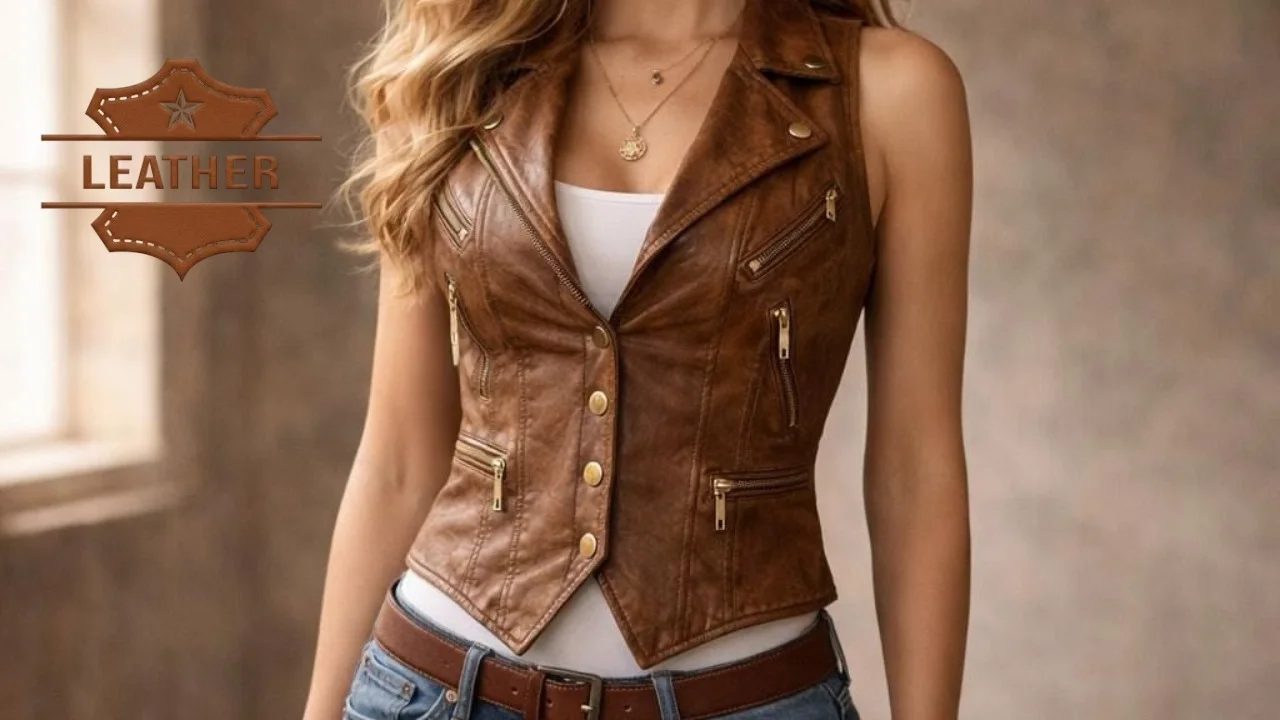
Vest Leather Women
The search for Vest Leather Women is no longer just about finding a cool biker piece. Today’s buyer wants a vest that fits well, layers easily, matches current fashion, and lasts more than one season. That is why the best article on this topic must do more than show outfit ideas. It must explain style, leather quality, fit, body shape, care, and how the piece works in real wardrobes. Fashion coverage in 2025 and 2026 keeps pushing leather toward sharper silhouettes, capsule-wardrobe thinking, chocolate-brown tones, funnel-neck shapes, oversized cuts, and Western-inspired styling.
A woman’s leather vest can be edgy, clean, minimal, or luxury-looking depending on the cut and material. It can sit over a tee, shirt, knit, dress, or hoodie and instantly change the whole outfit. This guide gives you the practical side of the trend too: what to buy, what to avoid, how it should fit, and how to style it for different seasons and body types.
What Is a Women’s Leather Vest?
A woman’s leather vest is a sleeveless outerwear piece made from real leather or faux leather. It works like a lightweight layer between a top and a jacket. Leather itself is animal skin that has been treated and preserved for use in clothing and other products, while faux leather is a synthetic material designed to mimic the look of real leather.
In fashion terms, the vest is a bridge piece. It adds structure without the bulk of sleeves. That is why it feels modern: it gives shape, edge, and layering power at the same time. A good leather vest can make a simple outfit look finished in seconds.
A Short History of the Leather Vest
Leather has been used for centuries because tanning turns raw hides into a durable material for clothing, footwear, and equipment. Over time, leather moved from utility into fashion, and the leather jacket became linked with rebellion, rock energy, and confidence. Vogue describes the leather jacket as “tailored armor,” showing how the material evolved from tough outerwear into a modern style staple.
The leather vest followed the same path. It began as practical riding and workwear-inspired layering, then moved into biker fashion, then fashion street style, and now it sits comfortably inside capsule wardrobes and trend-led outfits. That long fashion history is why the vest still feels relevant instead of dated.
Why Women’s Leather Vests Matter in 2026
The 2026 fashion mood favors pieces that do more than one job. ELLE points out that leather belongs in a strong fall capsule wardrobe, while Vogue highlights cropped, oversized, and sculptural leather silhouettes. Western styling is also active in the fashion conversation, and leather works naturally with that look.
That matters because women are looking for layers that feel current, not costume-like. A leather vest gives you:
modern structure,
easy layering,
seasonal flexibility,
and a polished finish that works with denim, tailoring, skirts, and dresses.
The trend is especially strong because it fits several style directions at once: quiet luxury, Western-core, moto style, minimalist layering, and oversized streetwear.
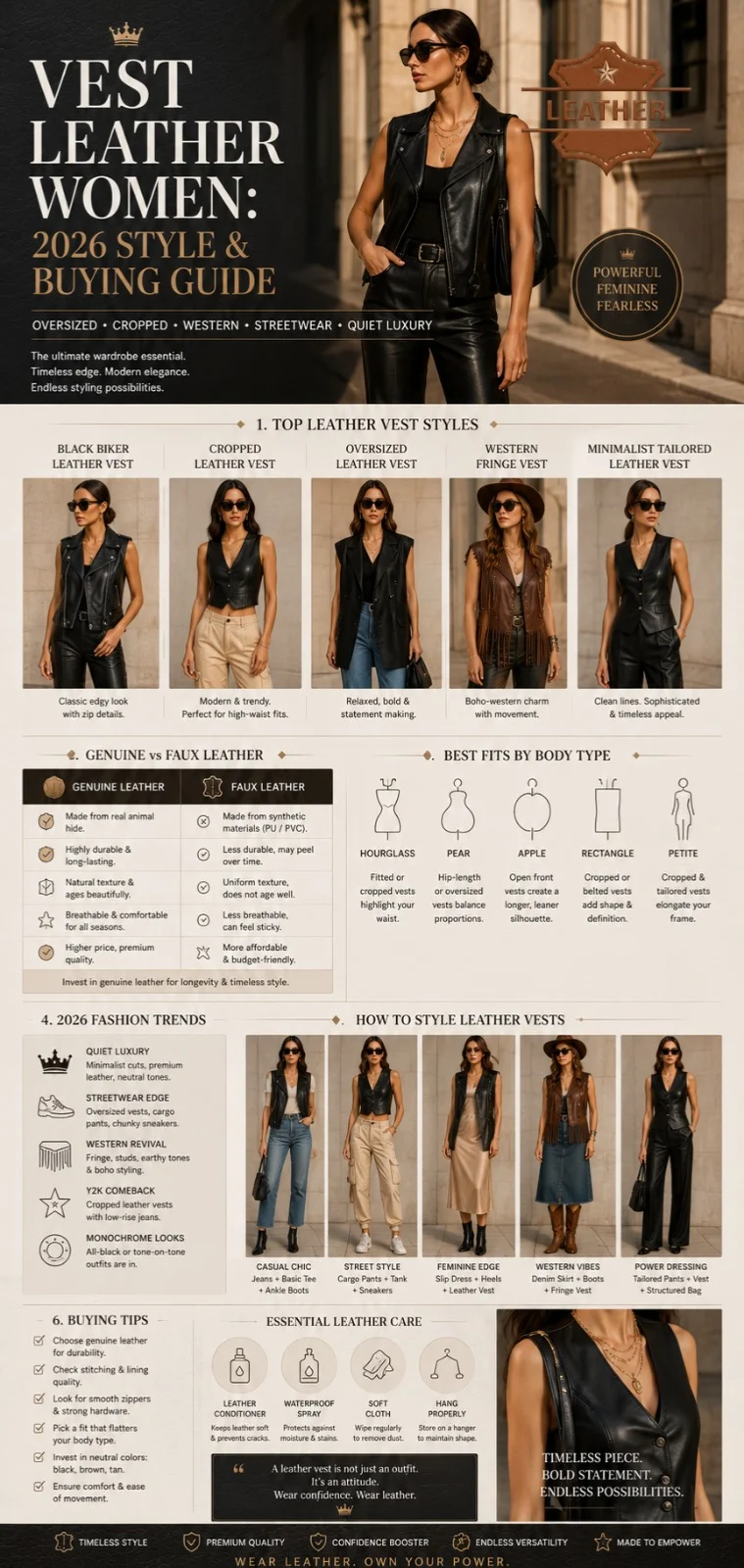
Types of Leather Vests for Women
Classic Biker Leather Vest
The biker vest is the most recognizable version. It usually has zippers, snaps, sharp seams, and a tougher attitude. This is the best option for women who want a strong, easy-to-style piece.
Best for:
streetwear, concerts, casual weekend outfits, edgy layering
Cropped Leather Vest
Cropped leather vests are especially useful with high-waisted pants, skirts, and jeans. They create a clean proportion and make the waist look more defined.
Best for:
petite frames, high-waist outfits, balanced silhouettes, modern styling
Oversized Leather Vest
Oversized leather is closely tied to current trend dressing. It looks relaxed, fashion-forward, and easy to layer over knits or long sleeves.
Best for:
street style, winter layering, oversized fashion, modern casual looks
Western Leather Vest
Western versions often use fringe, suede texture, rustic brown tones, or concho-style details. This style connects strongly with the current Western fashion wave.
Best for:
festival outfits, country-inspired looks, boho styling, statement dressing
Tailored or Minimal Leather Vest
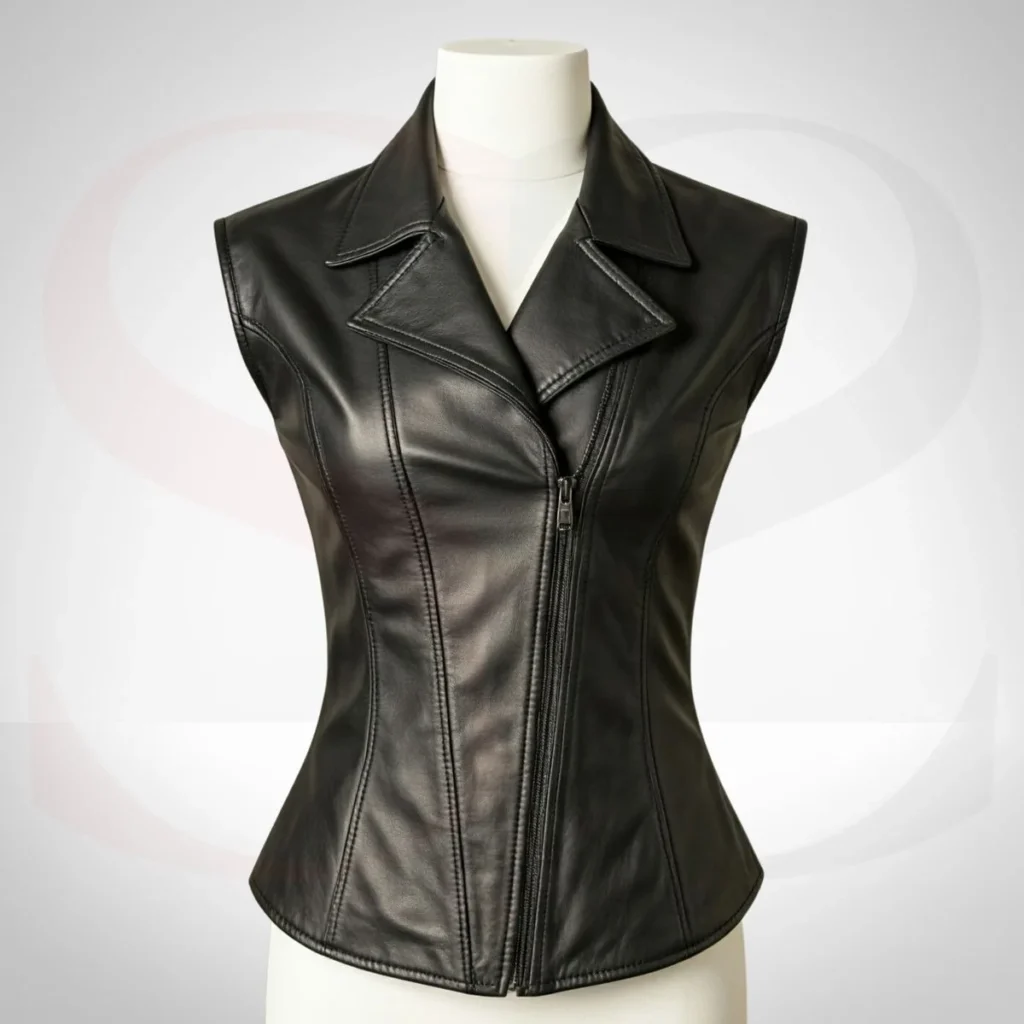
This is the quiet-luxury version. It is clean, smooth, and often less hardware-heavy. It can be worn with trousers, shirts, and monochrome looks.
Best for:
office styling, minimal wardrobes, polished outfits, smart casual wear
Suede or Nubuck-Style Vest
These softer finishes feel more relaxed and visually rich. They work especially well in earthy colors and autumn outfits.
Best for:
fall styling, softer fashion looks, boho outfits, warm neutral wardrobes
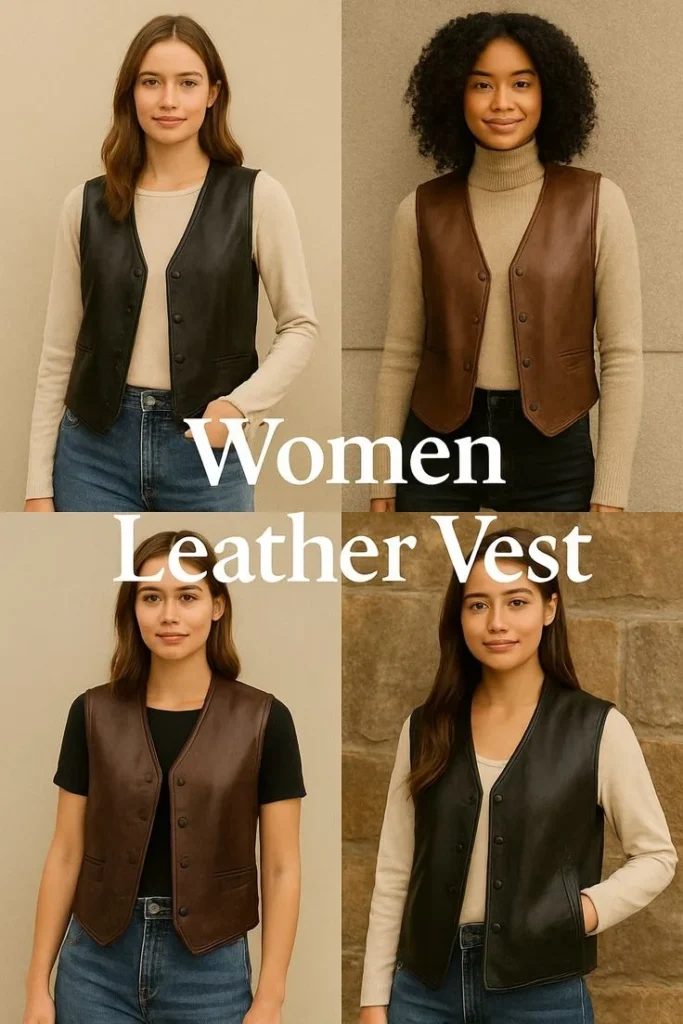
Leather Types Used in Women’s Vests
The leather inside a vest matters as much as the cut. The leather industry treats hides through tanning to preserve them and improve durability, and higher-quality cuts generally keep more of the natural grain structure. LWG also tracks different leather types and supply-chain standards, which matter for buyers who care about traceability and responsible sourcing.
| Leather Type | What It Means | Strengths | Best For |
| Full-grain | Top natural layer with the grain left intact | Most durable, rich aging, natural look | Premium vests, long-term wear |
| Top-grain | Smoothed or corrected top layer | Softer finish, more uniform appearance | Clean, polished vests |
| Genuine leather | Real leather, but not always the highest grade | Lower cost than premium cuts | Budget-conscious real leather buyers |
| Suede | Soft inner leather surface | Plush look, fashion appeal | Western, boho, fall styling |
| Nubuck | Lightly buffed outer surface | Velvet-like touch, premium feel | Refined casual or luxury looks |
| Faux / PU leather | Synthetic leather-look material | Lower price, vegan-friendly, easier entry point | Trend-led or budget buys |
Pros and cons
Full-grain
- Pros: strongest, ages beautifully, looks richer over time
- Cons: more expensive, may show natural marks
Faux leather
- Pros: cheaper, vegan-friendly, widely available
- Cons: usually less durable and can peel or crack over time.
Manufacturing Process: How a Leather Vest Is Made
A good leather vest does not happen by accident. Leather production begins with tanning, which chemically preserves raw hide and turns it into usable leather. From there, the garment goes through design, cutting, stitching, finishing, and hardware attachment.
- Hide selection
The tannery chooses hides based on grain, thickness, softness, and surface quality. - Tanning
The hide is preserved through vegetable, chrome, or other tanning systems. - Sorting and grading
The leather is checked for scars, texture, strength, and uniformity. - Pattern cutting
The vest pattern is cut so the front, back, armholes, and seams align cleanly. - Stitching and assembly
Panels are sewn together, and reinforcements are added where needed. - Lining and hardware
The lining, zippers, snaps, buckles, or buttons are attached. - Final finishing
The vest is pressed, inspected, and cleaned before packing.
Mini summary:
A premium vest is not just about leather. It is about leather choice, pattern accuracy, stitching quality, and hardware strength.
How to Identify Real vs Fake Leather
A lot of buyers look only at the label. That is a mistake. Faux leather is synthetic and usually looks more uniform, while real leather often shows Natural Variation in grain and surface character. Horween and other heritage leather makers emphasize the importance of natural grain and quality components, while Britannica and The Spruce confirm that faux leather is a manufactured imitation.
Real leather signs
- Natural grain variation
- Slight imperfections
- Softer, deeper smell
- Better aging over time
- Edges that feel more organic
Fake leather signs
- Very uniform surface pattern
- Plastic-like backing
- Stiffer artificial smell
- Tendency to peel or crack
- Lower long-term durability
Buyer’s tip:
Do not assume “genuine leather” always means top luxury. In the market, it simply means real leather, not synthetic leather. The quality can still vary a lot from item to item.
How Should a Leather Vest Fit Women?
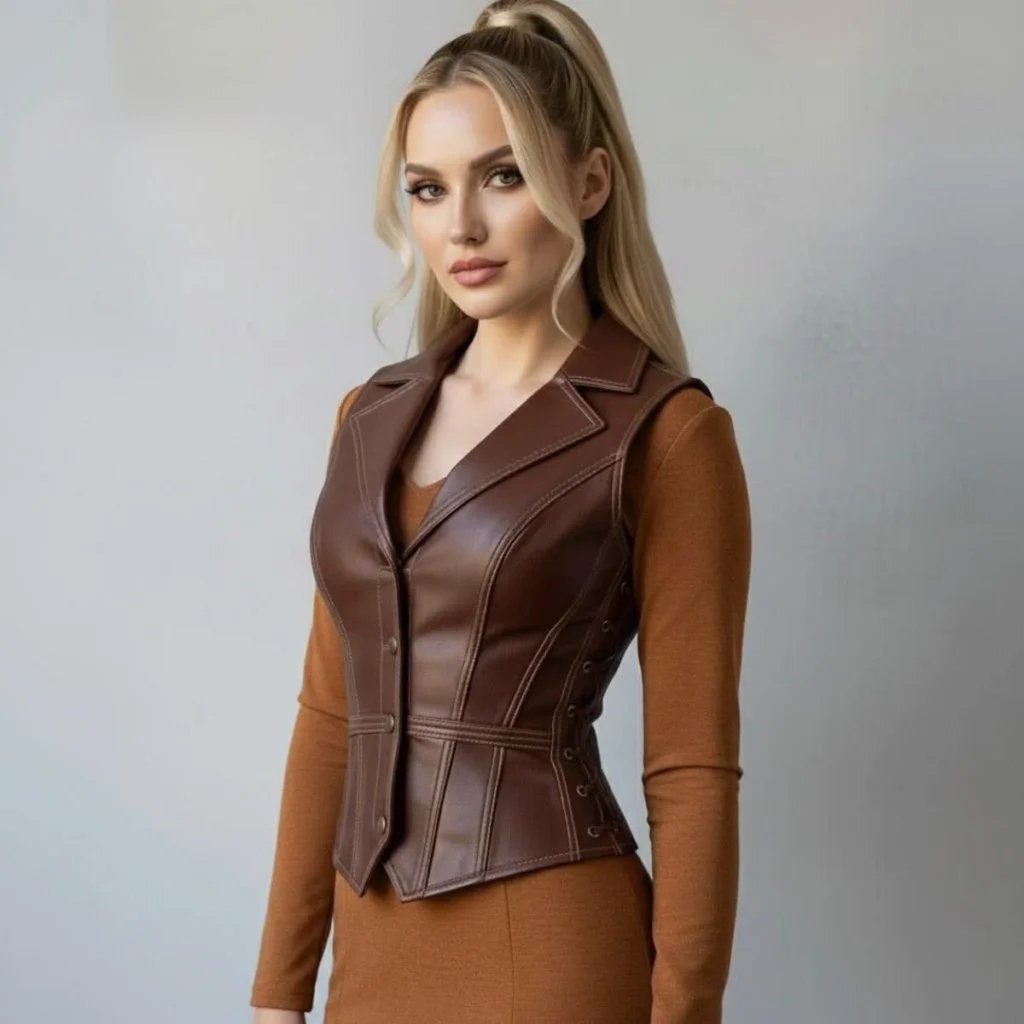
Fit is where most shoppers make mistakes. A leather vest should sit cleanly on the shoulders and chest without pulling. It should close or drape in a way that supports your shape, not fight it. Expert style guides for women’s leather vests consistently stress body-shape balance and proportional fit.
Fit checklist
- Shoulders sit flat
- Armholes do not cut in
- Chest feels secure, not tight
- The waist area leaves room to move
- Hem length works with your bottom half
- Layering space exists underneath
Fit by body type
| Body Type | Best Vest Choice | Why It Works |
| Pear shape | Cropped or structured vest | Balances hips and adds upper-body shape |
| Apple shape | Longer open-front vest | Creates vertical lines and reduces bulk |
| Hourglass | Fitted or belted vest | Highlights the waist |
| Rectangle | Cropped or shaped vest | Adds definition and curves |
| Petite | Shorter, cleaner vest | Avoids visual heaviness |
Snippet-ready answer:
A woman’s leather vest should fit snugly at the shoulders, allow layering at the chest, and create a clean line through the torso.
How to Style a Leather Vest for Women
ELLE’s vest and leather-jacket coverage shows that the best outfits are the ones that mix texture, balance, and personal style. That is the right way to style a leather vest, too. You want contrast, not clutter.
Casual everyday outfit
- White tee
- Black leather vest
- Straight-leg jeans
- Sneakers
This is the safest and most wearable formula.
Streetwear outfit
- Oversized leather vest
- Cargo pants
- Graphic tee or hoodie
- Chunky sneakers
This works because the vest adds structure to relaxed shapes.
Feminine chic outfit
- Leather vest
- Satin midi skirt
- Soft knit or fitted top
- Heeled boots
The mix of hard and soft textures creates a strong contrast.
Office-smart outfit
- Minimal leather vest
- Crisp shirt
- Tailored trousers
- Loafers or low heels
This is a smart way to wear leather without looking too edgy.
Western-inspired outfit
- Brown vest
- Denim
- Boots
- Simple belt
Western fashion is still active, so this Styling Direction feels timely.
Night-out outfit
- Sleek black vest
- Slim top
- Dark denim or a mini skirt
- Heeled boots
Keep the rest of the outfit clean so the vest stays the hero.
Mini summary:
The best leather vest outfits usually mix one strong leather piece with softer fabrics like cotton, denim, knitwear, silk, or satin.
Leather Vest Outfit Ideas for Every Season
Spring
- Vest over a light shirt
- Straight jeans
- Loafers or sneakers
Summer
- Cropped vest over a tank top
- Denim shorts
- Sandals or low-profile sneakers
Fall
- Oversized vest over knitwear
- Boots
- Dark denim or tailored pants
Winter
- Vest under a coat, or over a thick knit
- Turtleneck
- Wool trousers
- Heavy boots
The key is to avoid bulky layering that hides the vest’s shape. Vogue and ELLE both show that modern leather styling works best when the silhouette feels deliberate.
Best Colors for Women’s Leather Vests
| Color | Style Effect | Best For |
| Black | Most versatile, strongest visual edge | Everyday wear, biker looks, office-smart outfits |
| Chocolate brown | Warm, trend-aware, softer than black | Fall styling, Western looks, quiet luxury |
| Tan | Light and relaxed | Spring outfits, casual looks |
| Oxblood | Rich and bold | Statement dressing, evening wear |
| Cream/off-white | Fresh and modern | Minimal outfits, fashion-forward styling |
Black is still the easiest option if you want maximum flexibility. Brown is the smartest choice if you want a softer, more current feel.
Buying Guide: What to Check Before Purchase
This is the section most competitor pages skip, and it is where SEO value turns into buyer trust.
Check the shoulder fit
A vest should sit naturally. If the shoulders are wrong, the whole item looks cheap.
Check the lining
A smooth lining improves comfort and helps the vest slide cleanly over clothes.
Check the stitching
Look for even seams, tight stitching, and no loose threads.
Check the leather thickness
Too thin looks flimsy. Too thick can feel stiff and boxy.
Check the hardware
Zippers, snaps, and buckles should feel solid, not light or shaky.
Check the armholes
If the armholes are too small, layering becomes uncomfortable.
Check the style purpose
Buy for real use:
- casual layering
- of office outfits
- Western styling
- streetwear
- travel
- events
Check the return policy
Fit matters so much that a good return policy is a real advantage.
Expert tip:
The best vest is the one you will actually wear at least 20 times. A trendy vest that does not fit your wardrobe is still a bad purchase.
Common Styling Mistakes to Avoid
- Buying for the trend only
A vest that looks good online but does not match your lifestyle will sit in the closet. - Choosing the wrong length
Wrong hem placement can make the body look shorter or wider. - Ignoring proportion
An oversized vest plus oversized bottoms can create too much bulk. - Over-accessorizing
Leather already has presence. Too many loud accessories can make the outfit feel messy. - Forgetting texture contrast
Leather looks best beside cotton, denim, satin, knit, or wool. - Ignoring fit at the shoulders
Shoulder fit is often the difference between premium and amateur-looking.
Care, Cleaning & Maintenance Tips
Proper care keeps a leather vest in rotation for years. Leather care guidance from The Spruce emphasizes that Real Leather Benefits from regular cleaning, gentle care, and conditioning, while faux leather needs different handling because it is synthetic.
Care routine
- Hang on a padded hanger
- Keep away from direct sunlight
- Wipe light dust with a soft cloth
- Condition real leather occasionally
- Store in a cool, dry place
- Avoid soaking the vest
- Do not use harsh cleaners
For faux leather
- Wipe with a damp cloth
- Avoid strong heat
- Keep away from cracking conditions
- Never assume it can be treated like full leather
Mini summary:
Real leather needs conditioning and careful storage. Faux leather needs gentle cleaning and protection from cracking.
Price Range and Buying Tiers
Rather than locking into one number, it is smarter to think in tiers:
- Budget tier: faux leather and simpler construction
- Mid-range tier: real leather with decent lining and hardware
- Premium tier: better hides, stronger stitching, better patterning, richer finish
- Luxury tier: heritage craftsmanship, refined details, and higher-end tanning or finishing
Material quality changes the price a lot. Faux leather usually costs less, while real leather and suede tend to sit higher because of the material and construction value.
Top Countries and Brands Known for Leather Craft
Italy and Pakistan both have visible leather manufacturing and garment traditions, while heritage American tanneries like Horween are widely respected for leather quality. Pakistan’s leather garment sector is formally organized through PLGMEA, and Horween remains a benchmark name in U.S. leather processing.
That does not mean every item from those countries is automatically better. It means the market has strong expertise there, and buyers often find more serious leather knowledge, more custom work, and better finishing standards.
Budget-Friendly Options vs Premium Options
Budget-friendly options
- Faux leather vests
- Simple hardware
- Clean cuts
- Lightweight layering pieces
Premium options
- Full-grain or higher-quality genuine leather
- Strong lining
- Better structure
- Better stitching
- Hardware that feels substantial
Best buying rule:
Choose the best leather type you can afford, but never sacrifice shoulder fit and stitching quality just to get a lower price.
Future Trends in Leather Fashion
The future of leather is being shaped by two forces at once: style and responsibility. On the style side, Vogue and ELLE are still pointing to oversized shapes, cropped silhouettes, suede, funnel-neck details, and capsule-friendly leather layers. On the responsibility side, the Leather Working Group continues to push certification and environmental standards across the supply chain.
That means the next wave of women’s leather vests is likely to be:
- more versatile,
- more wearable,
- more tailored,
- more responsibly sourced,
- and easier to style across seasons.
The strongest product winners will combine fashion relevance with real utility.
Expert Tips Most Buyers Ignore
- Buy the vest based on the tops you already wear.
- Check how it looks both closed and open.
- Make sure the armholes allow movement.
- Look at the back view, not just the front.
- Choose one vest color that matches at least three outfits you already own.
- Prioritize shape and hardware before trend details.
- A simpler vest often lasts longer in style than a loud one.
These small checks save money and lead to much better long-term wear.
FAQs
A: Yes. Current fashion coverage keeps leather relevant through oversized cuts, cropped shapes, Western styling, and capsule-wardrobe layering.
A: It should sit flat on the shoulders, feel comfortable at the chest, and leave enough room for light layering without looking tight.
A: It works with jeans, shirts, tees, knitwear, dresses, skirts, cargo pants, and boots.
A: Genuine leather usually lasts longer and ages better. Faux leather is more affordable and vegan-friendly, but it is typically less durable.
A: Black is the most versatile. Brown is the most trend-aware and warm-looking. Both are strong choices.
Conclusion
A woman’s leather vest is one of the smartest fashion layers you can own because it is stylish, practical, and easy to wear in many ways. The best version is not just trendy. It fits well, uses strong materials, and works with your real wardrobe. In 2026, the winning styles are oversized, cropped, tailored, and Western-influenced, but the strongest article and the Strongest Product will always go deeper than trend talk. They will educate the buyer, solve fit problems, and make the purchase feel confident.
For readers of theleatheritems.com, this is the kind of evergreen guide that can build trust, attract search traffic, and support future internal linking. Explore more leather education on the site, leave a comment, and share the guide with anyone comparing leather vest styles.