Introduction
Leather Watch Bands remain one of the easiest ways to make a watch look more refined, more personal, and more expensive without replacing the watch itself. The challenge is that most buyers do not actually know what they are buying. They see “genuine leather” on one strap, “full grain” on another, “quick release” on a third, and then they still have to figure out size, fit, comfort, sweat resistance, and whether the band works with an Apple Watch or a traditional watch. That confusion is exactly why so many purchases end in disappointment.
This guide solves that problem. It explains the real differences between leather grades, tanning methods, sizing systems, strap styles, smartwatch compatibility, and care routines, so you can choose a strap that fits your wrist, your watch, and your lifestyle. It also shows when leather is the right choice, when it is not, and how to tell whether a strap is built for short-term fashion or long-term wear. The goal is simple: help you buy once, buy better, and enjoy the strap for years. Apple’s compatibility rules and standard lug-width measurement guidance make fitting the first thing to get right; everything else becomes easier after that.
What Are Leather Watch Bands?
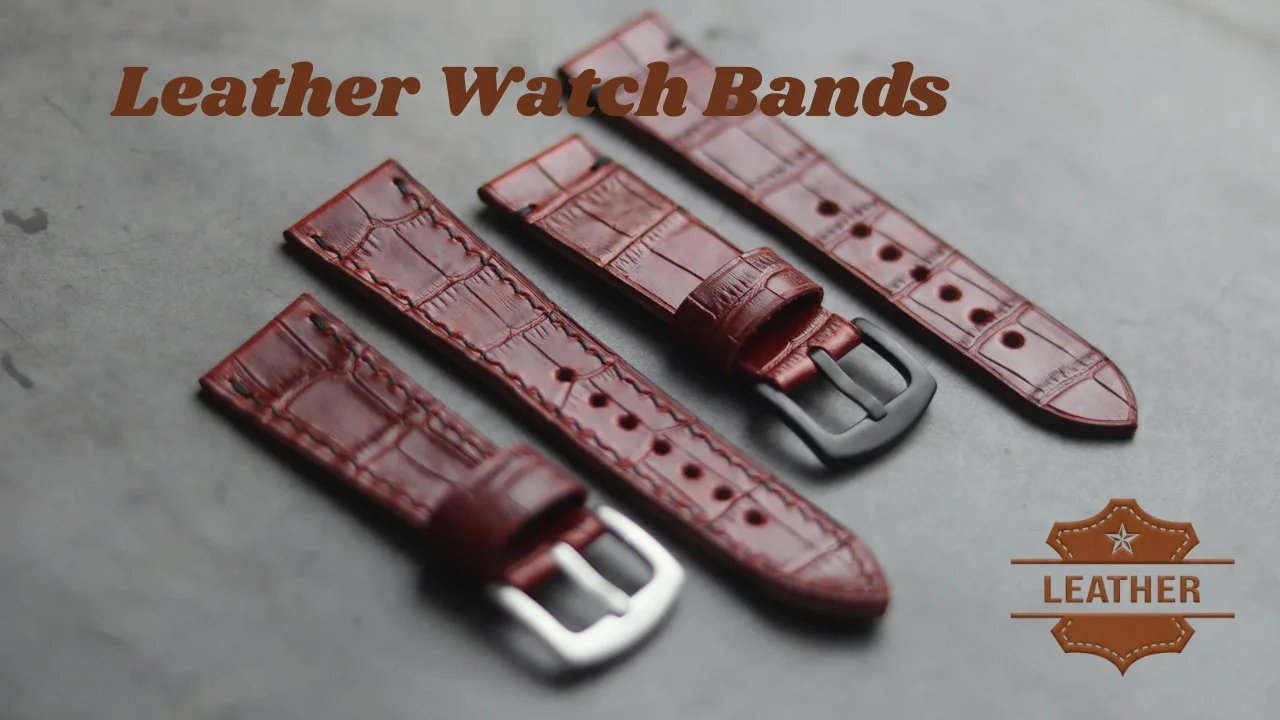
Leather watch bands are straps made from animal hide or leather-derived materials that attach a watch to the wrist. In practice, they do more than hold the watch in place. They change the way the watch looks, the way it feels, and the way it is perceived. A steel watch can feel sporty or cold on the wrist, while a leather strap can make the same case look warmer, more elegant, or more vintage.
The best leather straps are not all built the same. Some are soft and dressy. Many are rugged and textured. Some are designed for patina and aging. Others are made to stay visually clean for a long time. That is why a buyer should never choose by color alone. As the current ranking guides show, the real differences are in leather type, construction, comfort, and intended use.
Why Leather Watch Bands Still Matter in 2026
Leather still matters because it solves a style problem that other strap materials do not. It can make a watch feel more personal and more polished without looking flashy. It works for office wear, date-night wear, formal wear, and everyday wear. Also remains one of the best ways to give a watch a more classic identity.
Current buyer behavior shows two big trends. First, traditional watch buyers still want craftsmanship, patina, and dress appeal. Second, smartwatch buyers want a better style than the default sport band. That is why guides are now split into two camps: classic leather strap guides and Apple Watch leather band guides. The strongest pillar article should combine both.
Types of Leather Used in Watch Bands
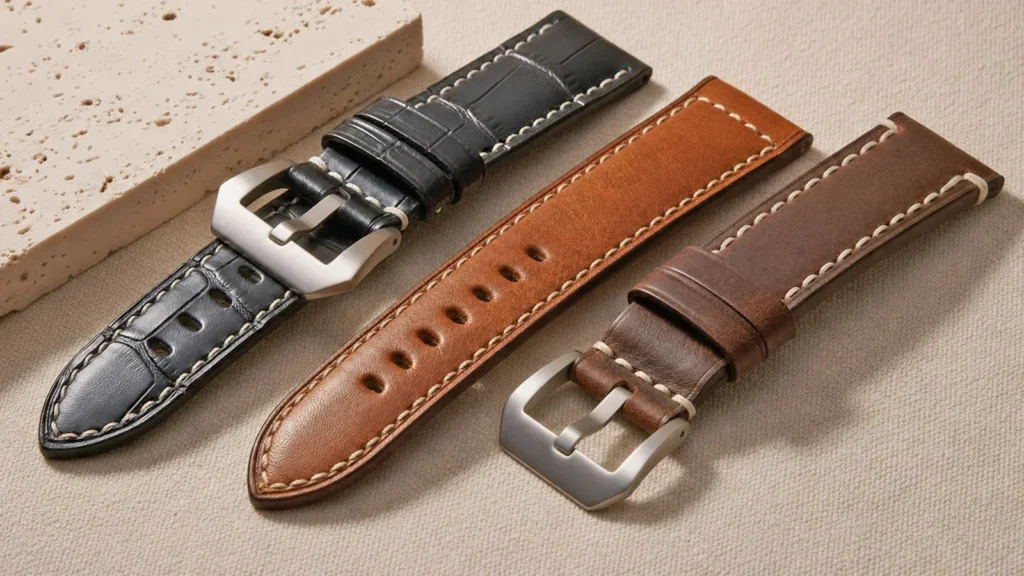
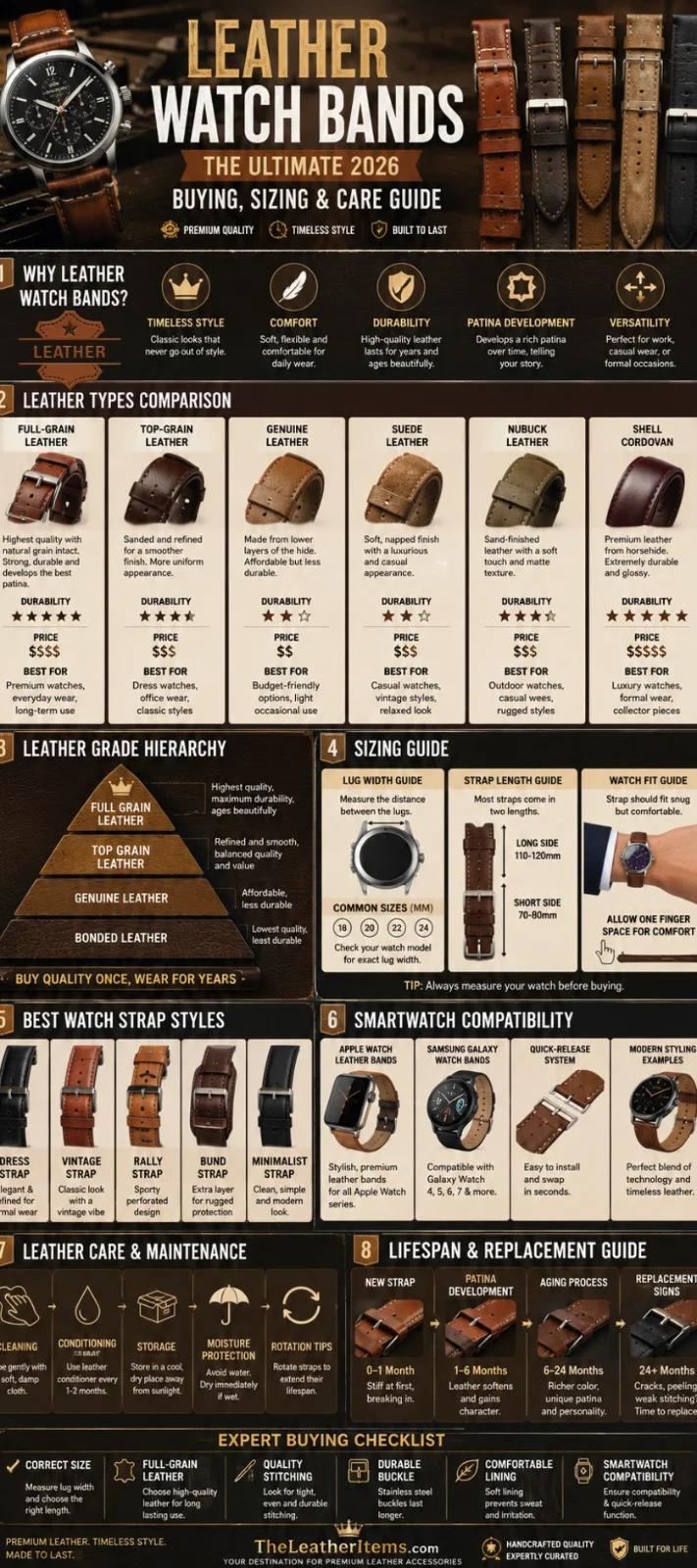
Leather Type Comparison Table
| Leather type | Feel and look | Best for | Watch owner takeaway |
| Full-grain leather | Natural, durable, develops patina | Everyday wear, premium builds | Best when you want character and longevity. |
| Top-grain leather | Cleaner surface, slightly more processed | Refined daily wear | Good balance of polish and practicality. |
| Genuine leather | Lower-tier catch-all term in many markets | Budget straps | Read the construction carefully before buying. |
| Suede | Soft, matte, relaxed texture | Casual and vintage looks | Stylish, but less friendly to moisture. |
| Nubuck | Velvety, lightly sanded surface | Elevated casual wear | Softer than smooth leather, but it needs more care. |
| Buffalo leather | Heavier grain, rugged texture | Tool watches, rougher looks | Great for texture and presence. |
| Cordovan/shell cordovan | Dense, smooth, premium finish | Dress watches, luxury use | High-end feel with a distinctive shine. |
| Vegan alternatives | Non-leather materials | Animal-free preferences | Useful, but not the same aging behavior. |
Full-Grain Leather
Full-grain leather keeps the strongest outer fiber layer of the hide, which is why it is often associated with durability and aging character. It is a favorite for buyers who want a strap that improves over time instead of staying artificially uniform. Guides that focus on craftsmanship consistently treat full-grain as the premium everyday option.
Top-Grain Leather
Top-grain leather is still a quality choice, but it is usually more processed than full-grain. The surface is refined, which can create a cleaner and more consistent appearance. That makes it a good option for buyers who want a neater strap with less visible natural variation.
Genuine Leather
“Genuine leather” sounds impressive, but on many product pages, it is more of a general category than a luxury signal. It can still be useful at the right price, but the buyer should inspect stitching, edges, lining, and hardware rather than relying on the label alone.
Suede and Nubuck
Suede and nubuck bring a softer, more relaxed texture. They suit vintage watches, casual outfits, and refined but not overly formal styling. They also tend to show wear differently from smooth leather, so they are usually best for buyers who are comfortable with a more delicate finish.
Buffalo Leather
Buffalo leather has more visible grain and a stronger, rugged character. That makes it popular for tool-watch styling and for buyers who want a strap with more visual depth. Panatime specifically positions buffalo leather around Durability and Texture, and Gear Patrol highlights it as part of the broader premium strap conversation.
Shell Cordovan
Shell cordovan sits at the luxury end of the leather strap market. It is known for a dense, refined surface and a dressier personality. In a pillar article, it is worth mentioning as an aspirational premium option for collectors and formal-watch buyers.
Leather Grades Explained
Leather grades matter because they shape how the strap will wear, age, and feel on the wrist. A well-made strap is not just about appearance. It is also about how the material is cut, finished, stitched, and backed.
In buyer terms, the hierarchy usually looks like this: premium full-grain and premium specialty leathers at the top, then top-grain and well-finished calfskin, then generic genuine-leather options, then fashion-first budget straps. The key is not to memorise labels; the key is to ask what the hide, finish, lining, and construction are actually doing. Guides that rank highly today consistently stress texture, durability, and how the strap behaves during wear.
Vegetable-Tanned vs Chrome-Tanned Leather
Vegetable-tanned leather is often chosen for character, patina, and a more artisanal feel. Chrome-tanned leather is often chosen for softness, color consistency, and practical everyday wear. Neither is automatically better. The right choice depends on how often the strap will be worn, how much aging you want to see, and how much maintenance you are willing to do.
If the strap is for office wear, dress wear, or occasional use, vegetable-tanned leather can be a beautiful choice. If the strap is for more frequent wear and the buyer wants a smoother, more consistent surface, chrome-tanned construction may be a better fit.
How to Choose the Right Leather Watch Band
The best leather watch band is not always the most expensive one. It is the one that matches the watch, the wrist, and the lifestyle.
1. Watch type
Dress watches usually look best on slimmer, cleaner straps. Tool watches and field watches can handle thicker leather, stronger grain, or rally-style perforation. Apple Watches and other smartwatches often need a more practical approach because the band should look good without getting in the way of daily use.
2. Lifestyle
If the strap will be worn in an office, leather is an easy win. If it will be worn through workouts, heat, or frequent moisture, traditional leather becomes a harder choice. Groove Life’s 2026 guide makes this trade-off explicit and positions hybrid leather as the answer for active users who still want leather styling.
3. Comfort
Comfort depends on leather softness, strap thickness, taper, lining, and buckle weight. A strap can look great on a page and still feel stiff on the wrist if the construction is wrong. That is why the construction checklist matters as much as the leather type.
4. Durability
Durability comes from the whole build: leather quality, stitching, reinforcement, edge finishing, and hardware. Gear Patrol’s roundup repeatedly separates straps by use case for exactly this reason.
5. Budget
Budget is not just about price. It is about value over time. A cheap strap that cracks quickly is rarely a better purchase than a mid-priced strap that ages well and feels better every day. Gear Patrol’s own example range shows how strap prices can span from budget-level picks to premium options in the same category.
Leather Watch Band Sizes Explained
Fit is the first thing to get right. For traditional watches, the most important measurement is lug width, which is the distance between the watch lugs where the strap attaches. Watch strap guides commonly explain that lug width is measured in millimeters and that common sizes often sit around 18mm, 20mm, 22mm, and 24mm. One guide notes that 20mm is especially common, while others show size ranges spanning roughly 16mm to 24mm.
Lug Width Guide
| Lug width | Common use |
| 16–18mm | Smaller or dressier watches |
| 19–20mm | Very common, everyday size |
| 21–22mm | Popular for tool, dive, and sport watches |
| 24mm | Larger, more substantial watches |
This is the simplest fit rule: the strap must match the lug width exactly or be designed for the specific connector system. A strap that is even slightly wrong can look awkward or fail to seat properly.
Strap Length Guide
Strap length matters almost as much as width. The ideal length depends on wrist circumference, strap thickness, and buckle style. Many sellers use short, standard, and long options, and some custom makers ask for the wearer’s actual wrist size before making the strap.
How to Measure Your Watch
- Measure the space between the lugs in millimeters.
- Check whether the watch has a traditional spring-bar setup or a special connector system.
- Confirm the strap length against your Wrist Size.
- Check taper, thickness, and buckle width if you want a cleaner fit.
Leather Watch Bands for Apple Watch
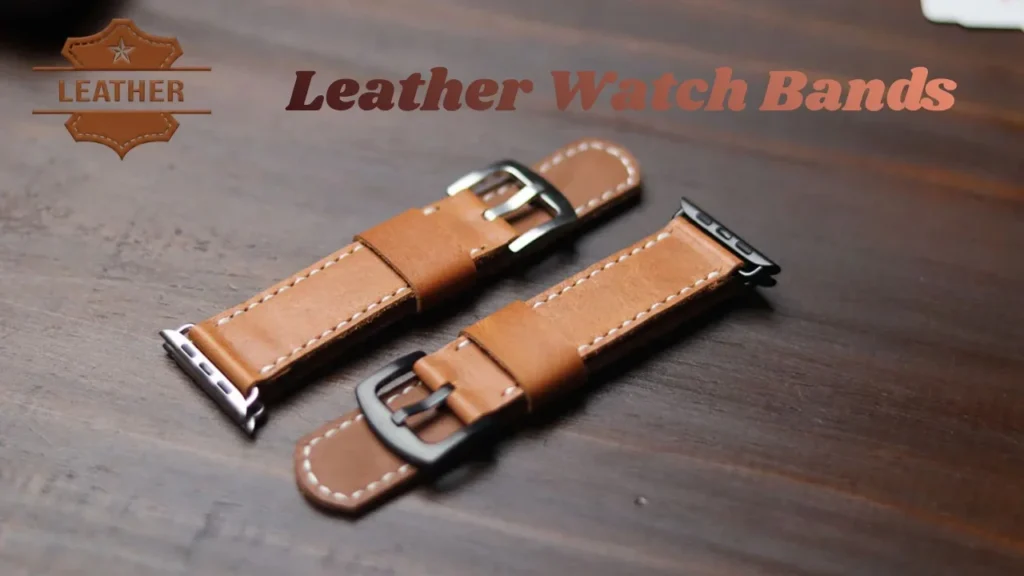
Apple Watch buyers are a huge opportunity because leather changes the watch from athletic-looking to more refined in one move. Apple’s compatibility rules are clear: bands for 38mm, 40mm, and 41mm cases are compatible with each other; 42mm, 44mm, and 45mm bands are compatible with each other; and 46mm bands are compatible with 44mm, 45mm, and 46mm cases. Apple also notes that bands designed for Ultra models are compatible with 44mm and 45mm cases.
That means the right Apple Watch leather band is not just about style. It is about case-size family, secure attachment, and daily comfort. For a pillar article, this deserves its own section, because smartwatch buyers are often looking for style without losing practicality.
Leather Watch Bands for Samsung Galaxy Watch and Other Smartwatches
Samsung and other smartwatch users follow a similar logic, even if the connector systems differ. The buyer still needs the correct attachment system, the right width or adapter, and a strap that matches the use case. A modern pillar article should cover smartwatches separately because these buyers often search with high commercial intent and very low patience for generic watch advice.
Best Leather Watch Band Styles
Dress straps
Slim, clean, and understated. Best for suits, formal outfits, and minimalist watches.
Vintage straps
Aged finishes, visible texture, and patina-friendly personalities. Best for collectors and heritage styling.
Rally straps
Perforated straps inspired by vintage racing watches. Gear Patrol highlights this style as a sporty classic.
Bund straps
A more dramatic, military-inspired option with a padded base. Great for visual impact.
Minimalist straps
Simple, smooth, and modern. A good fit for buyers who want the watch to stay visually calm.
Best Leather Watch Band Colors
Black, brown, tan, cognac, and dark blue remain the most useful colors because they fit the widest range of wardrobes. Black looks sharp and formal. Brown is the most versatile. Tan and cognac feel warm and premium. Dark blue can look subtle and elevated when paired carefully. Gear Patrol and OPUMO both show how color and finish change the personality of the same strap category.
Leather Watch Bands Buying Checklist
Before buying, check these points:
- Correct lug width or connector type.
- Leather grade and tannery quality.
- Stitch density and edge finishing.
- Lining material.
- Buckle quality and finish.
- Quick-release convenience.
- Taper and thickness.
- Intended use: office, casual, smart watch, or formal wear.
That last point is easy to miss. A strap should match the way you actually live, not only the way it looks in a product photo. OPUMO and Panatime both lean into this lifestyle-first logic, and it is one of the strongest ranking signals in the current SERP.
Construction Quality Checklist
A well-made leather watch band usually shows quality in small details:
- Tight, even stitching
- Clean edge finishing
- Properly aligned holes
- Strong reinforcement near the spring bars and buckle holes
- Lining that feels smooth against the skin
- Hardware that matches the intended price point
- No weak creasing or sloppy glue marks
This is where many low-quality straps fail. Buyers often focus on the leather face and ignore the build underneath. That is a mistake.
How Long Do Leather Watch Bands Last?
Lifespan depends on leather type, wear frequency, climate, sweat, and care. A strap used occasionally in dry conditions can last much longer than a strap worn daily in heat and humidity. In general, better leather and better construction mean a longer useful life, but no leather strap lasts forever. OPUMO specifically notes that cracking near buckle holes, thinning where the strap flexes, or a strap losing its shape are signs that it is time to replace it.
Lifespan Table
| Wear pattern | Typical outcome |
| Occasional Dress Wear | Long service life with slow aging |
| Daily office wear | Good life if cared for properly |
| Hot, sweaty, high-moisture wear | Faster wear and earlier replacement |
| Hybrid leather with protective inner layer | Better resilience for active use |
Groove Life’s hybrid approach reflects a real market response to moisture and sweat concerns, especially for smartwatch users.
How to Clean Leather Watch Bands
Leather should be cleaned gently. The safest routine is a soft dry cloth, light wiping after wear, and careful storage away from direct heat and moisture. OPUMO recommends keeping leather away from water whenever possible and letting it dry naturally if it gets wet. Apple Watch cleaning guidance for leather bands also points away from liquids and toward gentle handling.
Cleaning Routine
- Wipe after wear with a soft cloth.
- Let the strap air-dry if it gets damp.
- Avoid soaking.
- Use conditioner sparingly and only when the leather actually needs it.
- Rotate straps so one band is not always exposed to stress.
Common Mistakes That Ruin Leather Straps
- Wearing a leather strap in heavy rain, swimming, or frequent workouts
- Buying the wrong size
- Choosing by color only
- Ignoring edge finishing and lining
- Using too much conditioner
- Letting sweat sit on the strap too long
- Assuming “genuine leather” automatically means premium quality
These are the mistakes that turn a good-looking strap into a short-lived one.
Leather Watch Band Lifespan and Replacement Signs
A leather strap should be replaced when the structure starts failing, not only when it looks old. Look for:
- Cracks around buckle holes
- Softening that becomes floppy
- Thin or frayed flex points
- Peeling finish on low-quality straps
- An odor that does not come out after cleaning
- Hardware failure
That replacement mindset is useful because leather is meant to age, but not to collapse. OPUMO’s replacement guidance is a strong practical benchmark here.
Leather vs Metal Watch Bands
Leather feels warmer, lighter, and more traditional. Metal feels more formal in some contexts, but also heavier and more reflective. If you want a strap that disappears into the outfit and gives the watch character, leather is usually the better choice. If you want durability in wet conditions, metal often wins.
Leather vs Rubber Watch Bands
Rubber is the clear practical winner for water, sweat, and sports. Leather is the style winner. For mixed-use smartwatch buyers, hybrid leather becomes the compromise solution. Groove Life’s guide is a strong example of this category shift.
Leather vs NATO Straps
NATO straps are casual, practical, and easy to swap. Leather is more polished and more dress-friendly. A strong watch wardrobe should include both.
Pros and Cons of Leather Watch Bands
Pros
- Timeless look
- Comfortable when well-made
- Ages beautifully
- Works with dress and casual outfits
- Can elevate the same watch instantly
Cons
- Not ideal for water or heavy sweat
- Lower-quality straps can crack quickly
- Needs more care than silicone or metal
- Fit and size matter a lot
Who Should Buy Leather Watch Bands?
Leather watch bands are ideal for buyers who want:
- A smarter everyday look
- A strap that ages with character
- A dress-watch upgrade
- A more refined smartwatch style
- A balanced mix of comfort and elegance
Who Should Avoid Leather Watch Bands?
Leather is not the best choice for buyers who:
- Swim or train in the watch
- Want zero-maintenance wear
- Need a strap for heavy moisture
- Prefer a fully technical, sporty look
Future Trends in the Leather Watch Band Market
The biggest trend is Hybridization. Buyers want the look of leather with more practical performance, especially for smartwatch use. That is why active-leather and leather-plus-performance constructions are getting attention. Another trend is better transparency: buyers increasingly want to know where leather comes from and how it is certified. The Leather Working Group’s current framework shows how important responsible supply-chain claims have become in the leather industry.
Price Ranges You Can Expect
Prices vary by brand, leather type, hardware, and market positioning. Current examples from the ranking pages show budget straps around the mid-$20s, midrange straps around $50, and premium leather straps around $85 to $90 and above. That is not a fixed rule, but it is a useful buying reference.
Best Countries and Regions Associated With Premium Leather Straps
In the current market, Italy often appears in premium strap storytelling and product positioning, while Chicago Horween leather remains a strong reference point for American tannery heritage. That does not mean every great strap must come from one country; it means origin can be a useful trust signal when the brand is transparent about sourcing and construction.
People Also Ask
A: Full-grain leather is usually the strongest all-around choice because it balances durability, aging character, and premium feel. For a cleaner, smoother look, top-grain or well-made calfskin can also work well.
A: Yes, especially if the strap is high quality and the wearer is not exposing it to heavy water or sweat. Daily office wear is one of the best use cases for leather.
A: Measure the lug width in millimeters, because that is the key fit number for traditional watches. For Apple Watch, match the correct case-size family instead.
A: You can, but it is not the best choice. Sweat and moisture shorten the life of traditional leather. A hybrid leather or a sport band is a smarter fit for active use.
A: It depends on the leather, construction, wear frequency, and care. A well-made strap can last for years, but daily sweat or water exposure will shorten its lifespan.
Conclusion
The best leather watch band is not the flashiest one. It is the one that fits correctly, matches the watch, suits the wearer’s routine, and is built well enough to age gracefully. Traditional watch buyers should focus on leather quality, sizing, and construction. Apple Watch users should focus on case-size compatibility, comfort, and whether they need classic leather or a hybrid design for more active days. Responsible sourcing also matters more now than ever, and LWG-certified supply-chain claims are an important trust signal when brands make them.
For TheLeatherItems.com, this pillar page can become a long-term authority asset if it connects naturally to related guides on wallets, jackets, belts, bags, leather care, and material comparisons. Build the page around trust, fit, and practicality, and it will serve both search engines and real buyers for years.
Disclaimer: Leather quality, pricing, manufacturing standards, and product availability may vary by country, brand, and supplier. Always Verify Authenticity, material details, and care instructions before purchase.