Introduction
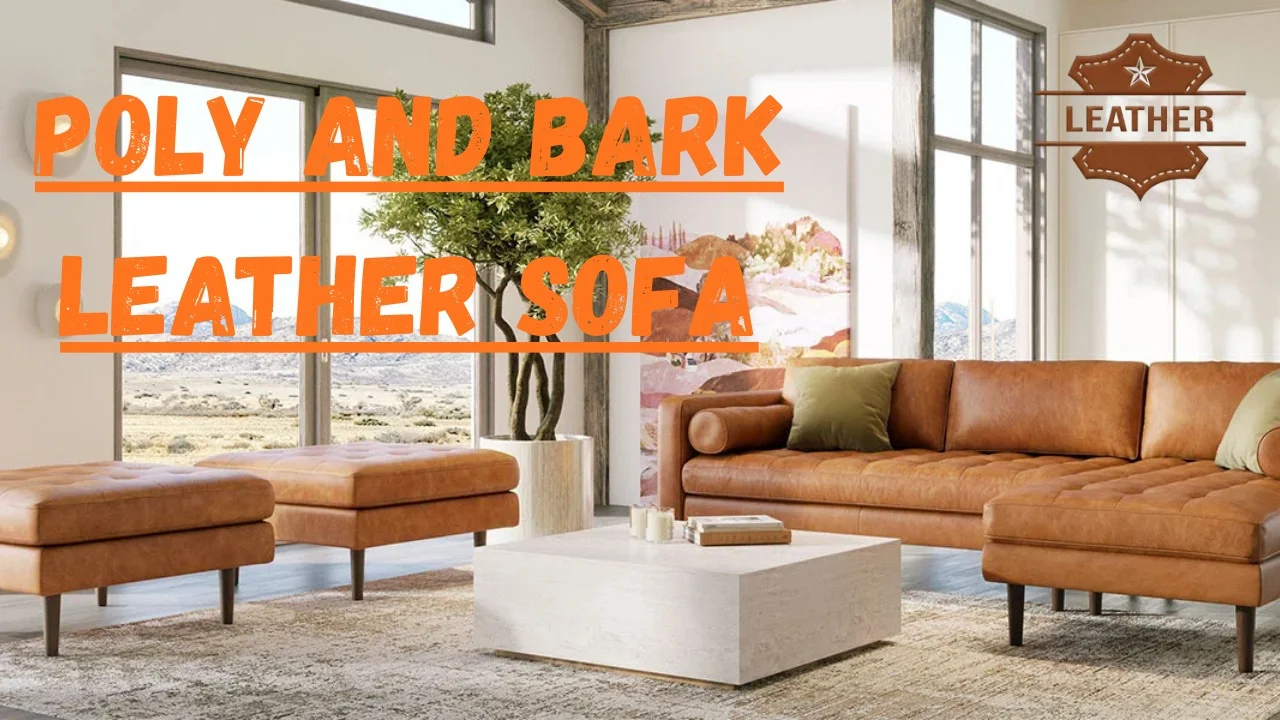
A Poly and Bark Leather Sofa is one of the most searched modern leather sofa options because it sits in a rare middle ground: it looks premium, uses real Italian-tanned leather on key models, and still lands below many showroom competitors in price. On the current site, the Napa, Essex, Capa, and Sorrento lines show full-grain or semi-aniline leather options, kiln-dried solid wood frames, Pirelli webbing, and feather-down comfort layers, with 100-day returns and free shipping on eligible orders.
That combination sounds great, but buyers still ask the same practical questions: Does the leather scratch too easily? Is the sofa too firm? Which model works best for a family room, an apartment, or a design-focused living room? This guide answers those questions in plain English, compares Poly & Bark against Article, West Elm, Burrow, and Castlery, and gives you a clear maintenance roadmap so the sofa keeps looking good after the excitement of delivery fades.
Why Poly and Bark Leather Sofas Are So Popular in 2026
Poly & Bark’s appeal comes from design and material strategy. The brand leans heavily into mid-century and modern silhouettes, and its Napa product family is still built around real leather, wooden frames, and feather-down comfort details rather than synthetic “look-alike” upholstery. The official pages also show fast-moving colorways such as Cognac Tan, Midnight Blue, Onyx Black, Olivine Green, and Cocoa Brown, which help the brand hit both classic and more style-forward buyers.
The other reason the brand keeps showing up is that it is easier to understand than many furniture sites. Poly & Bark’s care pages explain what full-grain leather is, why aniline and semi-aniline behave differently, and how the leather should be cleaned and conditioned. That makes the brand easier to research than competitors who only sell the aesthetic without clearly explaining the ownership trade-offs.
Poly and Bark Brand Overview
At a product level, Poly & Bark’s current leather sofas are built around the same core formula: real Italian-tanned leather, kiln-dried wood framing, corner blocking or reinforced joinery, Pirelli webbing, foam support, and feather or feather-blend toppers. The Napa 88.5″ sofa, for example, is shown with a 24-inch seat depth, a 19-inch seat height, and a 79.5-inch inside width without bolsters. The Essex is a more tufted, vintage-leaning 89-inch sofa, while Capa pushes into a lower, lounge-heavy shape at 96.5 inches.
That means Poly & Bark is not trying to be a soft, cloud-like sofa brand. It is selling a more structured leather sit with natural aging. The brand’s own care page reinforces that idea by telling customers that full-grain leather is intentionally left natural, that markings and patina are part of the appeal, and that semi-aniline is the more durable, easier-care option for higher-traffic homes.
What Makes Poly and Bark Different From Other Furniture Brands
The main difference is that Poly & Bark makes leather the hero. Burrow leans modular and modern, with top-grain leather and configurable layouts; Article’s Sven positions itself as a best-selling tufted leather sofa with full-aniline or semi-aniline Italian leather; West Elm spreads its leather offering across many contract-grade silhouettes and firmness levels; and Castlery emphasizes leather sofas that “live with you” with top-grain and full-grain options across the range. Poly & Bark’s identity is narrower, but clearer: mid-century leather with a patina-forward finish.
That clarity is useful for shoppers, because it helps set expectations. If someone wants an ultra-soft seat that hides everything, this is probably not the best fit. If they want a real leather sofa with visual character, a firmer base, and a more tailored appearance, Poly & Bark is often a stronger match. Dweva’s Napa review and user discussions both point in the same direction: the sofa tends to be supportive first, with visible patina and wear becoming part of the look over time.
Understanding Poly and Bark Leather Types
Poly & Bark’s leather terminology matters because comfort, aging, and maintenance all change depending on the finish. The brand’s own care guide explains that full-grain leather is the top layer of the hide and has not been corrected or coated in the same way as lower grades. It also explains that pure aniline keeps the most natural look, while semi-aniline adds a light protective topcoat that improves durability and cleaning.
Full-Grain Leather
Full-grain leather keeps the hide’s natural grain and strong fibers. On the Napa, the Cognac Tan version is described as full-grain pure-aniline dyed Italian-tanned leather, which means the finish is meant to show natural scars, wrinkles, and color variation rather than hide them. Poly & Bark says those marks are normal and part of the appeal, and the leather will develop a richer patina with use.
Pure Aniline Leather
Pure aniline is the most natural-looking finish in this lineup. It is beautiful, soft, and breathable, but it also shows scratches and tonal variation more easily. That is why Poly & Bark calls out scuffs, markings, and patina development on its Cognac Tan Napa and Essex pages. Buyers should think of pure aniline as “Highest Character, highest maintenance.”
Semi-Aniline Leather
Semi-aniline keeps much of the natural look but adds a light protective finish. Poly & Bark’s care page says semi-aniline is more durable, easier to clean, and better for pets or high-traffic rooms. The brand also notes that no leather is fully claw-proof, so semi-aniline is not indestructible, just more forgiving.
Italian-Tanned Leather
Poly & Bark repeatedly describes its upholstery as Italian-tanned. In practical terms, that usually signals a premium tanning and finishing story, but the real decision is still finish type, not the marketing phrase alone. Buyers should focus on whether the sofa is full-grain pure-aniline or full-grain semi-aniline, because that is what tells you how the sofa will wear in daily life.
Most Popular Poly and Bark Leather Sofas
Napa Sofa
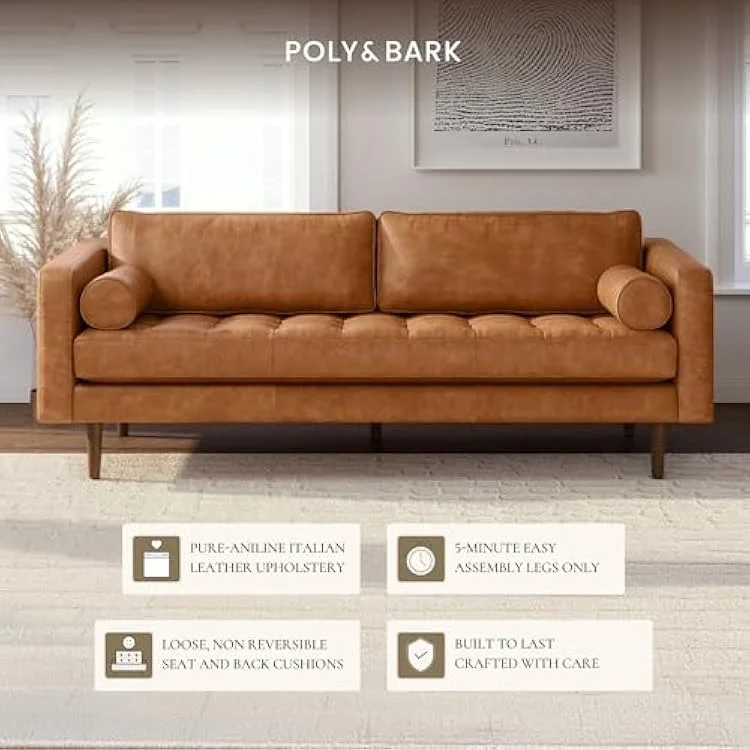
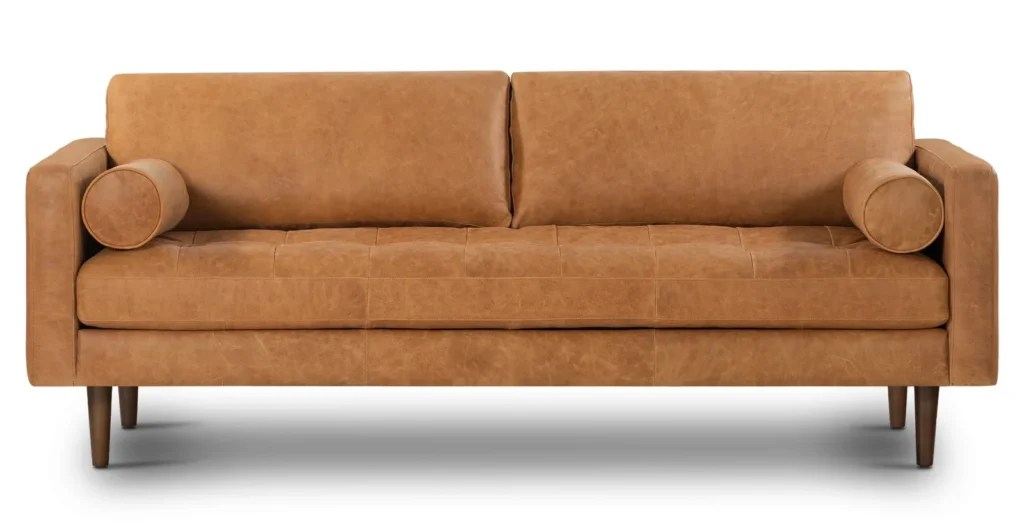
The Napa is the flagship model, and the one most people mean when they search for Poly and Bark leather sofa. The current Napa page shows an 88.5-inch sofa with a 24-inch seat depth, a kiln-dried solid wood frame, corner-blocked joinery, Pirelli webbing, a feather-down topper, and loose bolsters. The Cognac Tan version is the most natural-looking and the most patina-forward because it uses full-grain pure-aniline leather. Other colors use semi-aniline leather for a slightly more practical finish.
Best for: design-driven homes, mid-century interiors, and buyers who want natural leather character.
Not best for: people who want a plush cloud sit or a scratch-hiding surface.
Essex Sofa
The Essex is more vintage and tailored, with a diamond-tufted back, feather-down interiors, and either pure-aniline or semi-aniline leather depending on color. It reads a little more formal than Napa and works well in dens, reading rooms, and classic living rooms. Current product pages show it around 89 inches wide with a walnut-finished solid wood base.
Best for: buyers who want a refined, tufted leather look.
Watch out for: the same natural-leather trade-offs, including visible wear and patina.
Capa Sofa
The Capa is the low-profile, lounge-first option. Its current page shows a 96.5-inch leather sofa with French seams, an extra-low back line, Pirelli webbing, and feather-and-fiber fill. It is designed for relaxed posture, which makes it attractive for modern family rooms and larger open-plan spaces.
Best for: lounging, movie nights, and bigger rooms.
Watch out for: the low back can be a deal-breaker for buyers who want upright support.
Sorrento Sofa
The Sorrento adds a more cosmopolitan profile with arched legs and a refined silhouette. The current page describes full-grain pure-aniline leather, a corner-blocked solid wood frame, Pirelli webbing, and feather-blend comfort. It is one of the stronger choices for shoppers who want a sophisticated leather sofa without the extra bulk of a sectional.
Best for: elevated modern interiors and buyers who want a “finished” look.
Watch out for: the more natural leather finish still needs care and sun control.
Poly and Bark Napa Sofa Review
The Napa remains the brand’s strongest all-rounder because it balances structure, style, and leather character. The current Cognac Tan page describes a full-grain pure-aniline finish that highlights scars, wrinkles, and variation, while the other colors shift to semi-aniline for a bit more durability. That is the key decision buyers should understand: Napa is not one product with one personality; it changes depending on finish.
From a comfort perspective, Dweva’s 2026 hands-on review found the Napa to be supportive rather than sink-in soft, with enough feather-down softness to keep it from feeling rigid. That matches the structure implied by Poly & Bark’s own material stack: foam core, feather topper, Pirelli support, and a wood frame. In plain English, it is built to hold shape more than to disappear under you.
Poly and Bark Sofa Construction Explained
Good leather is only half the story. Poly & Bark’s product pages consistently show kiln-dried solid wood frames, corner blocking or reinforced joinery, Pirelli webbing, and foam topped with feather or feather-blend layers. That combination usually gives a sofa a cleaner silhouette, better structure, and more predictable break-in than cheaper all-foam builds.
The downside is that a structured build can feel firmer at first. That is why user feedback frequently splits into two camps: buyers who love the supportive sit and buyers who expected a softer, cloud-like lounge feel. The product itself is not really hiding that trade-off; the company’s own specs point toward structured support, not plush overstuffing.
Comfort Analysis: Firm vs Soft Feel
If you like posture-supportive seating, Poly & Bark is usually a good fit. If you want a sofa you can sink deeply into, Burrow’s leather line or West Elm’s softer models are more likely to satisfy you. Burrow positions its Nomad leather sofa around modular flexibility and plush, supportive cushions, while West Elm’s Harmony explicitly rates its seat as soft and its cushions as fiber-wrapped foam and down-filled back cushions.
That difference matters because leather sofas are often purchased for style first and comfort second, then judged as if they were cloud sectionals. Poly & Bark performs better when the buyer wants a tailored visual anchor with enough comfort for everyday use. It performs worse when the buyer wants deep lounging, childlike softness, or a very low-pressure sit.
How Poly and Bark Leather Ages Over Time
This is one of the biggest reasons people buy the brand. Poly & Bark says full-grain leather should be expected to show marks, scuffs, tonal differences, and patina as part of the ownership story. The article says the same thing about its Sven line, describing natural variations, wrinkles, and creases as normal characteristics that develop into a relaxed vintage look.
That means aging should be judged as “character development,” not “damage,” unless the wear is excessive or uneven. Owners who like leather to look polished and pristine for years may be disappointed. Owners who enjoy a lived-in, vintage aesthetic usually end up liking the sofa more after the first year than on delivery day.
Real Owner Experiences and Reviews
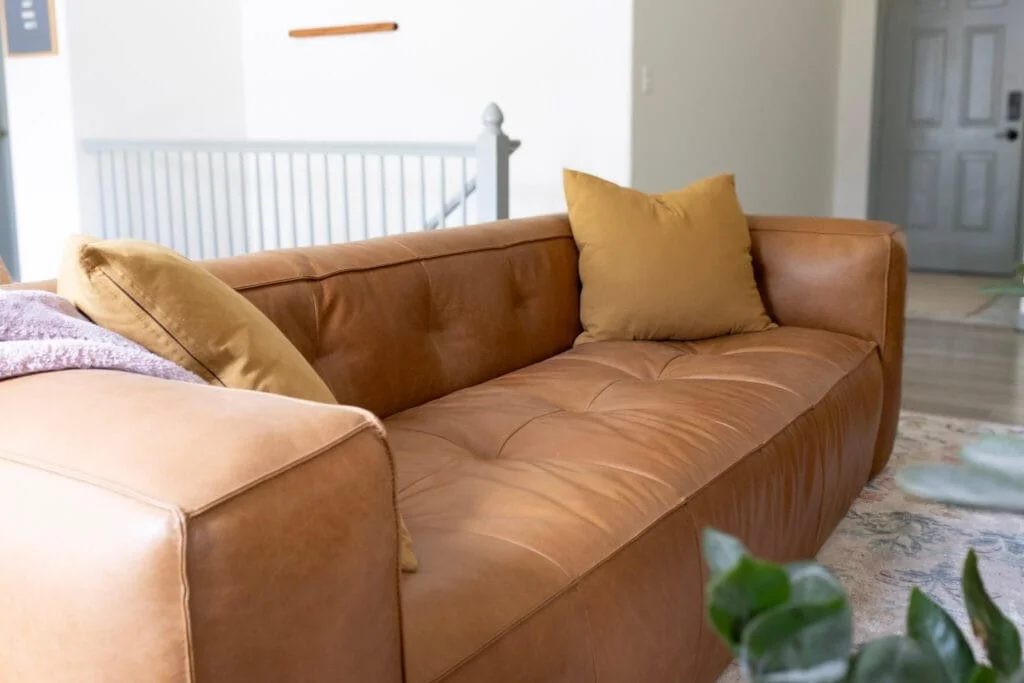
The strongest ownership themes in live reviews are Consistency, patina, and firmness. Some owners say the sofa looks better over time, has strong visual appeal, and holds up well in daily use. Others complain that cushions flatten earlier than expected or that the leather shows wear quickly, especially on higher-contact areas. That split is exactly what you would expect from a real leather sofa with a natural finish.
The practical lesson is simple: buyers should not treat visible patina as a defect, but they should be realistic about cushion support and scratch visibility. If those are deal-breakers, a more protected leather, a fabric performance sofa, or a different comfort architecture will likely be a better fit.
Poly and Bark Napa vs Article Sven
This is the comparison many buyers actually need. On paper, both brands live in the same mid-century leather universe. Article’s Sven uses top-grain, full-aniline Italian leather on key versions and is known for its tufted bench seat, loose cushions, and bolster pillows. Poly & Bark’s Napa uses full-grain pure aniline in Cognac Tan and semi-aniline in other colors, with a similar natural-aging philosophy but a slightly more structured overall feel.
The article gives you a very broad review footprint and a clear 30-day satisfaction guarantee. Poly & Bark currently shows a 100-day return window on its site and positions the Napa as a more character-rich, patina-forward sofa with a deeper ownership story. Choose Sven if you want a softer mainstream crowd favorite; choose Napa if you want the more leather-forward, boutique feel.
Poly and Bark vs West Elm
West Elm’s leather line is broader and more retailer-like. Its current leather sofas include contract-grade models, top-grain leather options, and firmer or softer seat ratings depending on the piece. That gives West Elm more variety, but it also makes the comparison less direct. Poly & Bark is more concentrated on the mid-century leather look and often feels easier to understand for shoppers who want one specific aesthetic.
In price terms, West Elm often sits higher. Its current leather sofas show a wide range that starts around the mid-$1,000s for some models and reaches well above $3,000 for others, while Poly & Bark’s Napa, Essex, and Sorrento commonly sit around the low-$2,000 range before discounting. That does not automatically make Poly & Bark cheaper in every case, but it often makes the value proposition easier to defend.
Poly and Bark vs Castlery
Castlery’s leather pages lean into “lived-in” comfort and family practicality. Its leather sofa collections emphasize full-grain and top-grain categories, configurable shapes, and room-friendly layout advice. That is helpful for buyers who want a little more handholding, especially around sectional formats and family use. Poly & Bark is less modular, but its best models often give a stronger design-first read.
Price also matters. Castlery’s Dawson and Fable positions sit around the high-$2,000 to mid-$3,000 range on current pages, which places them in a slightly more premium bracket than many Poly & Bark shoppers expect. If the buyer wants modular flexibility and family-first comfort, Castlery deserves a look. If the buyer wants a cleaner mid-century leather focal point, Poly & Bark often has the sharper silhouette.
Best Poly and Bark Sofa for Every Room
Apartment or small living room: Napa 72″ Apartment Sofa. The shorter footprint and bolster styling make it easier to fit into tighter rooms without losing the brand’s identity.
Open-plan modern living room: Capa. The lower profile and extra width create a relaxed look that suits larger spaces.
Formal den or reading room: Essex. The tufted back and tailored profile make it feel more refined.
Statement room / sophisticated lounge: Sorrento. Its arched legs and full-grain character give it a more finished, upscale presence.
Best Colors and Leather Finishes
Cognac Tan is the most character-rich choice. On the Napa and Essex lines, it is shown as pure aniline, which means more markings, more natural variation, and a faster patina story. If you love leather that looks alive, this is the finish to chase.
Semi-aniline colors like Midnight Blue, Onyx Black, Olivine Green, and some non-cognac variants are better when you want a little more protection and a more even surface appearance. Poly & Bark says semi-aniline is more durable and easier to maintain, which is exactly why it is the safer everyday pick for many homes.
Living Room Styling Ideas
Poly & Bark sofas work best when you let the leather breathe visually. Pair them with walnut, oak, brass, black metal, or natural stone, and avoid overloading the room with too many competing textures. The Napa and Essex especially suit mid-century, modern organic, and understated urban interiors.
A practical styling formula is simple: one leather sofa, one warm wood element, one soft textile, and one metallic accent. That keeps the room from feeling too dark or too “showroom.” It also helps the sofa age gracefully because the space around it feels intentional rather than busy. This is an inference based on the sofas’ visual design language and material palette.
Poly and Bark Leather Sofa Maintenance Guide
Poly & Bark’s care page is unusually useful. It recommends regular dusting, gentle wipe-downs, avoiding direct sunlight and heat, testing products on an inconspicuous area, and conditioning leather to prevent over-drying. The page specifically notes conditioning every 3 to 6 months for full-grain leather.
A simple ownership routine looks like this:
- Dust weekly with a soft, dry cloth.
- Wipe minor marks with a damp cloth.
- Keep the sofa out of direct sunlight and away from heat sources.
- Condition the leather every few months.
- Rotate seating spots so wear develops more evenly.
For pet homes, Poly & Bark says semi-aniline is the better option because it is more durable and easier to clean, but it also warns that no leather is 100% claw-proof. That is the most honest way to think about any leather sofa in a pet household.
Common Problems and Solutions
Scratches: On pure-aniline leather, light scratches are expected. In many cases, they blend into the patina rather than ruining the sofa.
Firmness: The sofa may feel firmer at first than buyers expect, especially compared with plush fabric couches. Break-in helps, but the underlying structure is still supportive.
Uneven aging: Leather naturally varies in tone and texture. That is not a defect when you are buying full-grain or semi-aniline hides.
Are Poly and Bark Sofas Good for Pets?
They can be, but only with the right expectations. Poly & Bark’s own care guidance says semi-aniline is the more pet-friendly choice, while pure-aniline surfaces will show more marks and wear. If a home has active claws, Jumping Pets, or rough play, the buyer should expect surface changes sooner.
Are Poly and Bark Sofas Good for Families?
Yes, especially if the family values easy cleaning, natural materials, and a sofa that can age with the home. The safer route is a semi-aniline colorway rather than a pure-aniline one. For families who need a softer, more forgiving sit, Burrow’s modular leather or certain West Elm options may be more comfortable, but Poly & Bark still wins on leather character and mid-century visual impact.
Cost of Ownership Over 10 Years
A useful way to judge leather furniture is to spread the price over time. Using current site prices, a Napa at about $1,698.40, an Essex at about $1,798.40, a Sorrento at about $1,798.40, or a Capa at about $1,992 changes the long-term cost picture quickly. A $1,698 sofa used for 10 years is roughly $170 per year before care; a $1,992 sofa is about $199 per year. That is just simple math, but it makes the value conversation much clearer.
That framework also explains why many buyers tolerate a firmer seat or visible patina. They are not just buying a couch; they are buying a leather centerpiece that is expected to last longer and look better with age. Poly & Bark’s current materials, care guidance, and return policy all support that long-view approach.
Who Should Buy a Poly and Bark Leather Sofa?
Buyers who like mid-century silhouettes, real leather, visible patina, and a structured sit will usually get the most from Poly & Bark. The brand is especially strong for people who want a sofa that looks more expensive than a typical online furniture find and who are willing to maintain natural leather properly.
Who Should Avoid One?
Avoid it if you want ultra-plush comfort, maximum scratch resistance, or a sofa that stays visually unchanged for years. In that case, a protected leather, a performance fabric model, or a softer modular brand like Burrow may be the better route.
People Also Ask
A: For buyers who want real leather, good design, and a sofa that develops character, yes. The brand’s strongest models offer full-grain or semi-aniline leather, solid frames, and clear care guidance. The trade-off is that the sit is more supportive than plush.
A: The pure-aniline versions can scratch and scuff more easily, and the brand says that is part of the material’s natural aging process. Semi-aniline finishes are more forgiving.
A: The Napa 72″ Apartment Sofa is the clearest fit because it keeps the brand’s leather look in a smaller footprint.
A: Comfort depends on taste, but the Capa is the most lounge-oriented, while Napa and Essex are more supportive and structured.
A: Dust it regularly, wipe spills with a damp cloth, keep it out of direct sun, and condition it every 3 to 6 months. Use the brand’s care guidance, not random, harsh cleaners.
Conclusion
Poly and Bark wins when the buyer wants style-first leather seating with honest natural aging, not a plush sofa that hides everything. The Napa is the flagship, the Essex is more tailored, the Capa is more lounge-friendly, and the Sorrento offers a more refined silhouette. Official product pages show real leather construction, solid wood frames, Pirelli webbing, feather-down comfort layers, and a 100-day return window, while Poly & Bark’s own care guide gives buyers a realistic plan for keeping the leather healthy over time.
For design-focused buyers, the Napa remains the safest recommendation. For lounge-first buyers, the Capa or a competing modular brand may be better. As shoppers who want a softer mainstream favorite, Article’s Sven is the most natural comparison. For buyers who care about sourcing and Sustainability language, the Leather Working Group is the right authority to cite alongside brand care documents and product specs.
Legal disclaimer: Leather quality, pricing, manufacturing standards, and product availability may vary by country, brand, and supplier. Always verify authenticity, material details, and care instructions before purchase.