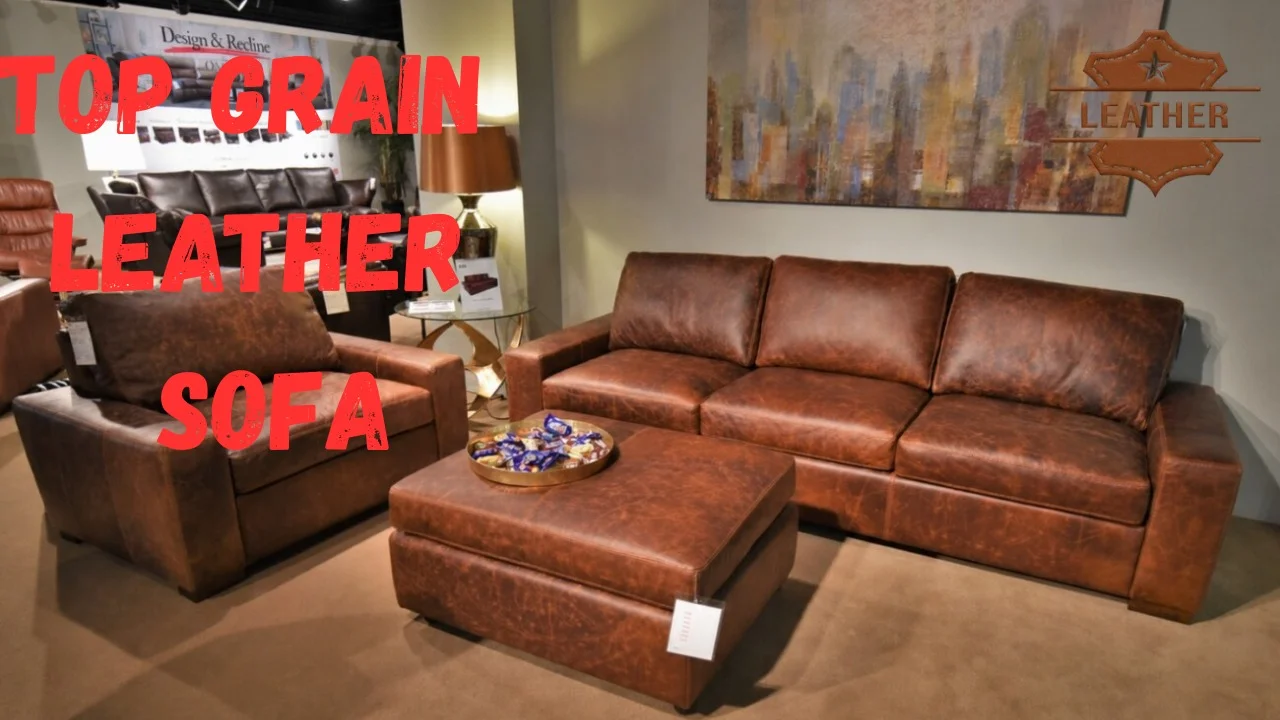
TOP GRAIN LEATHER SOFA
A Top-Grain Leather Sofa is one of the smartest living room investments you can make if you want a piece that looks premium, feels comfortable, and holds up well in everyday use. In 2026, buyers are not just looking for a sofa that looks expensive in photos. They want a real decision framework: Which leather type is best? How much leather is actually on the sofa? What frame and cushion construction should you trust? And how do you care for it so it still looks beautiful years later?
That is where most competitor pages fall short. They may explain the basics of leather, but they often skip the deeper questions that matter at purchase time: finish type, leather coverage, durability trade-offs, room fit, and long-term maintenance. This guide closes those gaps with a practical, buyer-first approach so you can choose a sofa that fits your home, your budget, and your lifestyle.
Snippet-ready answer: A top grain leather sofa is a sofa upholstered in leather that has been refined for a smoother, more uniform surface than full grain leather. It is popular because it balances real leather feel, easier maintenance, and strong everyday durability.
What Is a Top Grain Leather Sofa?
In leather terminology, the grain is the outer surface of the hide. The Leather Working Group’s definitions distinguish full-grain leather as leather that keeps its entire grain with no corrective surface removal, while corrected-grain leather has had part of the grain removed by buffing or a similar mechanical treatment and then finished. In consumer furniture language, top-grain leather is commonly used for the refined, sanded, and finished upper-layer leather that offers a cleaner, more uniform look.
That finishing process matters. It helps create a surface that is more consistent in color and appearance, which is why top-grain leather is so common in sofas, sectionals, recliners, and premium seating collections. Retailers also position it as a practical choice because it tends to be softer and easier to maintain than more natural, less finished leathers.
Why buyers like it
Top grain leather offers a sweet spot between luxury and practicality. It usually looks polished, feels comfortable, and is easier to live with than very delicate natural leathers. For many homes, that makes it more useful than chasing the absolute “most natural” leather finish.
Top Grain Leather vs Full Grain Leather
This is the comparison buyers search for most, and it is also where many articles stay too shallow. The right answer depends on how you live, how much wear the sofa will get, and how much natural character you want in the leather.
| Feature | Top Grain Leather | Full Grain Leather |
| Surface | Smoothed and finished for a more uniform look | Keeps the natural grain surface |
| Appearance | Cleaner, more consistent | More natural, more character, more markings |
| Maintenance | Easier for most buyers | Can need more careful handling depending on finish |
| Patina | Develops some aging, but usually less dramatic | Often develops the richest natural patina |
| Best for | Busy homes, family rooms, modern interiors | Buyers who want maximum natural character |
| Trade-off | Less raw texture and natural variation | Less uniform, more expensive in many cases |
The Leather Working Group’s definitions make the structural difference clear: full grain keeps the entire grain, while corrected grain has part of the surface mechanically removed and then finished. That is why top grain is often chosen for a more controlled look, while full grain is favored by buyers who want the most natural surface possible.
Mini summary:
Choose top grain if you want a polished, easier-care leather sofa for everyday life. Choose full grain if you want maximum natural character and are comfortable with a more visible, less uniform surface.
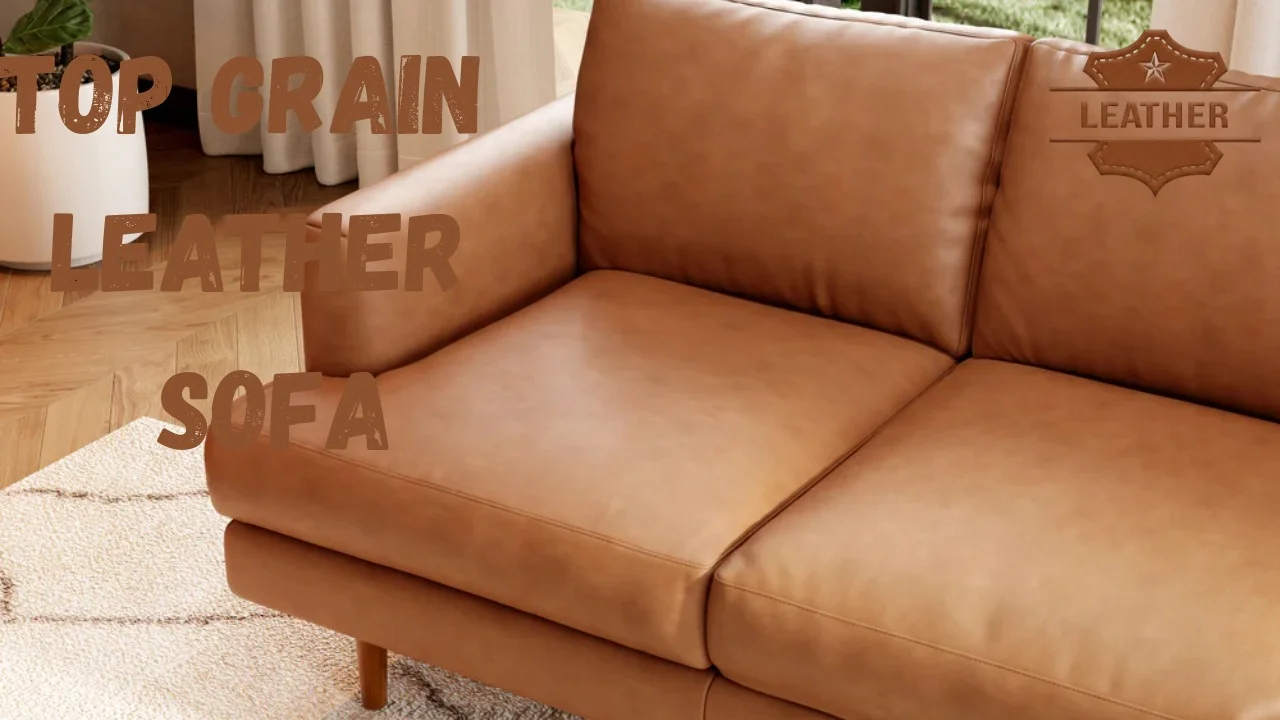
Top Grain Leather vs Genuine Leather vs Bonded Leather
A lot of shoppers get confused here, and the confusion is costly. The Federal Trade Commission’s Leather Guides exist specifically to address misrepresentation and the disclosure of leather and imitation leather content, which is exactly why buyers should ask for precise material details rather than relying on vague labels.
| Term | What it usually means in practice | Buyer takeaway |
| Top grain leather | Finished upper-layer leather with a smoother surface | Strong choice for premium everyday use |
| Full grain leather | Natural grain surface retained | Highest natural character, often pricier |
| Genuine leather | A broad label that may vary by brand and market | Ask what layer, finish, and coverage it actually has |
| Bonded leather | Leather scraps and backing material combined | Lower durability; not ideal for a long-life sofa |
| Faux / PU leather | Synthetic leather-look material | Easier on the budget, but usually less durable |
The safest buying rule is simple: do not buy based on the label alone. Ask exactly what part of the sofa is leather, what finish it has, and whether the visible panels are all leather or only selected sections. Povison’s buying guide rightly emphasizes checking leather coverage, frame, cushions, and room fit before purchase.
Why Top Grain Leather Matters in 2026
In 2026, buyers are more value-conscious than ever. They want furniture that looks good in modern spaces, fits a multi-use lifestyle, and does not create maintenance stress. That is exactly where top-grain leather still wins. Recent buying guides from large retailers continue to recommend leather types with protective finishes for longevity, while review roundups from BHG and Real Simple continue to emphasize comfort, durability, customization, and practical upkeep.
Current trends also show a shift toward quieter, more grounded interiors: warm brown leather, modular seating, curved silhouettes, and performance-focused finishes. Those trends support top grain leather because it pairs easily with both contemporary and classic decor, while still handling daily living better than many delicate upholstery options.
Mini summary:
Top grain leather matters now because it delivers the look of luxury without forcing buyers into a high-maintenance lifestyle. That balance is exactly what modern households are asking for.
Different Styles and Variations of Top Grain Leather Sofas
Top grain leather is not one sofa style. It shows up in many forms, and the right shape depends on your room, seating needs, and design taste.
Common styles
- Standard 2- or 3-seat sofas
- Sectionals
- Loveseats
- Recliners and power recliners
- Sleeper sofas
- Modular sofas
- Chesterfield-style sofas
- Track-arm and square-arm modern sofas
- Roll-arm transitional sofas
Which style suits which buyer?
A smaller apartment usually benefits from a loveseat or compact 3-seater. A family room often needs a sectional or Modular Piece. A formal living room may suit a rolled-arm or Chesterfield silhouette. A modern loft often looks best with square lines, low profiles, and a darker finish.
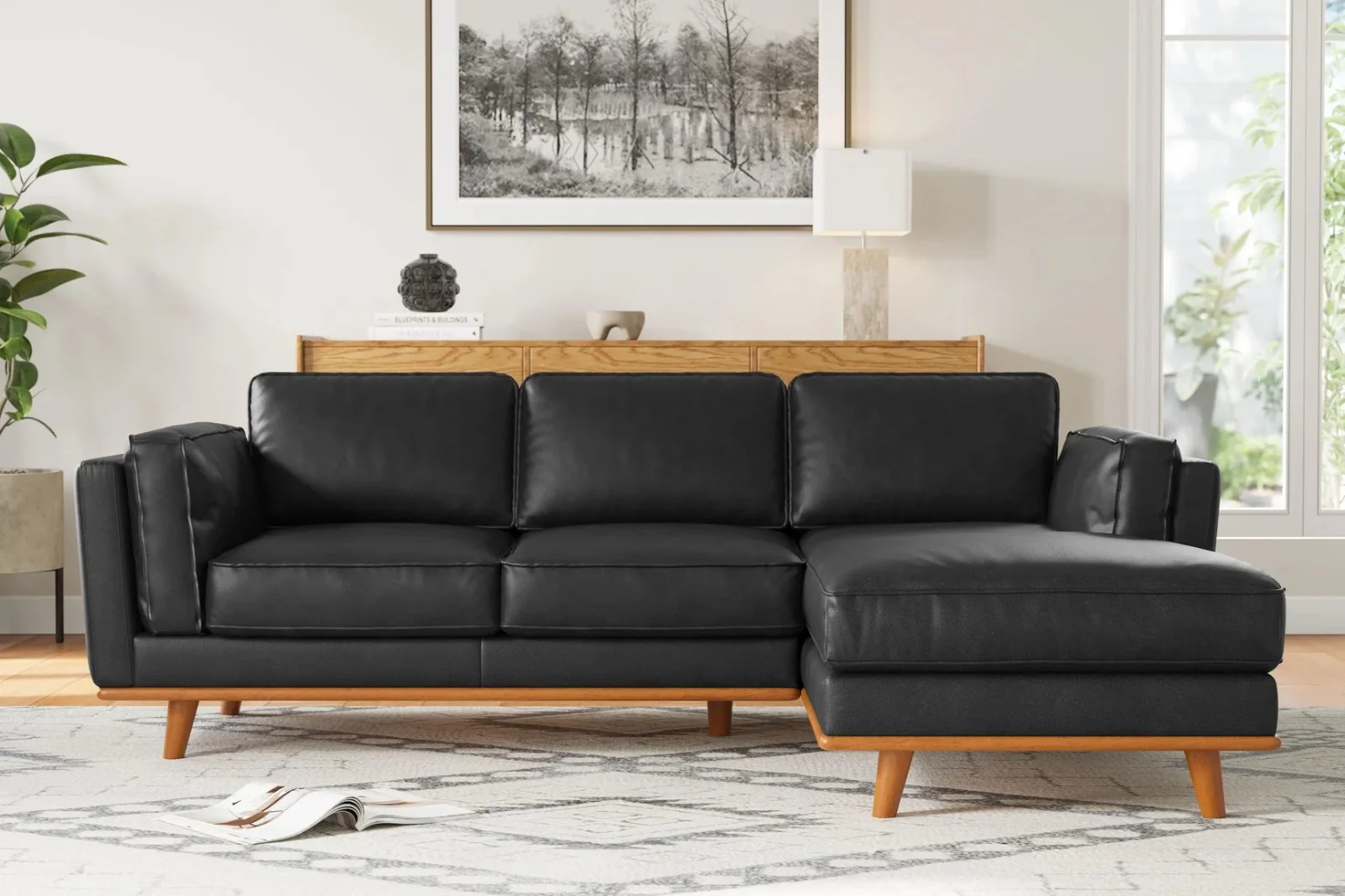
Leather Types Used in Sofas
Not all leather upholstery performs the same way. The finish matters as much as the grain. Many brands now guide buyers toward finish types such as protected, semi-aniline, or aniline, because each one changes the sofa’s look, feel, and care needs.
| Leather type | Look and feel | Maintenance | Best for |
| Full grain | Most natural, rich character | Can require more thoughtful care | Luxury buyers, patina lovers |
| Top grain | Smooth, refined, more uniform | Usually easier than full grain | Everyday family use |
| Semi-aniline | Natural feel with added protection | Moderate care | Buyers who want softness plus protection |
| Pigmented / protected | More even color, stronger surface protection | Often easiest to maintain | Busy homes, kids, pets |
| Suede / nubuck | Soft and matte, but more delicate | Higher care burden | Lower-traffic, design-led spaces |
| PU / faux leather | Synthetic leather look | Easy cleaning, lower lifespan | Budget buyers, short-term use |
Specialty care sources consistently warn that suede, nubuck, aniline, and semi-aniline leathers need more careful handling than protected leathers. That means the “best” sofa is not the one with the fanciest word in the description; it is the one that matches your household.
How Top Grain Leather Sofas Are Made
A high-quality leather sofa is not just about the visible upholstery. The production process matters because the frame, foam, suspension, and leather finishing all affect how the sofa will feel and age. Retail buying guides increasingly tell shoppers to inspect the whole product, not just the material name.
Step-by-step manufacturing overview
- Hide selection – Quality hides are chosen for consistency, size, and usable grain.
- Tanning – The hide is stabilized so it can become durable leather.
- Surface refinement – For top grain, the upper surface is corrected or finished for a more uniform appearance.
- Coloring and coating – Pigments or protective finishes are applied depending on the desired look and performance.
- Cutting and matching – Sections are cut for sofa panels, ensuring color and grain consistency.
- Frame building – The frame is constructed, often with kiln-dried hardwood or a strong engineered structure.
- Cushion assembly – Foam, fiber, or hybrid fills are added to shape comfort.
- Upholstery and stitching – Leather panels are pulled tight, stitched, and finished.
- Quality control – The piece is checked for seams, alignment, comfort, and finish consistency.
Why the frame matters as much as the leather
A sofa can have excellent leather and still feel disappointing if the frame is weak, the seat depth is wrong, or the cushion fill flattens too quickly. That is why strong buying advice now consistently includes frame and cushion checks alongside material checks.
How to Identify a Real Top Grain Leather Sofa
The market is full of vague labels, so buyers need a practical checklist.
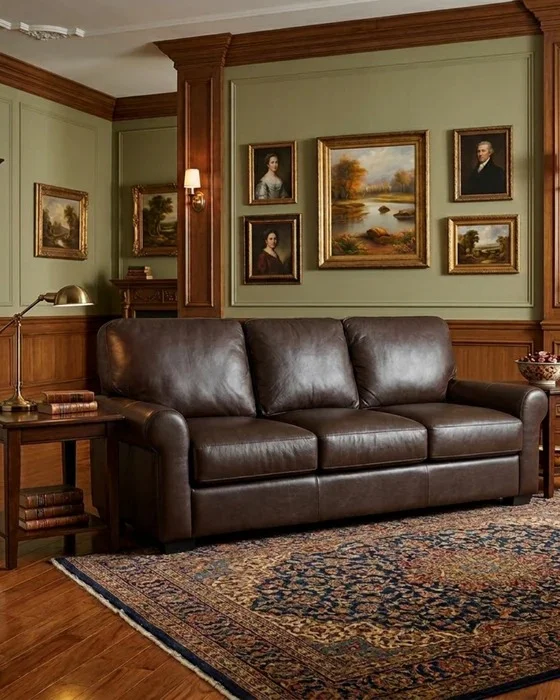
Smart buying checklist
- Ask whether the sofa is top grain, corrected grain, semi-aniline, or protected leather
- Ask which parts are leather and which parts are not
- Ask whether the leather is pigmented or lightly finished
- Check the frame material
- Ask for cushion fill details
- Review dimensions in both sitting and reclining positions
- Confirm care instructions before purchase
- Ask whether the manufacturer supports the leather with a warranty or care program
Red flags
- “Genuine leather” with no more detail
- No mention of leather coverage
- No frame or cushion information
- Overly perfect photos with no close-ups of stitching and texture
- No care instructions
- No return or warranty clarity
Complete Buying Guide: How to Choose the Right Sofa
This is the section most competitors should have, but often do not.
1) Start with your room
Measure the wall, walkway, doorways, elevator, and turning spaces. Many buying mistakes happen because the sofa is beautiful online, but too large, too deep, or too awkward to move. Povison specifically advises checking room fit and motion clearance before ordering.
2) Decide how you live
A family with kids and pets should usually prioritize protected or top-grain leather with a durable finish. A design-first buyer who wants a softer, more tactile look may prefer semi-aniline or more natural leather. A low-maintenance buyer should avoid very delicate finishes.
3) Check the comfort profile
Seat depth, seat height, cushion firmness, and back support matter more than the word “luxury” in the product title. Real-world review coverage continues to reward sofas that balance comfort and construction, not just leather quality alone.
4) Inspect the leather coverage
Some sofas are full leather, while others use leather only on the front-facing or contact areas and pair the rest with Matching Material. That is not automatically bad, but it must be disclosed clearly.
5) Think about finishing and aging
If you want a clean, modern look, top-grain leather is usually a strong match. If you want a visible natural character and a richer patina story, full grain may be better. There is no universal winner; there is only the right match for your lifestyle.
Best Uses of a Top Grain Leather Sofa
Top grain leather performs well in many settings because it is easier to live with than highly delicate leather finishes and more upscale in appearance than many fabric alternatives.
Best use cases
- Family living rooms
- Modern apartments
- Open-plan homes
- Home offices with guest seating
- Media rooms
- Upscale rental properties
- Lounge spaces that need easy wipe-down care
Best design styles
- Modern minimal
- Scandinavian modern
- Transitional
- Contemporary luxe
- Warm rustic
- Quiet luxury interiors
Price Ranges in the Real Market
Exact pricing changes by country, brand, leather coverage, frame quality, and customization. But current retail examples show how wide the range can be. A top-grain leather collection at Prospera Home is listed at $2,999, while Dweva’s featured leather sofa guide shows a $1,699 top-grain Italian leather sofa example, proving how sharply price shifts with brand and construction.
| Price band | What you usually get | Buyer profile |
| Budget-friendly | Simpler construction, fewer customization options, often partial leather coverage | Value-focused shoppers |
| Mid-range | Better foam, stronger frame, more consistent leather finish | Most home buyers |
| Premium | Better craftsmanship, better leather selection, more styling options | Long-term owners and design buyers |
| Luxury | Custom work, elevated materials, higher attention to detail | High-end interiors |
Important note: treat these as market estimates, not fixed global prices. Upholstery quality, manufacturing origin, and leather coverage can change the final price dramatically.
Best Countries and Markets Famous for Leather Sofas
Different markets are known for different strengths. Italy is often associated with design-led leather craftsmanship, the United States with customizable furniture production, and the United Kingdom with strong leather care and sofa retail guidance. In practice, the best sofa is less about the country alone and more about the specific factory standards, tanning source, frame quality, and warranty terms.
What to look for in the market
- Italy: design quality, fine finishing, premium leather selections
- USA: customization, broad retail choice, family-friendly sizing
- UK/EU: strong care documentation, finish options, and upholstery detail
- Global certified supply chains: look for LWG certification signals where relevant
The Leather Working Group states that it audits and certifies leather manufacturers, and it reports a large global network of certified suppliers. That makes it one of the most useful sustainability and supply-chain references for buyers who care about responsible sourcing.
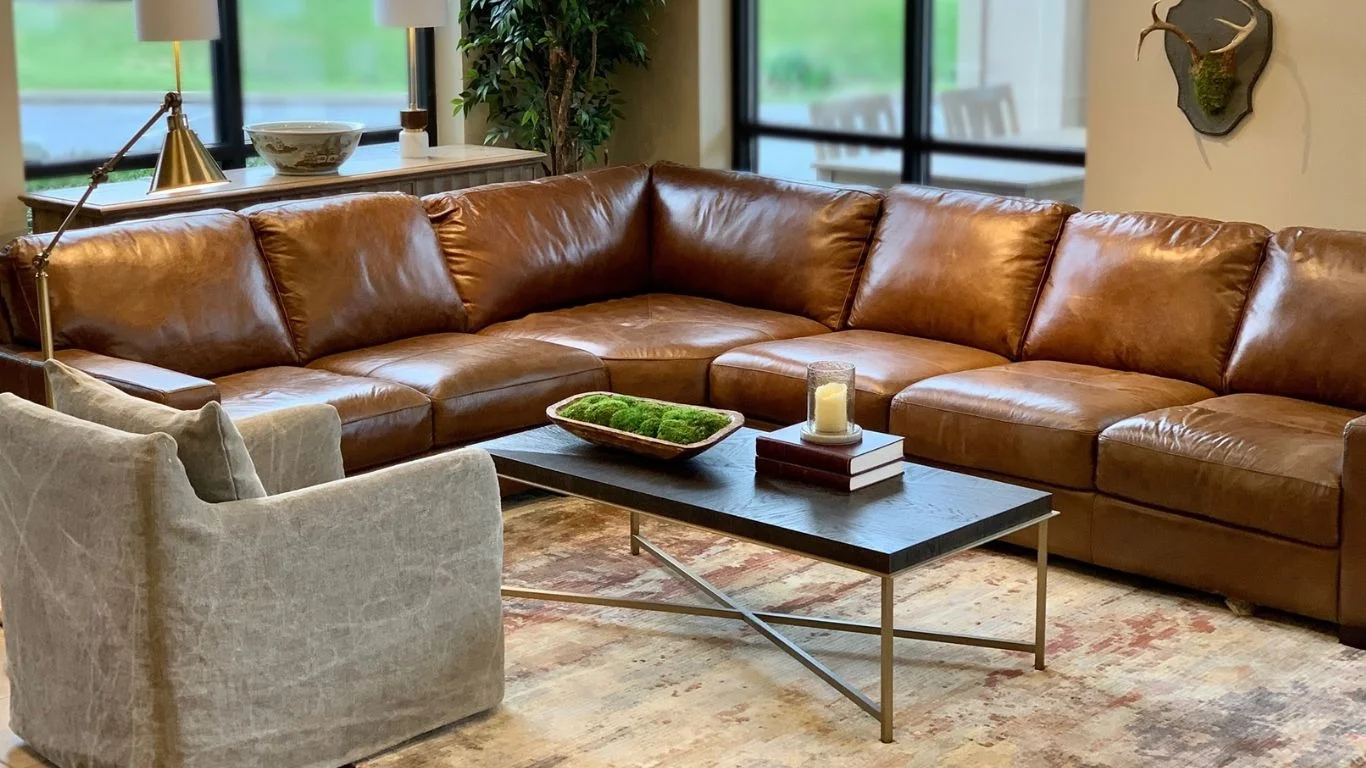
Budget-Friendly vs Premium Choices
A low-price sofa is not automatically a bad sofa, and a high-price sofa is not automatically a great one. What matters is what you receive for the money. Review roundups from major outlets keep returning to comfort, durability, and construction details as the deciding factors.
Budget-friendly options usually include:
- Simpler silhouette
- Fewer custom finishes
- Less elaborate stitching
- Possibly mixed material construction
- Acceptable comfort, not a luxury feel
The premium option usually includes:
- Better leather consistency
- Stronger frame
- More refined cushion behavior
- Better stitching and tailoring
- More customization
- Better long-term ownership value
Pros and Cons of Top Grain Leather Sofas
| Pros | Cons |
| Real leather with a refined look | Usually costs more than fabric or faux leather |
| Easier to maintain than more natural finishes | Less natural texture than full grain |
| Good for busy households | Can still scratch, fade, or dry out if ignored |
| Works in many interior styles | Quality varies widely by brand |
| Ages well with proper care | Needs correct cleaning products |
Top grain leather is a strong middle ground. It is usually the best balance for buyers who want real leather, practical upkeep, and a polished look without going all the way to a more delicate or expensive full-grain piece.
Common Buyer Mistakes to Avoid
1) Buying by label only
A label like “Genuine Leather” does not tell you enough. Ask for the exact leather type, finish, and coverage.
2) Ignoring room fit
A sofa that is too deep, too long, or too wide can ruin the experience before you ever sit on it.
3) Forgetting the frame
Leather is only one part of the product. Frame and cushion construction decide how long the sofa feels comfortable.
4) Choosing the wrong finish for your home
Very delicate finishes can be beautiful, but they are not always practical for kids, pets, or daily use.
5) Skipping care instructions
Leather care is not complicated, but it has to be correct for the finish. Different leather types need different care.
Care, Cleaning, and Maintenance Tips
Leather sofas can last a very long time when you protect them properly. DFS recommends keeping leather out of direct sunlight, using a protector or conditioner early, cleaning spills immediately, and wiping the sofa weekly with a dry cloth.
Practical care routine
- Keep it away from direct sunlight.
- Keep it away from heaters and strong heat sources.
- Wipe dust weekly with a soft dry cloth.
- Blot spills immediately; do not rub.
- Use only leather-safe cleaners approved for your finish.
- Test any new product on a hidden area first.
What not to do
- Do not soak the leather
- Do not use harsh chemicals
- Do not use the wrong conditioner on delicate finishes
- Do not leave it in the strong sun for long periods
- Do not let spills sit until they set
Mini summary:
The best leather care is boring and consistent. Keep it clean, dry, shaded, and treated with the right product for the finish.
Expert Tips Most Buyers Ignore
- Check the leather finish first, not just the type name. Top grain can still be protected, semi-aniline, or more natural in feel.
- Measure seat depth, not only sofa width. Comfort often comes from depth, not size alone.
- Ask about the match material. Some sofas are not fully leather everywhere, and that affects value.
- Look for sourcing signals. LWG certification is a useful responsibility indicator.
- Choose color for your room, not your browser. Brown, tan, and charcoal age differently in real interiors depending on light and use.
Who Should Buy a Top Grain Leather Sofa?
A top-grain leather sofa is a strong choice for:
- Buyers who want a premium look with manageable care
- Families who need practicality without giving up style
- People furnishing a long-term home
- Buyers who prefer a smoother, more uniform leather appearance
- Shoppers who want a better value-per-year than lower-quality furniture
Who Should Avoid It?
You may want to avoid top grain leather if:
- You want the most natural, untouched grain possible
- You prefer a very soft, fabric-like feel
- You do not want to think about care at all
- Your home gets harsh sunlight, and you will not place the sofa carefully
- Your budget only allows low-grade materials with weak construction
Future Trends in the Leather Sofa Market
The 2026 direction is clear: buyers want more comfort, quieter design, and clearer product transparency. Current retailer content points toward modular seating, deeper comfort, curved lines, warm earth-tone leather, and performance-focused finishes. At the same time, certification and responsible sourcing are becoming more important in buyer trust.
What to expect next
- More modular leather sofas
- More protected finishes for daily use
- Stronger demand for clear leather coverage disclosures
- More interest in sustainable and certified sourcing
- More earthy, quiet-luxury styling choices
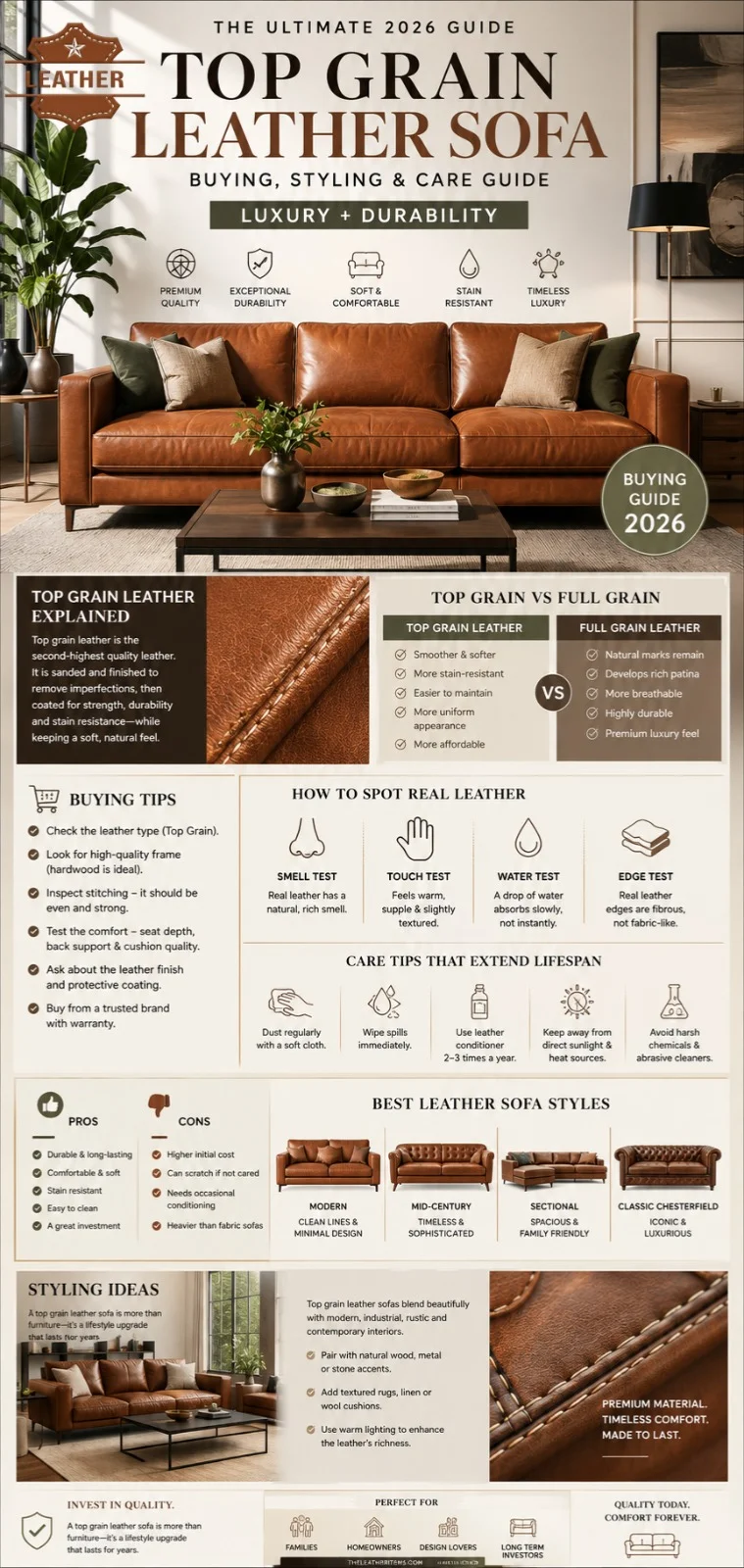
People Also Ask
A: Yes, for most households, it is worth it because it gives you real leather, a cleaner look, and easier maintenance than more delicate finishes. It is especially useful when you want style and everyday practicality together.
A: It can if it is neglected, dried out, or exposed to harsh sun and heat for long periods. Regular cleaning, careful placement, and the right care products help reduce that risk.
A: In many furniture markets, “genuine leather” is too vague to judge on its own. Top grain is usually clearer because it tells you more about the leather surface and finish, which is why buyers should ask for exact specs.
A: Lifespan depends on the frame, cushion quality, use, sunlight exposure, and care routine. High-quality leather sofas can last many years when they are well-built and properly maintained.
A: Tan, brown, cognac, charcoal, and deep neutral tones are the safest choices for most homes because they work across many styles and age well visually.
Conclusion
A top-grain leather sofa is one of the best all-around choices for modern homes because it offers the look and feel of premium leather without requiring the most delicate maintenance routine. For most buyers, it strikes the right balance between beauty, durability, comfort, and Long-Term Value. The smartest purchase is not the one with the biggest marketing claim; it is the one with the clearest leather description, the strongest frame, the right comfort profile, and the care routine you can actually follow.
For readers of TheLeatherItems.com, the ideal next step is to explore related guides on leather care, leather grades, and sofa-buying basics so the final choice feels confident rather than confusing. When a sofa is selected well, it becomes more than seating. It becomes a long-term anchor for the room.
Legal disclaimer: Leather quality, pricing, manufacturing standards, and product availability may vary by country, brand, and supplier. Always verify authenticity, material details, and care instructions before purchase.