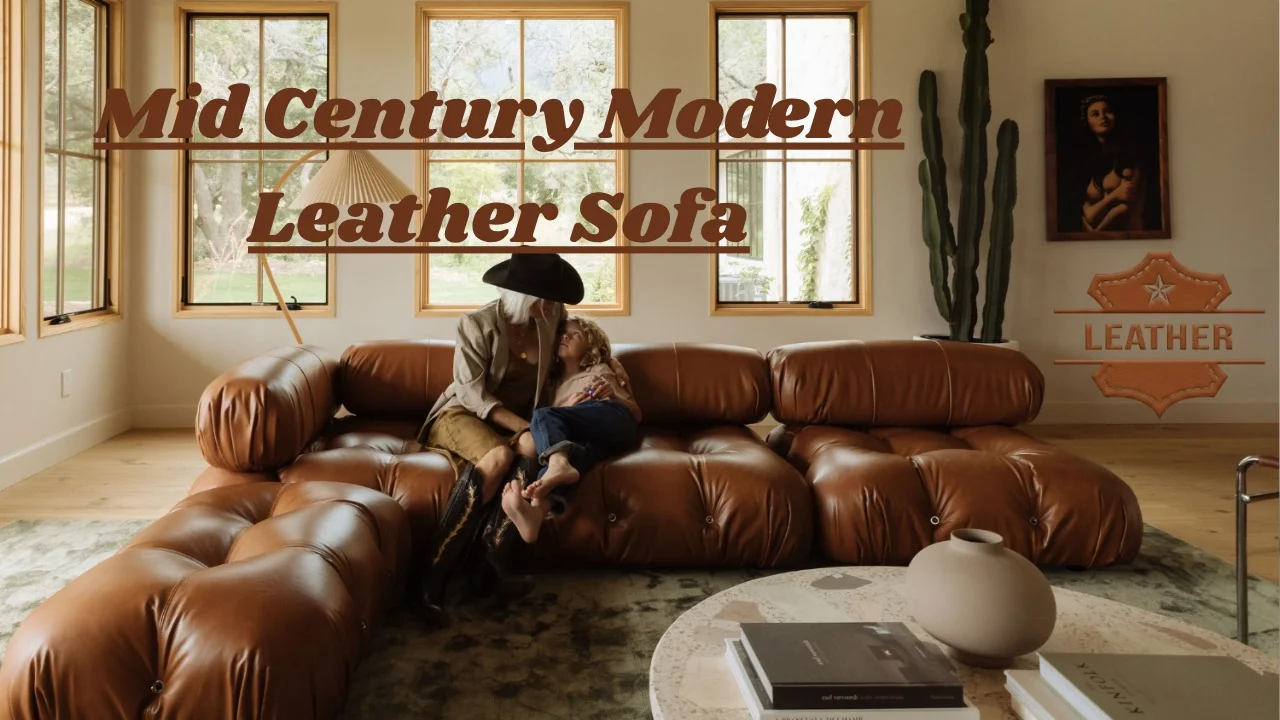
Mid Century Modern Leather Sofa
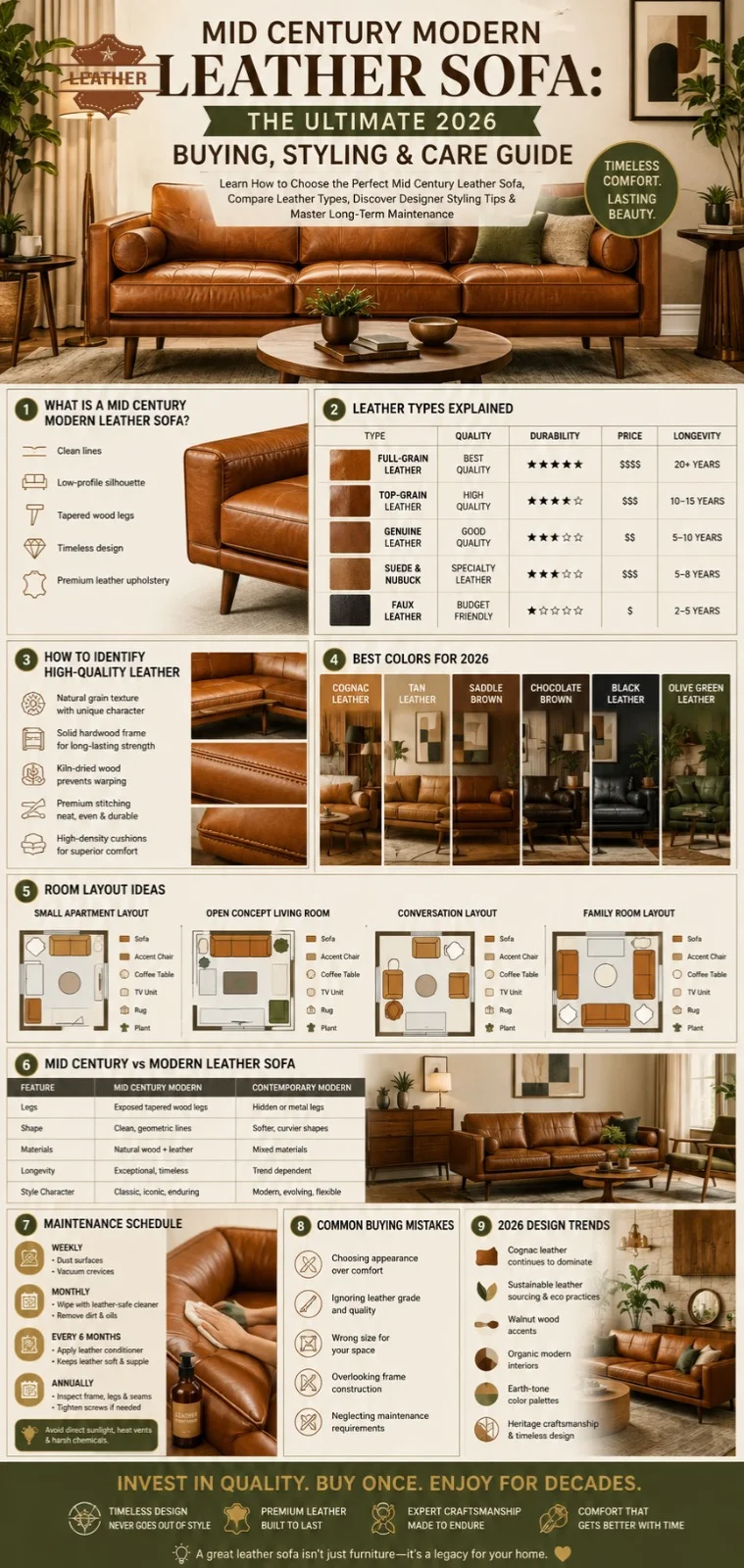
A Mid-Century Modern Leather Sofa is one of the rare pieces of furniture that can feel stylish on day one and still look relevant many years later. That is part of its appeal. Mid-century modern design is built on clean lines, organic shapes, and functionality, while leather adds warmth, depth, and a lived-in finish that improves over time with proper care.
This guide is designed to solve the real buyer problem: most people can spot a good-looking sofa, but they cannot easily tell whether it is genuinely well-made. Is the leather full-grain or just heavily corrected? Is the frame durable? Will the shape work in a small living room? Will the sofa still look good after years of use? Those are the questions that matter, and this guide answers them in plain English.
Snippet-ready answer: A mid-century modern leather sofa is a low-profile, clean-lined sofa with raised legs, usually upholstered in leather that develops patina over time. The best versions combine strong construction, the right leather grade, and room-friendly proportions.
What is a mid-century modern leather sofa?
A mid-century modern leather sofa blends the classic furniture language of the 1940s–1960s with leather upholstery. The style usually features a low or balanced profile, visible legs, simple geometry, tailored cushions, and a design that looks lighter than a traditional bulky couch. Leather makes that silhouette feel richer and more architectural.
The reason this combination works so well is simple: mid-century design values form, function, and honest materials, while leather brings tactile depth and natural aging. In modern interiors, that gives you a sofa that feels both refined and comfortable instead of overly formal.
The History of Mid-Century Modern Design
Mid-century modern design is generally associated with the period from about 1933 to 1965, and it grew out of a broader modernist movement that prized simplicity and function over ornament. After World War II, designers increasingly used natural materials such as wood and leather alongside new manufacturing methods. Scandinavian design in particular became known for combining warm woods with leather in a clean, human-scaled way.
That history matters for shoppers because the best mid-century pieces do not rely on trends to look good. They rely on proportion, restraint, and material quality. That is why a well-made leather sofa from this style often looks even better after years of use.
Why It Matters in 2026
The 2026 design landscape is leaning toward warmth, longevity, rich materials, and wellness-focused spaces. Houzz’s 2026 trend coverage highlights earthy colors, medium and warm wood tones, and homes that feel calm and built to last rather than novelty-driven. That is exactly why leather-and-wood mid-century sofas are still strong choices in 2026.
This is also why the keyword has strong commercial value. Buyers are not just looking for “a sofa.” They are looking for a durable centerpiece that works with modern interiors, ages gracefully, and fits current color directions like cognac, walnut, olive, taupe, and deep brown.
Different Types, Styles & Variations
A mid-century leather sofa can show up in several forms. The classic version is a three-seater with slim arms and tapered legs. A loveseat works well in apartments or reading corners. A sectional gives you more lounge space while still keeping the lower profile and clean geometry. Some versions lean more vintage, while others feel more contemporary with softer cushions or modular construction.
The main style difference is how much the sofa leans into retro character. A tufted cognac leather sofa with walnut legs feels more classic. A smoother silhouette in dark leather feels more modern and tailored. A modular leather sofa can still read as mid-century if the legs are visible and the proportions stay light.
Quick style map
| Style variation | Visual effect | Best for |
| Classic three-seater | Balanced, timeless, easy to style | Most living rooms |
| Loveseat | Compact, airy, apartment-friendly | Small spaces |
| Sectional | Lounge-focused, family-friendly | Open-plan rooms |
| Tufted leather sofa | More vintage character | Retro and formal spaces |
| Modular leather sofa | Flexible and modern | Changing layouts |
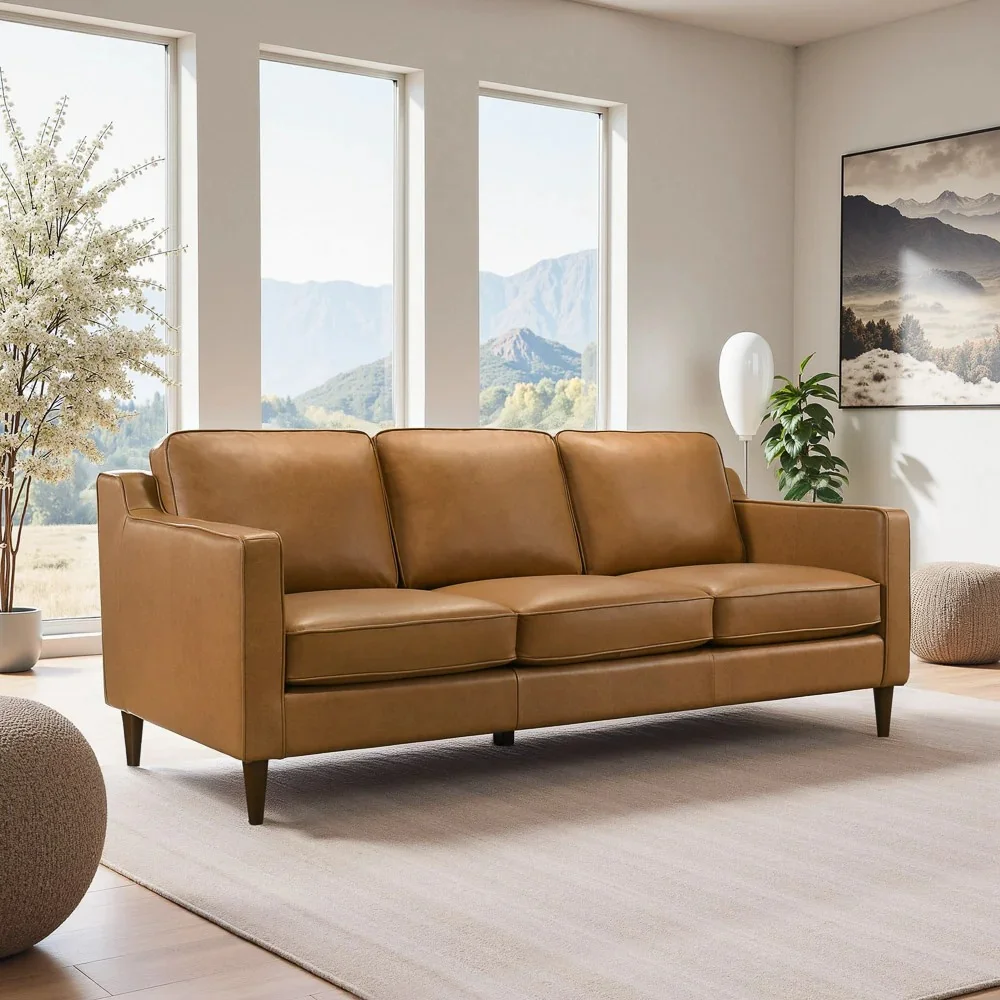
The structure above reflects how current sofa guides frame the category: a mid-century sofa is about proportion, seating depth, and how the piece lives in a room, not just how it looks in a product photo.
Leather Types Used
The leather itself matters as much as the silhouette. Industry guidance from the Leather Working Group defines full grain as leather that keeps its entire grain surface with no corrective surface removal, while split leather comes from the lower layer after the hide is divided. Retailers such as West Elm and Room & Board further distinguish top-grain, semi-aniline, and pigment-dyed leathers by look, feel, and durability.
Leather comparison table
| Leather type | What it feels like | Strengths | Trade-offs | Best for |
| Full-grain leather | Most natural, most character | Very durable, breathable, and develops rich patina | Usually, the most expensive | Buyers who want longevity and authenticity |
| Top-grain leather | Smooth and refined | Durable, more uniform, still premium | Slightly less natural character than full grain | Most households |
| Aniline / semi-aniline | Soft, rich, elegant | Beautiful depth and aging | More sensitive than protected finishes | Design-focused buyers |
| Pigmented leather | More even, more protected | Easier to clean, family-friendly | Less natural feel | Busy homes |
| Genuine leather | Varies by maker and grade | Can be a strong value | Needs closer spec checking | Budget-conscious buyers |
| Faux / vegan leather | Uniform and low-cost | Easy to wipe, lower price | Less aging, can crack over time | Short-term or budget use |
West Elm notes that full aniline leather is very natural and develops patina, semi-aniline adds a light protective top coat, and pigment-dyed leather is the Most Durable and Cleanable option. Room & Board similarly emphasizes that top-grain and full-grain leathers are premium choices and that natural markings, scratches, stretching, and patina are part of leather’s character.
Mini summary
If you want the best long-term value, focus on full-grain or top-grain leather, a strong frame, and a finish that matches your lifestyle. If you want the easiest maintenance, a protected or pigmented leather is usually the safer choice.
How Leather Is Made
Leather is made by transforming animal hide through tanning, and the tanning method affects feel, durability, color depth, and maintenance. LWG describes leather manufacturing as a process from raw material to finished leather and notes that certification covers environmental impact, chemical management, and traceability.
A simple way to think about it is this:
- The hide is cleaned and prepared.
- It is tanned to make it stable and usable.
- The grain layer may be kept, lightly finished, or corrected depending on the leather grade.
- The leather is dyed and finished for use in upholstery or accessories.
That is why two sofas that both say “leather” can feel completely different. One may be soft, breathable, and naturally marked; another may be more uniform and coated for easier cleaning.
How to Identify High-Quality Leather
High-quality leather should not just look expensive. It should feel substantial, age naturally, and be backed by clear construction details. For sofas, the best spec sheets usually mention leather grade, frame material, cushion fill, suspension system, and joinery. Brands that publish those details are generally easier to trust because they are giving you something measurable, not just marketing language.
Buying checklist
- Look for full-grain or top-grain leather when possible.
- Prefer a kiln-dried hardwood frame or another solid wood frame.
- Check for high-density foam, spring support, or supportive cushion fill.
- Ask whether the leather is aniline, semi-aniline, or pigmented.
- Confirm whether the maker lists care instructions and warranty terms.
Frame Construction & Cushion Quality
Leather gets most of the attention, but the frame determines whether the sofa actually lasts. A strong frame, good joinery, and a reliable suspension system matter just as much as the upholstery. Current product specs from mid-century leather sofa listings frequently highlight kiln-dried wood, plywood support, pocket springs, and foam densities because those details are part of long-term comfort and durability.
Room & Board also notes that leather stretches naturally with use and develops character, which means the frame and cushion support need to be good enough to age gracefully with the leather rather than fight against it.
Best Colors for Mid Century Leather Sofas
The safest colors are usually cognac, caramel, chestnut, brown, and black. These shades work well with walnut, oak, and other warm woods. Eternity Modern and Povison both emphasize cognac, chestnut, espresso, and black as flexible choices depending on the room’s mood.
Houzz’s 2026 trend coverage also supports warmer palettes, with olive green, taupe, deep brown, and other earthy tones gaining momentum. That makes cognac and walnut especially strong choices for 2026 interiors.
Color guide
| Color | Mood | Works best with |
| Cognac | Classic, warm, iconic | Walnut, brass, cream rugs |
| Tan | Light, versatile, airy | Oak, linen, Scandinavian spaces |
| Chestnut | Rich, grounded, elegant | Earth tones and traditional layouts |
| Dark brown | Deep, luxury feel | Warm lighting, textured fabrics |
| Black | Sleek, modern, dramatic | Pale woods and high-contrast rooms |
| Olive-toned leather | Trend-forward, organic | Natural textures and soft neutrals |
How to Choose the Right Sofa Size
Size is where many buyers go wrong. A sofa can look perfect online and still fail in the room if it blocks movement, overwhelms the space, or feels too shallow for everyday use. Current sofa guides recommend measuring wall length, doorways, hallway turns, and viewing distance before buying.
A practical approach is simple:
- Measure the wall where the sofa will sit.
- Measure access points, not just the room.
- Leave space for Walking Paths and side tables.
- Choose seat depth based on how you sit.
- Make sure the visual scale matches the room.
Room sizing guide
| Room type | Suggested sofa range | Notes |
| Small apartment | Compact 70–84 inches | Narrow arms and raised legs help |
| Medium living room | 84–96 inches | Best balance for most homes |
| Large room | 96 inches and up | Sectionals or longer sofas work well |
| Open-plan layout | Modular or sectional | Helps zone the space |
Mid Century Modern Leather Sofa vs Modern Leather Sofa
A mid-century leather sofa is not the same thing as any modern leather sofa. Mid-century pieces usually have exposed tapered legs, a lower profile, and a strong focus on wood and leather as paired materials. More contemporary leather sofas may be lower, softer, or more sculptural, but not necessarily mid-century in spirit.
Comparison table
| Feature | Mid Century Modern Leather Sofa | Contemporary Modern Leather Sofa |
| Legs | Visible, often tapered wood | Hidden, metal, or minimal |
| Profile | Low and light | Can be low, plush, or boxy |
| Materials | Leather + wood | Mixed materials |
| Character | Retro warmth | Minimal, sculptural, or trend-led |
| Longevity | Usually timeless | Depends on current trend |
Best Room Layout Ideas
A leather sofa can anchor a room beautifully if the layout supports it. Povison’s current guidance emphasizes room scale, walkways, and the need to balance a sofa with rugs, lighting, and wood tones. Eternity Modern adds that bold leather looks best when paired with grounding pieces like wool rugs, travertine, and warm brass lighting.
Good layout formulas
- Small apartment: sofa + one accent chair + round coffee table
- Open concept: sofa as a zone divider + area rug + side lamp
- Conversation layout: sofa facing two lounge chairs
- Media room: sofa centered to the screen with enough clearance behind it
Designer Styling Tips
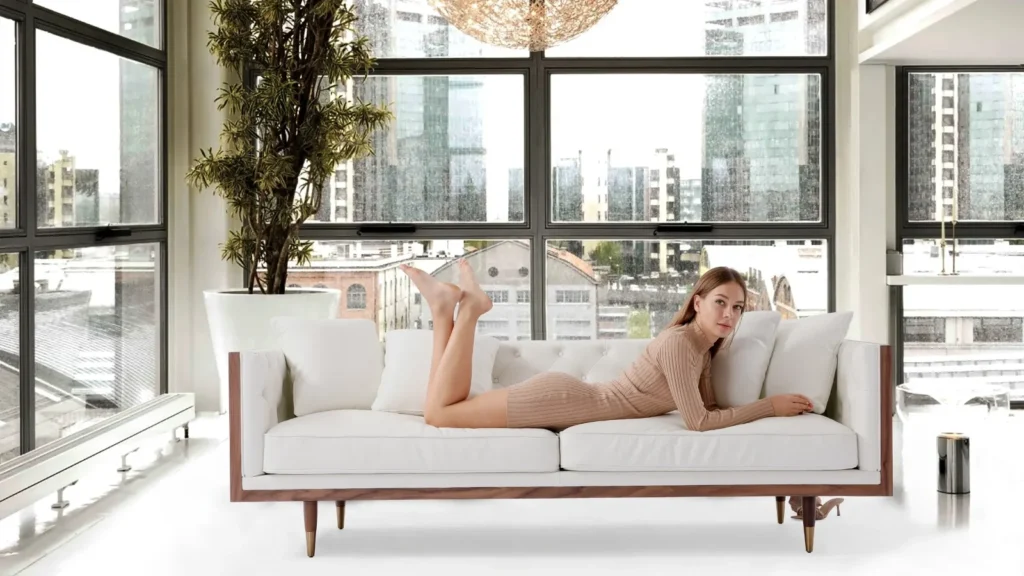
A mid-century leather sofa looks best when it is balanced by texture. If the sofa is smooth and rich, the rest of the room should feel softer and more layered. That is why natural fibers, wood, stone, and warm metals work so well with leather. Houzz’s 2026 trend coverage reinforces that natural materials and warm finishes are in demand.
Styling rules that work
- Pair leather with linen, wool, and cotton.
- Add walnut, oak, or teak-like wood tones.
- Use brass or aged gold accents sparingly.
- Bring in plants or organic decor for softness.
- Avoid over-accessorizing with too many shiny finishes.
Maintenance & Cleaning Schedule
Leather can last a long time, but only if it is treated properly. West Elm and Room & Board both advise keeping leather out of direct sunlight and away from heat sources, dusting or vacuuming regularly, blotting spills instead of rubbing them, and using conditioner only when needed and suitable for the leather type.
Simple maintenance schedule
| Timing | Task |
| Weekly | Dust and vacuum crevices |
| Monthly | Wipe with a soft cloth and inspect for wear |
| Every 6 months | Condition if the leather feels dry |
| Annually | Check seams, feet, and cushion shape |
Avoid these mistakes
- Placing the sofa in strong sunlight
- Using harsh cleaners
- Scrubbing spills aggressively
- Applying conditioner to the wrong leather type
- Ignoring early signs of drying or sagging
Pros and Cons
Pros
- Timeless mid-century style
- Leather develops character and patina over time
- Easy to style in many interiors
- Strong value when construction is good
- Can work in both small and large spaces
Cons
- Higher-quality leather costs more
- Some finishes need more care
- Poorly made versions can feel firm or shallow
- Dark or glossy leather can dominate a room if the styling is weak
Common Buyer Mistakes
The biggest mistakes are usually avoidable. Buyers often choose by photo alone, skip measurements, ignore leather grade, or assume all “Real Leather” is equal. That is not true. LWG and major furniture makers show that grain, finish, and construction make a huge difference in how leather performs over time.
Avoid these mistakes
- Buying without checking seat depth and total width
- Choosing style before comfort
- Ignoring frame material and joinery
- Assuming faux, genuine, and top-grain leather age the same way
- Forgetting to plan room lighting and texture balance
2026 Trends
The strongest 2026 directions are warm woods, earthy colors, curved forms, and rich tactile materials. That means cognac leather, walnut legs, rounded or softened silhouettes, and modular but visually light designs all fit the year’s direction well.
Sustainability also matters more than before. LWG positions its certification as a global standard for responsible leather manufacturing, with audits covering environmental impact, chemical management, and traceability. Buyers care more about this now, so mentioning it on-page is a good EEAT signal.
Best Uses of This Sofa
A mid-century modern leather sofa works especially well in:
- Living rooms with walnut or oak furniture
- Apartments that need visual lightness
- Open-plan rooms that need a design anchor
- Reading rooms and creative studios
- Family spaces that want durability plus style
Practical note
The sofa becomes even more useful when the room is built around it with natural textures, warm light, and a balanced floor plan rather than crowded accessories.
Worldwide Price Ranges
Price varies widely by leather grade, construction quality, brand position, and country of sale. Current market examples show mid-century sofas ranging from roughly the lower hundreds into the several-thousand-dollar range, with premium leather versions often landing higher than fabric versions.
A practical way to think about price:
- Budget tier: faux leather or simpler genuine leather constructions
- Mid-tier: top-grain leather with a solid frame and good cushion support
- Premium tier: full-grain or high-end aniline/semi-aniline with strong build quality
Best Countries & Brands Famous for It
Rather than picking by country alone, buyers should prioritize leather spec sheets, warranty terms, and certification. That said, mid-century furniture history is strongly tied to Scandinavian and American design, and many respected makers today publish detailed leather guides and material breakdowns.
Useful brands and retailer types to study include those that publish clear leather guides, care rules, and construction details. Examples from the sources reviewed here include West Elm, Room & Board, Moore & Giles, Eternity Modern, Povison, Dweva, and MidInMod.
Budget-Friendly Options
Budget-friendly does not always mean bad quality. It means you should be more selective. Look for top-grain or well-finished genuine leather, a solid warranty, and honest care instructions. Protected finishes can be a smarter choice for active homes because they are easier to maintain.
Premium & Luxury Options
Premium options usually use better hides, more natural finishes, and stronger construction. Moore & Giles emphasizes full-grain and top-grain hides, natural patina, and handcrafted upholstery. That is the type of positioning that signals genuine long-term value rather than just a premium look.
Expert Tips Most Buyers Ignore
One of the biggest mistakes is ignoring how leather behaves in real life. Leather is natural, so it will show some marks, stretch slightly, and develop patina. That is not failure; it is part of the material’s character. Room & Board explicitly notes that scratches, stretching, and patina are normal.
Another overlooked point is that the sofa should suit your sitting habits. If you lounge, choose a deeper seat and a softer cushion package. If you sit upright for long periods, choose a seat with more support and a seat depth that does not force you to slouch. That practical fit is one reason Dweva’s testing criteria include seat-depth fit, back support, cooling, and layout practicality.
Who Should Buy This Product
A mid-century modern leather sofa is a strong choice for people who want one piece that does several jobs at once: style anchor, daily seating, and long-term investment. It is especially good for buyers who like warm interiors, wood finishes, and furniture that improves with age.
Who Should Avoid This Product
This style may be less ideal for someone who wants a very soft, cloud-like lounging sofa or a fully maintenance-free surface. It may also be a poor choice if the room is so small that the sofa would crowd circulation or if the buyer wants a look that changes dramatically with trends.
Future Trends in the Leather Industry
The industry is moving toward traceability, more responsible production, and clearer material disclosure. LWG’s certification model reflects that shift, and more furniture brands are now publishing leather grades, care guidance, and sourcing details because customers expect it.
On the design side, 2026 favors warm woods, earthy color palettes, and tactile interiors. That means mid-century leather sofas are not fading away; they are aligning better with the broader direction of home design.
People Also Ask
A: Yes, if you buy the right one. A good leather sofa can last many years, develop a beautiful patina, and stay stylistically relevant far longer than trend-driven furniture.
A: For the best long-term value, full-grain and top-grain leather are usually the strongest choices. Full grain gives the most natural aging, while top grain offers a refined balance of durability and appearance.
A: Yes. Warm earthy interiors are a major 2026 trend, and cognac works especially well with walnut, oak, brass, and cream textiles.
A: Keep the sofa away from direct sun and heat, dust it regularly, blot spills instead of rubbing, and condition only when the leather type and care guide recommend it.
A: Compact sofas around 70–84 inches are often safer for small rooms, especially when paired with slim arms and visible legs that keep the room feeling open.
Conclusion
A mid-century modern leather sofa is the kind of piece that can anchor a room for years without feeling dated. The real winners are not the loudest or most expensive models. They are the sofas that get the balance right: good leather, good frame, good size, and styling that fits the home. For readers who want Long-Term Value, cognac or brown leather with walnut accents is the safest starting point, while full-grain or top-grain leather gives the best long-term story when the budget allows.
For TheLeatherItems.com, this topic is a strong authority-building opportunity because it connects naturally to wallets, jackets, belts, bags, leather care, and buying guides. If you publish this as a pillar page and support it with related internal links, it can become the central mid-century leather resource on the site.
Legal disclaimer: Leather quality, pricing, manufacturing standards, and product availability may vary by country, brand, and supplier. Always verify authenticity, material details, and care instructions before purchase.