Tan Leather Sofa
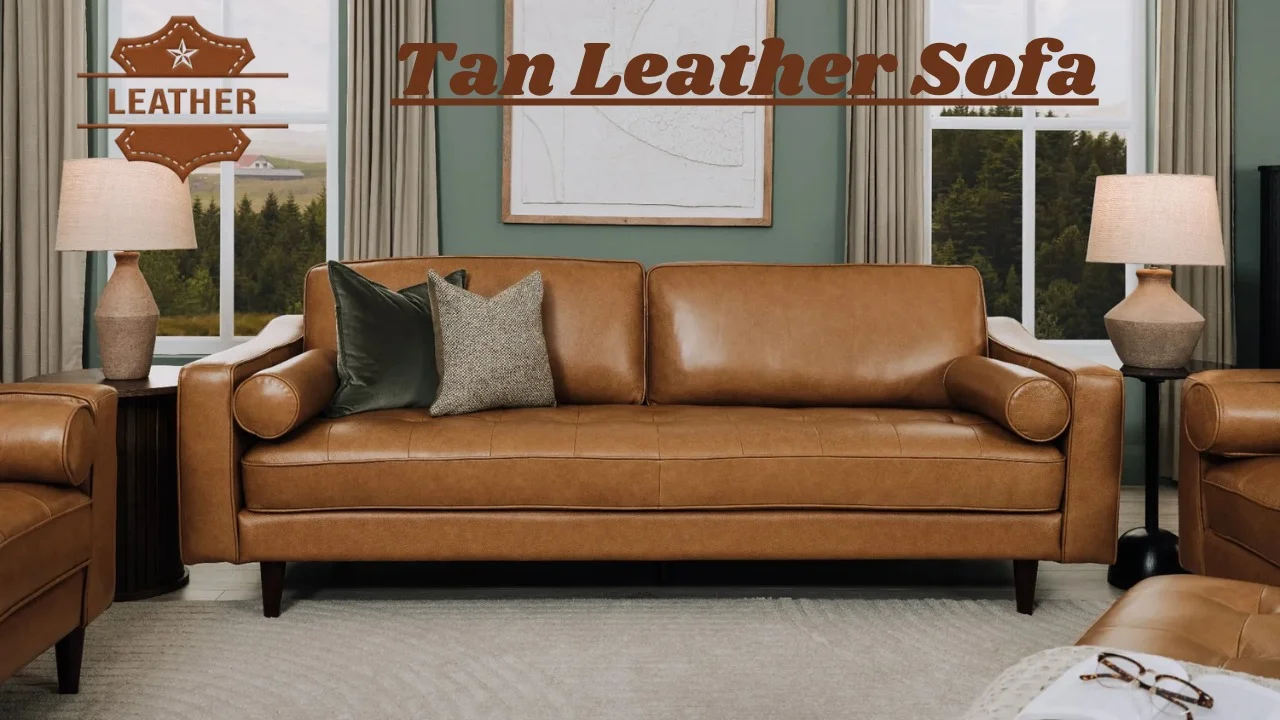
A Tan Leather Sofa is one of the easiest ways to make a living room feel warm, expensive, and timeless at the same time. Unlike trend-led fabric colors that can date quickly, tan leather sits in a sweet spot between neutral and rich, which is why it works in modern apartments, family rooms, farmhouse interiors, and luxury homes. Tan itself is a light yellowish-brown color, but in furniture shopping, the exact shade can shift from soft camel to deep cognac depending on the hide, finish, and lighting in the room.
The problem is that most buyers stop at “it looks good.” They do not compare shade undertones, leather quality, room size, maintenance, or how the sofa will age over time. That is where this guide helps. You will learn how to choose the right tan shade, understand leather grades in plain English, style the sofa with confidence, and care for it properly so it keeps its value and character for years. Leather is durable and flexible by nature, and when the right grade is chosen and maintained, it can develop a beautiful patina instead of looking worn out.
Mini summary: a tan leather sofa is not just a color choice. It is a style decision, a material decision, and a long-term care decision.
What Is a Tan Leather Sofa?
A tan leather sofa is a leather-upholstered couch finished in a tan family of colors, usually ranging from pale camel to deeper brown-orange tones. In practical interior design terms, tan behaves like a warm neutral, so it can soften modern spaces, add warmth to white rooms, and balance wood, metal, or stone finishes.
Because leather is a natural material made through tanning, the final appearance depends on the hide selection, dye process, surface finish, and age of the leather. That is why two sofas labeled “tan” can look completely different once they are in a room.
Why it matters in 2026
Current buying guides continue to show strong interest in leather sofas because shoppers want durability, easy care, and timeless design. Brand and editorial guides in 2026 still focus heavily on leather quality, comfort, and value, which suggests the category remains strong and competitive.
Why Tan Leather Sofas Are So Popular
Tan leather is popular because it does three jobs at once: it looks refined, it hides everyday living better than many light fabrics, and it works with a wide range of décor styles. Better Homes & Gardens and King Living both emphasize leather’s durability and low-maintenance appeal, while also noting that good leather ages well when cared for properly.
A tan leather sofa is especially appealing because it adds warmth without feeling heavy. Dark brown can feel formal, black can feel sharp, and beige can feel too soft. Tan sits between those extremes, so it tends to look approachable and elevated at the same time. That is one reason it appears so often in modern furniture collections and style inspiration pages.
Key benefits
- Timeless look
- Strong visual warmth
- Flexible with many color schemes
- Easier to maintain than many fabrics
- Ages into a patina rather than looking flat when well cared for
Mini summary: tan leather stays relevant because it is practical, warm, and easy to style across changing interior trends.
Tan vs Camel vs Cognac vs Caramel Leather Sofa
Shoppers often use these color names interchangeably, but they are not exactly the same. This is one of the biggest missed opportunities in current content, even though it strongly affects buying satisfaction.
| Shade | Visual Feel | Best For | Design Effect |
| Tan | Light yellowish-brown, versatile | Most homes | Balanced, warm neutral |
| Camel | Softer, lighter brown | Scandinavian, minimal rooms | Airy and calm |
| Cognac | Richer, deeper reddish-brown | Mid-century, luxury spaces | More dramatic and elevated |
| Caramel | Honey-like warmth | Farmhouse, cozy rooms | Soft and inviting |
| Chestnut | Darker brown-leaning tone | Traditional interiors | Formal and classic |
These comparisons are design-based inferences from common color naming patterns and current furniture styling usage, not fixed industry standards. Furniture brands and style guides use these names inconsistently, which is why buyers should always check product photos in natural light and read the finish description carefully.
How lighting changes the look
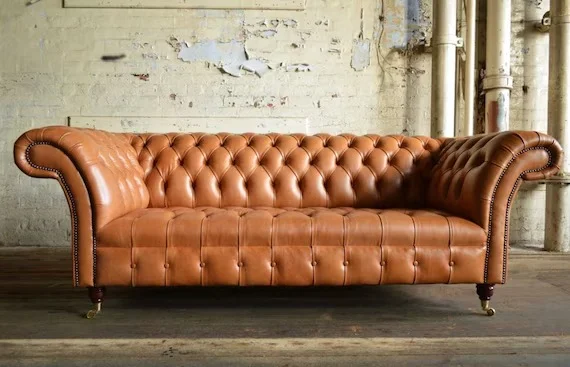
Tan leather can look lighter in bright daylight, warmer under soft warm bulbs, and deeper or redder near wood floors or darker walls. That is why a sofa that appears “camel” in a showroom can read as “tan” at home. This is a practical buying issue, not just a design detail.
Understanding Leather Types Before You Buy
This is where most buyers make the wrong decision. “Leather” is not one material with one feel. Leather furniture guides from American Leather, King Living, Rolford, and BHG all show that full-grain, top-grain, corrected, aniline, semi-aniline, nubuck, and bonded-style constructions have very different strengths and trade-offs.
| Leather Type | What It Means | Best Strength | Main Trade-Off |
| Full-grain | Outer hide kept intact | Best durability and patina | Highest price, more natural markings |
| Top-grain | Surface buffed/sanded | Softer, cleaner look | Slightly less character and patina |
| Corrected leather | Surface corrected for uniformity | More consistent appearance | Less natural grain visibility |
| Aniline leather | Dyed through, natural feel | Softest, most premium look | More sensitive to stains and marks |
| Semi-aniline | Light protective finish over dyed leather | Better balance of beauty and protection | Less “raw” look than pure aniline |
| Nubuck | Top-grain leather buffed for velvety feel | Luxurious matte texture | Easier to stain and requires care |
| Bonded-style leather | Reconstituted leather composite | Lower cost | Shorter lifespan, lower premium feel |
BHG notes that full-grain is considered the best type for durability and patina, top-grain is the next step down, nubuck has a soft matte look, but stains more easily, and bonded leather is the most affordable but does not age as well. King Living also notes that its cleaner kit is suitable for most corrected and aniline leathers, but not suede, nubuck, oiled, or waxed leathers.
Which type should most buyers choose?
If you want the best long-term value, top-grain or full-grain is usually the safest choice. As you want a softer, more luxurious look and you are willing to maintain it carefully, aniline or semi-aniline can be excellent. If your household has kids, pets, or heavy daily use, a more protected finish often makes more sense than a delicate premium surface. That is a practical inference from the durability and care differences described in current leather-buying guides.
Mini summary: the right leather type depends less on “best” and more on how you live.
Best Tan Leather Sofa Styles
Tan leather works across many styles because it brings warmth to clean architecture and structure to soft interiors. Current inspiration and style pages repeatedly show tan leather in mid-century, Scandinavian, farmhouse, contemporary, and transitional rooms.
1) Mid-Century Modern
Best with tapered wood legs, clean lines, and low-profile silhouettes. This is one of the most natural matches for cognac-to-tan tones.
2) Contemporary
Best with slim arms, structured cushions, and simple shapes. Tan softens the minimal look so the room does not feel cold.
3) Farmhouse
Best with linen textures, rustic wood, and layered neutrals. Caramel and lighter tan tones often work especially well here.
4) Scandinavian
Best with light woods, soft textiles, and calm color palettes. Camel or lighter tan shades fit best because they keep the space airy.
5) Industrial
Best with black metal, brick, and darker woods. Tan leather adds contrast and warmth without losing edge.
How to Choose the Perfect Tan Leather Sofa
A sofa purchase should be decided by room size, lifestyle, leather type, color temperature, and maintenance tolerance. That framework is missing from many competing pages, even though it is what buyers actually need.
Buying framework
| Buying Factor | Best Choice | Why |
| Small apartment | 2-seat sofa or loveseat | Preserves visual space |
| Family room | Sectional or deep 3-seater | Better for daily use |
| Luxury home | Full-grain or semi-aniline | Richer visual effect |
| Pets / kids | Protected top-grain | Easier to clean |
| Bright rooms | Mid-tone tan | Reduces washed-out look |
| Dark rooms | Warmer camel/tan | Adds light and warmth |
| Tight budget | Entry-Level Top-Grain or quality faux | Better value control |
These are practical recommendations based on the way current leather guides describe comfort, durability, and maintenance differences. Exact dimensions and upholstery build still matter, so buyers should always check seat depth, frame construction, and care guidance on the listing or brand page.
Decision checklist
- Measure the room and traffic paths.
- Choose the sofa size first, then the shade.
- Decide how much maintenance you will realistically do.
- Pick the leather type based on daily use.
- Match the finish to your floors, walls, and lighting.
Mini summary: do not shop by color alone. Shop by space, lifestyle, and care level.
Best Colors That Match a Tan Leather Sofa
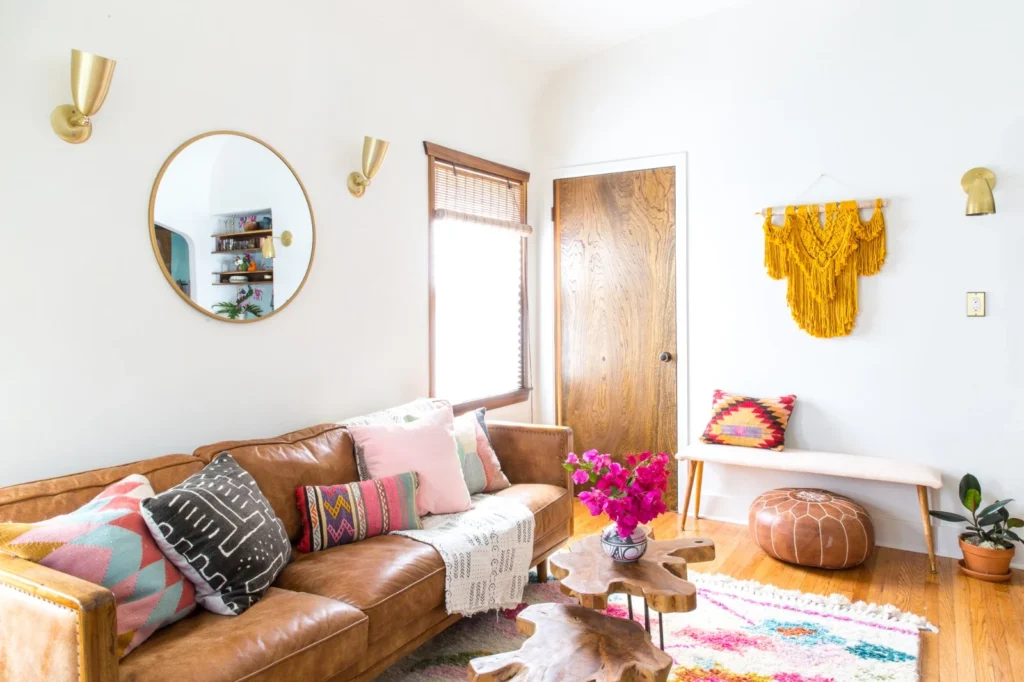
Tan leather is versatile because it sits comfortably between warm and neutral. That is why style articles repeatedly pair it with sage, cream, black, white, natural wood, navy, and earthy tones.
| Color Pairing | Effect |
| White | Clean contrast, brighter room |
| Cream | Soft, warm, layered look |
| Navy blue | Sophisticated contrast |
| Sage green | Calm, organic, designer feel |
| Black | Modern edge and definition |
| Terracotta | Earthy, inviting warmth |
| Charcoal gray | Balanced, contemporary structure |
| Natural wood | Warm, cohesive, timeless |
A good rule is to balance tan leather with either a cool contrast or a textured warm layer. White walls, navy accents, black frames, green plants, and natural wood furniture all help the sofa look intentional rather than floating in the room. This is an inference from current style guides and inspiration content that repeatedly uses these combinations.
Best Rugs for a Tan Leather Sofa
The best rug depends on whether you want contrast or harmony. Tan leather works especially well with rugs that have texture, subtle pattern, or muted contrast. Inspiration pages frequently show tan leather with layered neutrals, black-and-white contrasts, and earthy palettes.
Good rug directions
- Cream and ivory rugs for soft layering
- Patterned neutral rugs for depth
- Black-and-white rugs for modern contrast
- Muted green or earthy rugs for organic rooms
- Natural fiber rugs for Scandinavian and farmhouse spaces
Quick rule
If your tan sofa is already warm, do not overload the room with more warm brown elements. Add one cool or crisp element so the room still has balance. This is a design inference based on the current styling examples surfaced in the 2026 search results.
Best Wall Colors for a Tan Leather Sofa
The safest wall colors are white, off-white, cream, greige, soft sage, muted blue, and warm gray. Those colors are repeatedly used in current tan leather styling references because they allow the sofa to remain the focal point.
If you want a more dramatic room, charcoal or deep navy can work well, especially in larger spaces with good natural light. In smaller rooms, lighter walls usually help the tan sofa breathe visually. That is a practical design rule rather than a strict standard.
How to Style a Tan Leather Sofa Like an Interior Designer
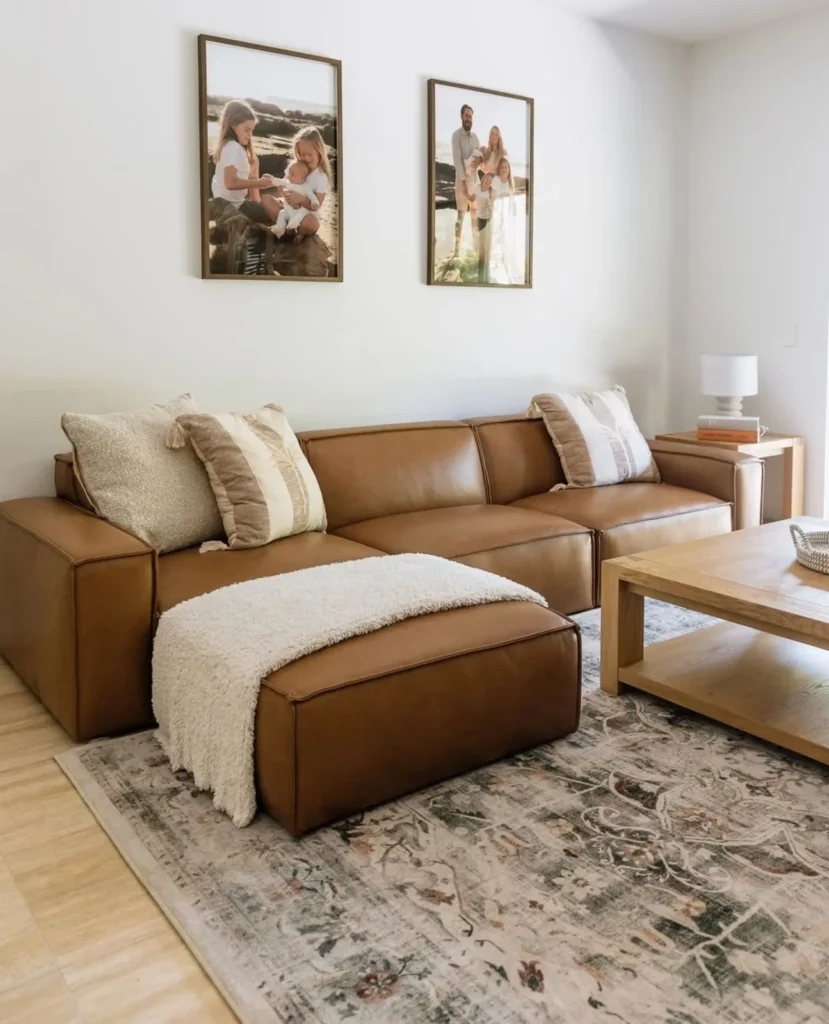
A tan leather sofa looks best when it is balanced with texture. Leather is smooth and reflective compared with many fabrics, so it benefits from soft layers around it. Style inspiration pages consistently show a mix of pillows, throws, wood, plants, and balanced lighting.
Simple styling formula
- 1 neutral rug
- 2–3 textured pillows
- 1 soft throw blanket
- Natural wood coffee table
- One plant or branch arrangement
- One metal or black accent piece
What to avoid
- Too many competing browns
- Overly shiny accessories
- Tiny pillows with no texture
- Harsh lighting that flattens the leather tone
- Clutter that hides the sofa’s shape
Mini summary: leather needs contrast. Pair the sofa with softness, texture, and a few crisp lines.
Tan Leather Sofa Ideas for Every Room
Small Living Rooms
Choose a compact two-seater or loveseat in a lighter tan. Keep the rug lighter and use slim furniture legs so the room feels open. Product and styling guides for small spaces consistently favor smaller silhouettes and lighter visual weight.
Large Family Rooms
A sectional or modular layout works best here. The tan leather grounds the room, while layered textiles keep it family-friendly and comfortable. BHG’s leather-couch testing highlights sectional and modular options as strong choices for bigger, lived-in spaces.
Luxury Homes
Choose richer cognac or a deeper tan in full-grain or semi-aniline leather. Pair it with natural stone, warm wood, and elevated lighting. Premium leather guides emphasize the beauty, longevity, and natural character of higher-end hides.
Modern Apartments
Go for clean lines, slim arms, and a mid-tone tan so the room feels intentional rather than heavy. Contemporary styling references repeatedly favor this look.
How to Clean a Tan Leather Sofa
Current care guidance from King Living and BHG is clear: dust regularly, clean gently, and condition on a sensible schedule. King Living advises weekly dusting or soft vacuuming and leather cleaner/conditioner every 6 to 8 weeks, depending on use, while BHG recommends dusting with a barely damp microfiber cloth, vacuuming crevices, and using conditioner every 6 to 12 months.
Weekly routine
- Dust the surface
- Vacuum seams and crevices
- Remove crumbs and loose grit
- Wipe light marks with a dry or barely damp microfiber cloth
Monthly routine
- Inspect for spills or scuffs
- Use a leather-safe cleaner on compatible leather only
- Test any product on a hidden area first
Every 6 to 12 months
- Apply leather conditioner as recommended by the brand or manufacturer
- Increase frequency if the sofa gets heavy from daily use or sits in a dry room
Avoid
- Harsh detergents
- Saturating the leather
- Direct sunlight for long periods
- Heat sources close to the sofa
- Using the wrong cleaner on suede, nubuck, waxed, or oiled leather
How to Remove Stains from Tan Leather
The safest approach is always to act quickly, blot rather than rub, and use a cleaner made for the specific leather type. BHG advises blotting spills gently, using mild soap and water only for certain non-oily spills, and Avoiding Detergents, polishes, and wax-based products. King Living also warns that its cleaner is not suitable for suede or nubuck.
Stain-response steps
- Blot the spill immediately.
- Do not scrub.
- Use the correct leather-safe product.
- Let the surface dry naturally.
- Condition later if the manufacturer recommends it.
For ink, dye transfer, or deep oil stains, professional leather help is often safer than experimenting with household products. That is a practical recommendation consistent with mainstream care guidance.
Pros and Cons of a Tan Leather Sofa
Pros
- Timeless and versatile
- Warm without being too dark
- Ages beautifully with patina
- Easy to dust and maintain compared with many fabrics
- Works with many design styles
Cons
- High-quality leather can be expensive
- Some leathers mark or scratch more easily
- Color and shade can vary from sample to sample
- Wrong cleaning products can damage the finish
- Delicate leather types need more care
Common Buyer Mistakes to Avoid
- Buying by color alone and ignoring the leather grade.
- Choosing a very light tan without checking maintenance needs.
- Forgetting to measure seat depth and room clearance.
- Placing the sofa in direct sunlight or too close to the heat.
- Using the same care routine for suede, nubuck, and protected leather.
- Assuming every “genuine leather” sofa is high-end.
Smart buyer habit
Read the product description carefully and look for leather type, finish, frame construction, and care instructions before you click buy. That simple step prevents the biggest disappointment cases.
Tan Leather Sofa Buying Checklist
- Measure room size and entryways
- Choose the sofa shape first
- Choose the leather grade second
- Choose the tan shade third
- Check seat depth and comfort
- Confirm care instructions
- Ask about sunlight exposure and finish type
- Review the return policy and warranty
Who Should Buy a Tan Leather Sofa
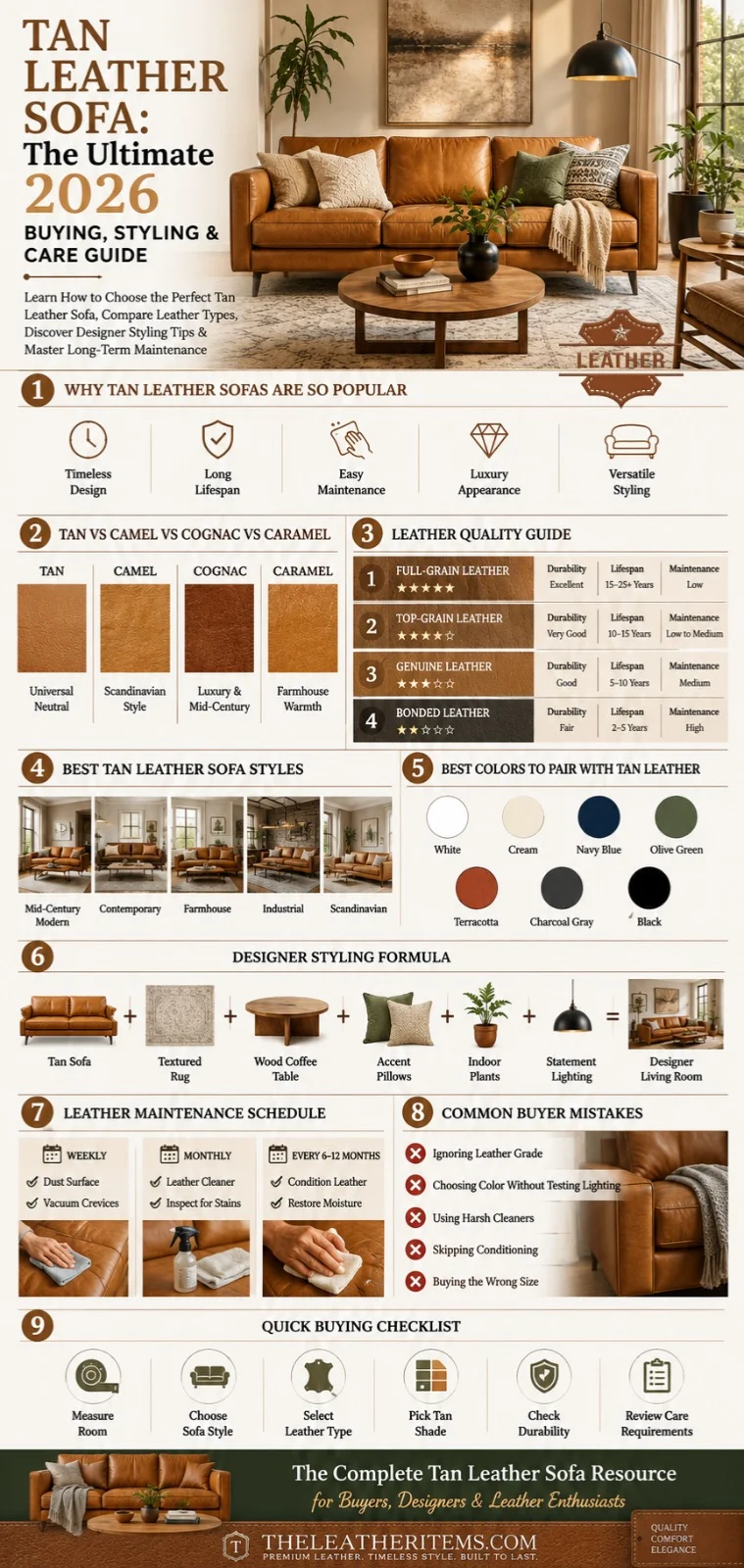
A tan leather sofa is ideal for buyers who want a warm, timeless centerpiece that can work in many interior styles. It is especially good for homeowners who value low-maintenance cleaning, natural aging, and a sofa that looks better with age when cared for properly.
It is also a strong choice for:
- Design-conscious buyers
- Families wanting a durable focal piece
- Apartment owners who want warmth without heaviness
- People who like natural materials and classic styling
Who Should Avoid It
A tan leather sofa may be a poor fit for buyers who want a no-maintenance surface, prefer ultra-plush fabric comfort, or do not want to manage cleaning and conditioning at all. Very delicate leather finishes also may not suit homes with rough daily wear unless the buyer accepts patina and occasional marks.
Future Trends in the Leather Industry
Responsibility, traceability, and transparency are increasingly important in leather sourcing. The Leather Working Group says its audit standard is an international certification for environmentally and socially accountable leather manufacturing, and it reports certified suppliers across 60+ countries. That makes certification more relevant than ever for buyers who care about sourcing.
On the design side, leather sofas remain popular because they combine durability, comfort, and a timeless appearance. Brand and editorial buying guides in 2026 continue to test and recommend leather couches across budgets and styles, showing that the category is still commercially strong.
People Also Ask
A: Yes. Tan leather remains a strong choice because it is warm, versatile, and easy to pair with modern, classic, and rustic interiors. Current 2026 guides still feature leather sofas heavily in both buying and style content.
A: White, cream, navy, sage green, charcoal, and natural wood are some of the most reliable pairings. They either balance the warmth or give the sofa a clean focal point.
A: Full-grain is generally considered the most durable and the most natural-looking, while top-grain is still high quality and usually easier to live with for everyday homes. The best choice depends on whether you prefer maximum character or a cleaner, more uniform surface.
A: A good rule is every 6 to 12 months, but some brands recommend more frequent care depending on use. King Living suggests cleaner and conditioner every 6 to 8 weeks for its leather furniture, while BHG suggests conditioning every 6 to 12 months under normal use.
A: It can be a strong choice, especially if you choose a more protected leather finish and stay on top of quick cleaning. Leather is relatively low-maintenance, but the wrong finish can still scratch or mark more easily.
Conclusion
A tan leather sofa is one of the rare furniture choices that can be both practical and beautiful for years. When you choose the right shade, the Right Leather Type, and the right care routine, it becomes more than a couch. It becomes the anchor of the room. That is why the smartest buyers do not stop at style photos; they compare leather grades, room fit, maintenance needs, and long-term durability before they buy.
For TheLeatherItems.com, this topic is a strong authority-building opportunity because it naturally connects to leather quality, leather care, luxury leather taste, and buying confidence. Readers who understand tan leather sofas are also likely to trust deeper guides on leather bags, wallets, jackets, belts, shoes, and care. That makes this article useful both for rankings and for building a broader leather content cluster.
Disclaimer: Leather quality, pricing, manufacturing standards, and product availability may vary by country, brand, and supplier. Always verify authenticity, material details, and care instructions before purchase.