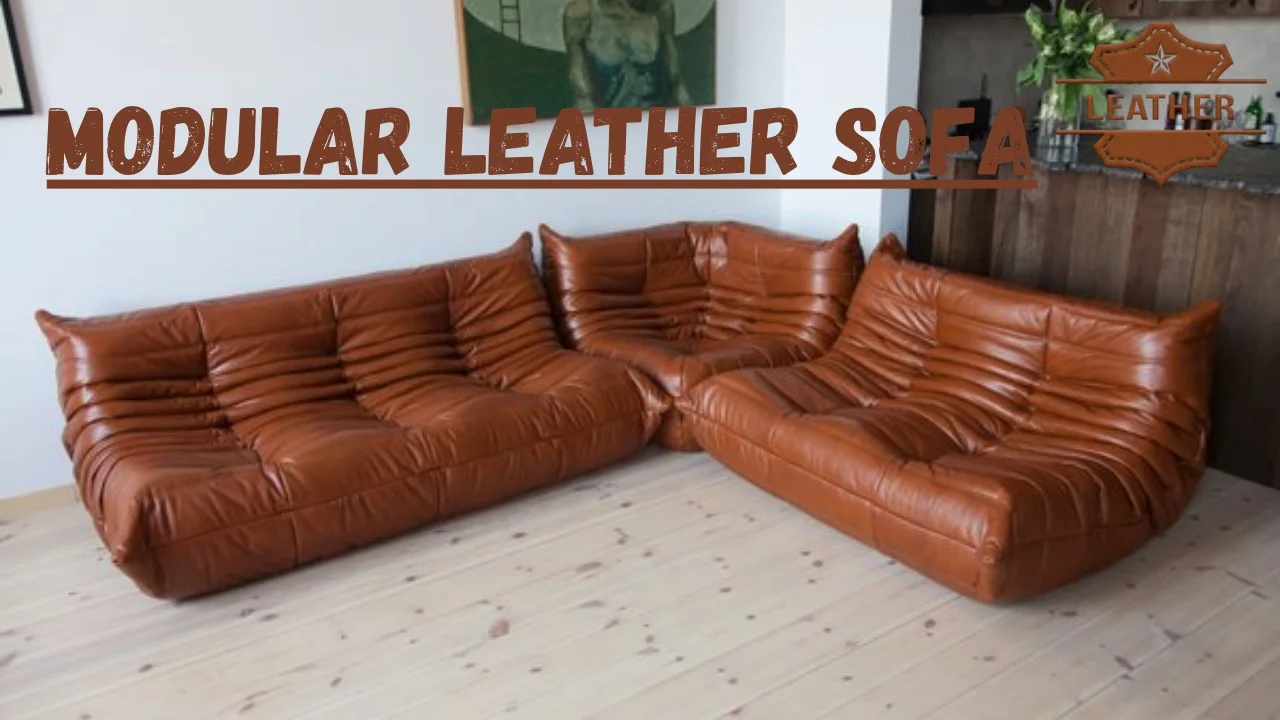
Modular Leather Sofa
A Modular Leather Sofa is one of the smartest furniture buys for modern homes because it combines two things buyers care about most in 2026: flexibility and durability. Modular seating continues to gain traction because people want furniture that can be rearranged, expanded, or moved without starting over, while leather remains one of the most desirable upholstery choices for a premium look and long-term wear.
The problem is that most articles only cover one part of the decision. Some pages explain modular layout basics, others sell a specific model, and others talk about leather care. Very few show how to choose the right configuration, compare leather grades, think through room flow, and understand long-term ownership value in one place. This guide fixes that gap.
What Is a Modular Leather Sofa?
A modular sofa is a seating system made of individual units that can work separately or connect into a larger arrangement. In practice, that means you can combine armless chairs, corner units, chaise modules, ottomans, and sometimes storage or recliner pieces into layouts that fit your room and your lifestyle. A leather version simply uses leather upholstery across those modules for a more elevated and durable finish.
The key difference from a traditional sectional is flexibility. Sofatica explains that true modular sofas are designed so the pieces can be rearranged, expanded, or reduced, while many sectionals are fixed to a small number of layouts. IKEA also recommends starting with a to-scale floor plan and deciding how you actually use the sofa before choosing the configuration.
Snippet-ready answer
A modular leather sofa is a leather-upholstered seating system made from separate pieces that connect together, so you can build an L-shape, U-shape, chaise layout, or a straight sofa and later change it as your room or family needs change.
Why Modular Leather Sofas Matter in 2026
The 2026 design direction is moving toward adaptable, practical furniture with a cleaner silhouette. Editorial trend coverage points to modular seating as a major sofa trend, while shoppers also keep prioritizing durability, flexibility, and understated luxury. That makes modular leather a strong fit for homes that need style without sacrificing usability.
This matters because many homes now do double duty. The same living room may serve as a TV room, work space, entertaining zone, and family hangout. A modular leather sofa lets the seating adapt instead of forcing the room to adapt to the sofa. That flexibility is exactly why modular systems keep showing up in current buying guides and product collections.
Different Types, Styles & Variations
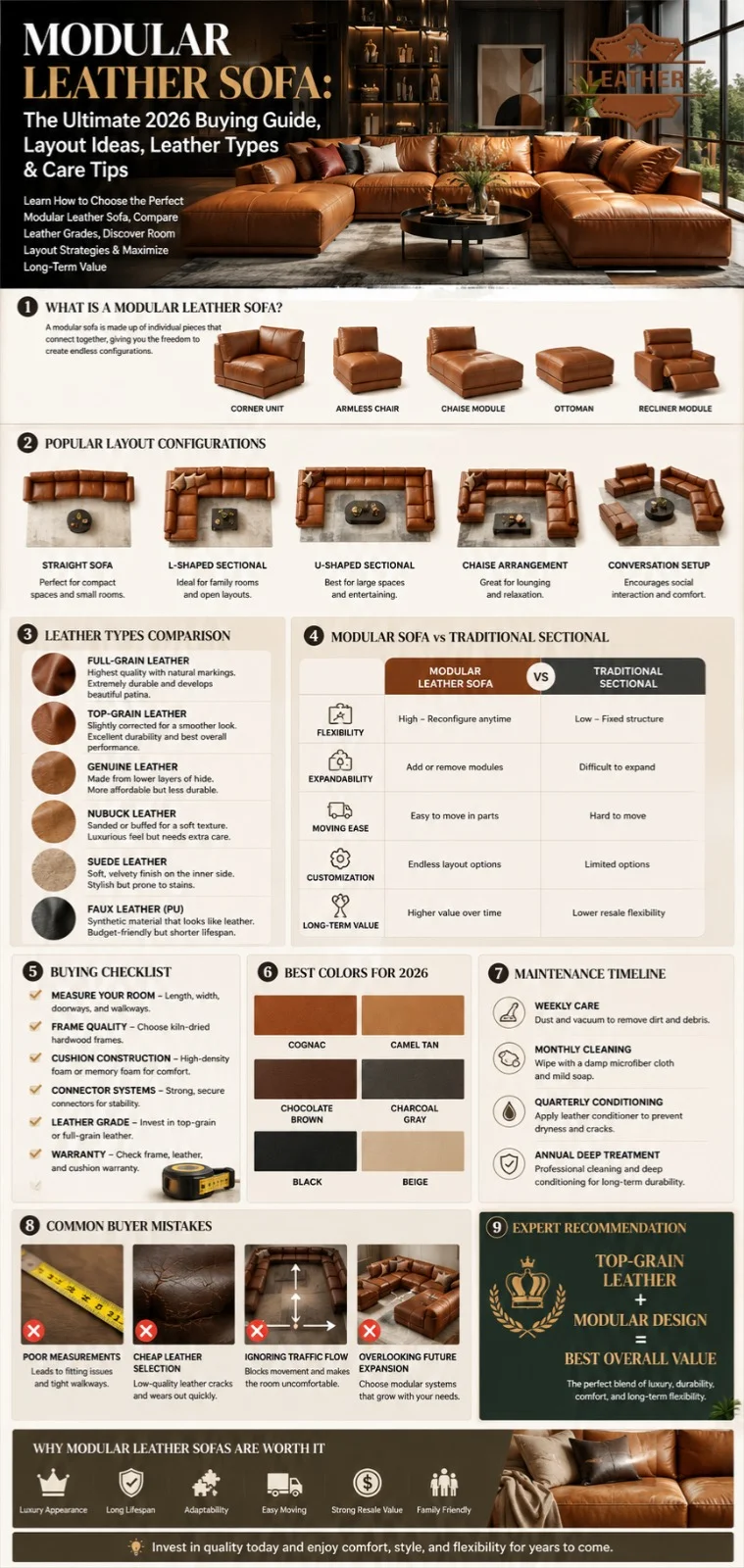
Modular leather sofas are not one-size-fits-all. In current collections and guides, the most common configurations include straight sofa layouts, L-shaped layouts, U-shaped layouts, chaise setups, and conversation layouts. Brands also increasingly offer add-on ottomans and extra modules so buyers can scale later.
Common configuration types
- Straight modular sofa: Best for compact rooms and clean wall placement.
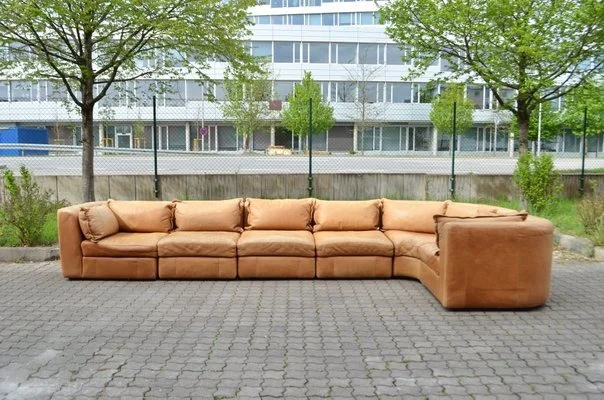
- L-shaped modular sectional: Best for family rooms and TV viewing.
- U-shaped modular sectional: Best for larger open-plan spaces and entertaining.
- Chaise configuration: Best for lounging without needing a full sectional.
- Conversation layout: Best for social rooms where face-to-face seating matters.
Leather Types Used in Modular Sofas
This is where many buyers make expensive mistakes. Leather is not just “leather.” The grain layer, finishing method, and surface treatment all affect durability, breathability, and how the sofa ages over time. The Leather Working Group defines full grain as leather that has kept its entire grain with no surface removed by corrective mechanical treatment, and it defines corrected grain, nubuck, and suede as different processed forms with different looks and performance.
Full-grain leather
Full-grain keeps the natural surface intact, so it tends to show character, marks, and patina over time. It is usually the premium option for buyers who want the most natural look and the strongest long-term story.
Corrected-grain leather
Corrected grain has had part of the surface mechanically treated, then finished for a more uniform look. It is often a practical option for buyers who want a smoother appearance and easier styling consistency.

Nubuck and suede
Nubuck is buffed to create a velvety surface while keeping the grain pattern visible, and suede is made from the split layer with a velvety nap. Both look refined, but both need more careful maintenance than a protected smooth leather.
Genuine leather
“Genuine leather” is a Real-Leather Label, but it is not a precise quality story on its own. The FTC’s Leather Guides address misrepresentations in leather labeling, and current leather-buying explainers note that “genuine leather” does not automatically tell you which hide layer was used or how heavily it was finished. That is why buyers should always ask for the exact leather specification, not just the marketing term.
PU / faux leather
Faux leather and PU can lower the price and simplify cleaning, but they do not age like real hide. If the goal is premium appearance plus long-term ownership value, leather remains the stronger category for serious buyers.
Manufacturing Process: What Good Buyers Should Know
A quality modular leather sofa starts with the right hide and ends with good frame engineering. Leather Working Group notes that the leather supply chain involves stages from raw material through tanned, crust, and finished leather, while its audit standards cover traceability, chemical management, wastewater, energy, and social responsibility. That matters because the quality of the final sofa begins long before upholstery.
A strong modular sofa also needs a well-built frame, reliable connectors, and upholstery work that allows pieces to attach securely. West Elm, for example, lists kiln-dried engineered hardwood, mortise-and-tenon or slot-and-tenon joinery, high-gauge springs, and alligator clip connectors on current modular leather models, which shows the kind of build details smart buyers should look for.
What the production chain should include
- Hide selection and sorting
- Tanning and finishing
- Frame construction
- Cushion build and spring support
- Leather upholstery and stitching
- Connector installation
- Final quality control and alignment checks
How to Identify Original vs Fake Leather
The most reliable way is not a “hack”; it is documentation. Ask for the material spec, the leather type, whether it is full grain, top grain, corrected grain, split, or synthetic, and whether the seller can show care instructions and construction details. FTC guidance exists specifically to reduce misleading leather claims, and LWG definitions help separate real grain-based leathers from processed alternatives.
Also, look at the product page language carefully. A good retailer usually states the exact leather type, frame material, joinery, cushion fill, and care notes. West Elm, Povison, and other current product pages all show that the best listings do not hide those details.
Complete Buying Guide
The smartest way to buy a modular leather sofa is to start with layout, then comfort, then leather grade, then brand support. That order matches what current retailer guides and design sources emphasize: room measurement, traffic flow, sofa use case, upholstery choice, and delivery constraints.
| What to check | Why it matters |
| Room dimensions and doorways | Prevents a sofa that crowds the room or cannot be delivered easily |
| Walking clearance | Keeps the layout functional instead of blocked or awkward |
| Seat depth and seat height | Determines whether the sofa feels loungey or upright |
| Frame and joinery | Directly affects longevity and stability |
| Connector system | Keeps modules aligned and easy to reconfigure |
| Leather type | Controls aging, maintenance, and visual character |
| Care instructions | Prevents premature cracking, fading, or staining |
Best Uses of a Modular Leather Sofa
This sofa works especially well in rooms that need flexibility. IKEA recommends thinking about how the sofa will actually be used—TV, reading, relaxing, or entertaining—and then matching the layout to that use. Modular systems are especially practical in apartments, open-plan living rooms, and homes that may move or expand later.
It is also a strong choice for people who want a more premium look without locking themselves into one fixed shape forever. Current modular leather pages from West Elm, Koala, AllModern, and Povison all frame the category around adaptability and long-term usability.
Worldwide Price Ranges
Current live examples show a wide range. Koala’s modular leather sofas surface around the low-to-mid $2,000s to mid-$5,000s. AllModern’s Jaye modular leather sofa is listed at $3,699, and West Elm’s Harmony modular leather sofa sits around $4,598 to $6,697, depending on size and configuration. That makes the realistic 2026 market range for quality modular leather sofas broad, with pricing driven by leather grade, size, construction, and brand positioning.
Practical price bands
- Entry to mid-range: smaller or simpler modular leather builds
- Mid-to-premium: Stronger Frames, better leather, larger configurations
- Premium: top-grain leather, contract-grade construction, better warranties, and more add-on flexibility
Best Brands and Market Signals
The strongest visible names in current search results include West Elm, Koala, Povison, Burrow, and AllModern. Their product pages show the market’s main expectations: modular flexibility, strong joinery, real leather options, and easy-to-understand dimensions. Burrow also reinforces the broader modular trend by emphasizing systems that can expand and move with life changes.
Budget-Friendly vs Premium Choices
Budget-friendly in this category usually means fewer modules, simpler silhouettes, and less customization. Premium means better leather, stronger construction, and more configuration choices. Current product pages make that difference obvious: West Elm focuses on contract-grade build details, while Koala and Povison lean into large, lifestyle-focused modular systems with pricing that rises as the configuration becomes more substantial.
Pros & Cons
Pros
- Flexible layouts that can change with the room
- Strong visual impact in modern interiors
- Leather ages better than many budget upholstery options when cared for properly
- Easier to reconfigure during a move or home refresh
Cons
- Higher upfront cost than fixed basic sofas
- Good models require careful measurement and planning
- Leather can show natural variation and may need conditioning
- Poor connector systems can make modules shift over time
Common Buyer Mistakes to Avoid
The biggest mistake is choosing by looks alone. Good Housekeeping and IKEA both stress measurement, traffic flow, and door clearance, because a sofa that looks perfect online can fail in the room if the footprint is wrong. Another common mistake is assuming every “leather” label means the same thing; FTC labeling guidance exists precisely because leather terminology can be misleading.
Mistakes that cost money later
- Not measuring the room to scale
- Ignoring walkway clearance
- Buying without checking the leather type
- Forgetting future expansion or add-on pieces
- Skipping warranty and connector checks
Care, Cleaning & Maintenance Tips
Leather care is simple when it is consistent. DFS recommends keeping leather out of direct sunlight, wiping spills immediately, using proper leather-specific products, and dusting regularly. Other care guides echo the same basic rule set: avoid harsh cleaners, keep the sofa away from heat, and condition periodically so the leather stays supple.
Simple care schedule
Weekly: dust and wipe with a soft dry cloth.
Monthly: clean gently with a suitable leather-safe product, following the manufacturer’s care guide.
Every 6–12 months: condition the leather if the brand recommends it.
Always: test any product on a hidden area first.
Expert Tips Most Buyers Ignore
The best modular leather sofas are not just about upholstery; they are about the system. Look for add-on availability, connector quality, and whether the brand keeps the same modules in production long enough for future expansion. West Elm’s modular leather listings show that attachable pieces and bundled ottomans matter for long-term flexibility, while Burrow’s modular collection shows how important system-level consistency is to the buyer experience.
For styling, scale matters. Designers consistently warn against undersized rugs, poor visual balance, and weak traffic flow. A modular leather sofa looks best when the room has enough breathing space, the rug grounds the layout, and the accessories match the visual weight of the sofa.
Who Should Buy a Modular Leather Sofa
This is an excellent choice for households that want one piece of furniture to do several jobs: everyday lounging, entertaining, family use, and future reconfiguration. It is especially strong for buyers who value premium design, durability, and a Flexible Layout plan.
Who Should Avoid It
Avoid it if you want the lowest possible price, a very soft upholstery feel regardless of upkeep, or a fixed silhouette that never changes. Also, avoid buying before measuring carefully, because modular sofas still need proper room planning and delivery clearance.
Future Trends in the Leather Sofa Market
The direction is clear: modular, refined, flexible, and durable. Trend reporting points to a move away from oversized, overly plush silhouettes and toward more structured, practical, and versatile designs. Sustainability and traceability are also becoming more visible through systems like the Leather Working Group, which audits environmental performance, chemical management, traceability, and social responsibility in leather manufacturing.
That means future-proof modular leather sofas will likely keep getting better in three areas: cleaner modular engineering, more transparent leather sourcing, and smarter long-term replacement or expansion options.
People Also Ask
A: Yes, when you want flexibility, a premium look, and a sofa that can evolve with the room. The value is strongest when the frame, leather, and connectors are all high quality.
A: Full-grain is the most natural and character-rich, while corrected-grain and top-grain-style retail options are usually easier to keep uniform. The best choice depends on whether you value patina, softness, or low-maintenance appearance.
A: Measure the room to scale, include doorways and walkways, and leave enough room for traffic flow. Designers consistently warn that bad measurement is one of the most expensive sofa mistakes.
A: Yes. Modular systems are often easier to move through tight entries and can be sized down for smaller homes. IKEA and other current guides specifically highlight layout flexibility and fit as major benefits.
A: Dust regularly, wipe spills quickly, avoid harsh chemicals, and follow the manufacturer’s care instructions. Direct sun and heat are the two biggest everyday enemies of leather.
Conclusion
A modular leather sofa is worth ranking for because it sits at the intersection of design, comfort, and long-term value. The strongest buyers are not just shopping for a sofa; they are shopping for flexibility, better room flow, premium materials, and a piece that can stay relevant as the home changes. The pages currently ranking do parts of that job well, but they still leave a gap for one complete guide that blends layout, leather expertise, ownership cost thinking, styling, and maintenance in a single resource. That is the opening this article is designed to own.
Legal disclaimer: Leather quality, Pricing, manufacturing standards, and product availability may vary by country, brand, and supplier. Always verify authenticity, material details, and care instructions before purchase.